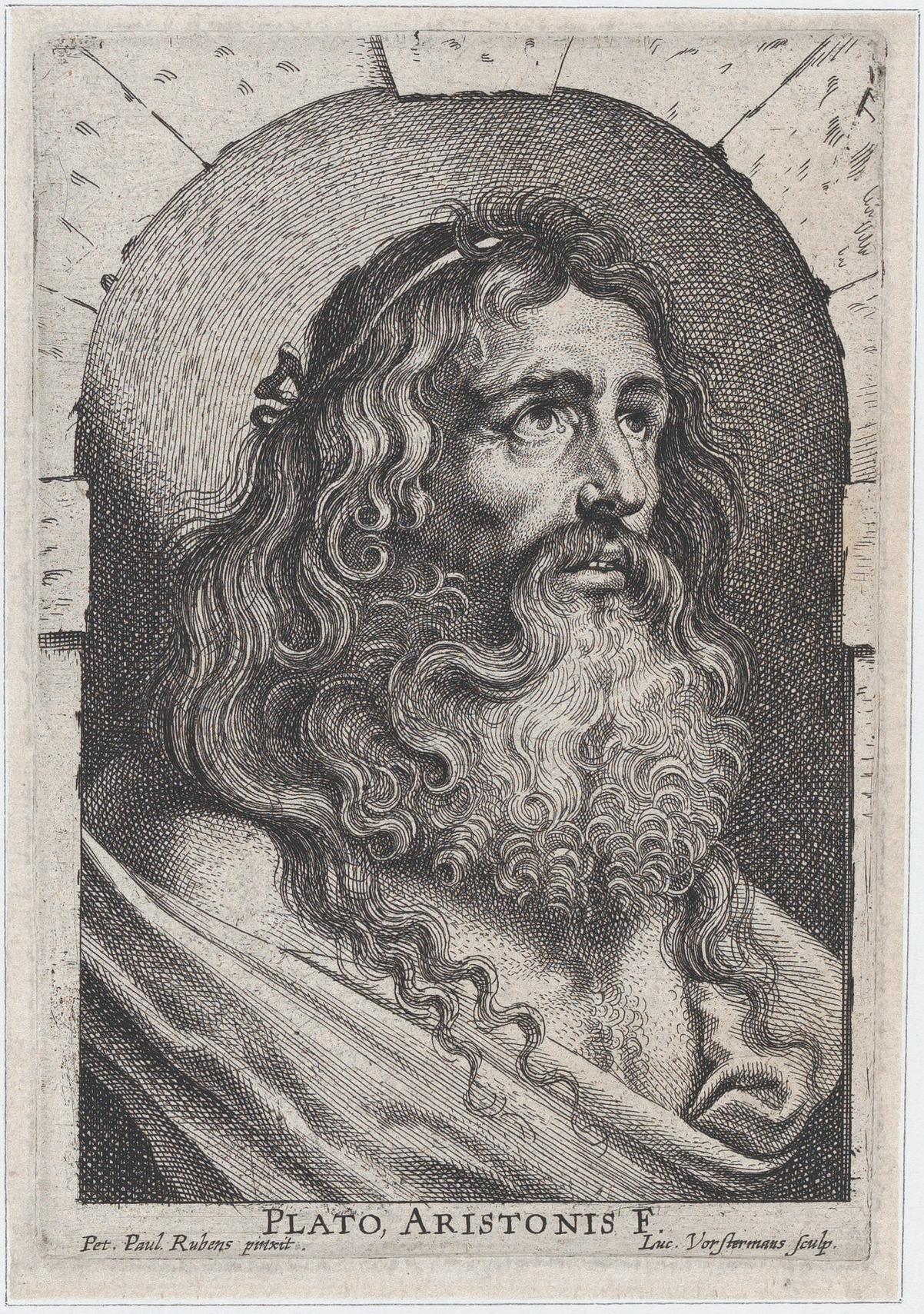
Plato
Dates: c. 428–348 BCE Domain: Philosophy, Mathematics, Education, Political Theory
Biography
Plato was born in Athens around 428 BCE into an aristocratic family with political connections. As a young man he was drawn to the teaching of Socrates, whose manner of philosophizing — the public examination of the claims of conventional wisdom — left a mark that Plato spent the rest of his life working out. The execution of Socrates in 399 BCE, on charges of impiety and corrupting the youth, was the defining trauma of Plato's intellectual life; the dialogues that resulted from it are, among other things, an attempt to understand how a just city came to kill the most just man it contained. He traveled after Socrates' death — to Megara, to Egypt (reportedly), and three times to Syracuse in Sicily, where he attempted to implement his philosophical politics at the court of the tyrant Dionysius. These visits ended badly each time; on the second visit he was reportedly sold into slavery and had to be ransomed. He founded the Academy in Athens around 387 BCE, the first permanent institution of higher learning in the Western world, and taught there until his death around 348 BCE.
The Platonic corpus — thirty-six dialogues and thirteen letters, of varying authenticity — is one of the most studied bodies of writing in Western intellectual history, and the scholarly disagreements about its interpretation are still unresolved. The most important question is not the standard philosophical one (what is the theory of Forms, and is it metaphysically defensible?) but a different one: what is the relationship between Plato's philosophical arguments and the initiatory tradition in which he was formed? The ancient world took for granted that Plato had been initiated into the Mysteries — probably at Eleusis, possibly at other shrines. His own dialogues, without ever directly disclosing initiatic content, are suffused with the vocabulary, the images, and the structure of initiatory experience.
The cave allegory in The Republic (Book VII) is the primary example. Prisoners chained in a cave see only shadows of objects passing before a fire; one prisoner is freed, turned around, dragged upward into the light, and initially blinded. Eventually his eyes adjust; he sees the sun itself; he returns to the cave to free the others, but the other prisoners, who have not made the journey, think him deranged and resist liberation. This is not merely an epistemological argument about the relationship between appearances and reality; it is an initiatory narrative. The stages — imprisonment, liberation, ascent, blinding, adjustment, descent back to instruct — map precisely onto the stages of Mystery initiation. Whether Plato consciously encoded this or arrived at it through the internal logic of his epistemological argument may not be answerable, but the mapping is too precise to be accidental.
The Symposium's ladder of love — in which Diotima instructs Socrates in the ascent from love of a single beautiful body through love of beautiful bodies in general, love of beautiful souls, love of beautiful activities, love of knowledge, and finally the sudden vision of Beauty Itself — is similarly structured as a graduated ascent that ends in direct mystical experience of the highest principle. The Phaedrus describes four forms of divine madness: prophecy, ritual purification, poetry, and erotic love — the last being the highest form, because it recovers the soul's memory of its pre-embodied experience of the Forms. The doctrine of anamnesis (recollection) — that all learning is remembering what the soul already knew before birth — encodes in philosophical argument the initiatory claim that genuine knowledge is not acquired from outside but recovered from within.
The Timaeus, Plato's account of the creation of the world by the Demiurge, is the text that most directly influenced Neoplatonism and the Hermetic tradition. Its concept of the World Soul, the mathematical structure of the cosmos, and the descent of human souls through the planetary spheres gave later thinkers the framework for integrating philosophy with astrology, cosmology, and theurgic practice.
Key Works (in library)
| Work | Year | Relevance |
|---|---|---|
| The Republic | c. 380 BCE | The cave allegory as initiation narrative; the philosopher-king as initiated guide |
| Symposium | c. 385–370 BCE | The ladder of love as graduated ascent; Diotima's instruction as Mystery initiation |
| Phaedrus | c. 370 BCE | Divine madness, anamnesis, and the soul's chariot as initiatory psychology |
| Timaeus | c. 360 BCE | Cosmology, the Demiurge, the World Soul; the foundation of Neoplatonic metaphysics |
| Phaedo | c. 360 BCE | The soul's immortality argued through the approach to death; Socrates as initiate |
Role in the Project
Plato is the project's ambivalent center. He is the figure in whom the transition from oral-initiatic transmission to written philosophical argument is enacted — and therefore the figure in whom both the preservation and the transformation of the Mysteries is concentrated. His dialogues are the best evidence we have for what was taught in the Mysteries (because Plato clearly knew it) and are simultaneously the first step in the process by which that knowledge became separable from the experience that produced it. Once the initiation narrative is transformed into a philosophical argument, it can circulate without the initiatory context — but in doing so, it loses something. Plotinus, Iamblichus, and Ficino are all attempts to recover what Plato's philosophical sublimation had transformed. The project traces this history as its central arc.
Key Ideas
- The Cave Allegory: The initiatory narrative of the soul's liberation from the images of the ordinary world into the direct perception of the real; the philosopher as the one who has made this journey and returned.
- Theory of Forms: Not merely an epistemological claim but an ontological one — the permanent, intelligible realities of which particular things are temporary manifestations; the structure of the Platonic cosmos.
- Anamnesis (Recollection): All genuine knowledge is the recovery of what the soul already knew in its pre-embodied state; learning as a form of initiation back into original knowledge.
- The Ascent of Eros: The graduated movement from love of particular beauty through universals to the direct vision of Beauty Itself — the initiatory path encoded in the theory of love.
- Philosopher as Initiate: The philosopher does not merely argue about higher realities but has encountered them through a specific discipline of soul-purification; philosophy as a way of death and rebirth.
Connections
- Influenced by: FIG-0035 Pythagoras (mathematical mysticism, transmigration), Socrates (the dialectical method), the Eleusinian Mysteries (initiatory experience), Heraclitus, Parmenides
- Influenced: FIG-0005 Plotinus (the Neoplatonic development), FIG-0024 Ficino (the Renaissance Platonic revival), FIG-0004 Iamblichus (theurgic Platonism), virtually all subsequent Western philosophy
- In tension with: Aristotle (who criticized the transcendent Forms), sophists (who denied absolute truth), modern empiricism (for which the Forms are meaningless)
Agent Research Notes
[AGENT: perplexity | DATE: 2026-03-22] Plato's dates are typically given as c. 428/427–348/347 BCE. The Academy was founded c. 387 BCE and continued until Justinian closed it in 529 CE. The Seventh Letter, attributed to Plato, contains the famous "unwritten doctrines" reference that has generated enormous scholarly controversy. Gregory Vlastos and Julia Annas represent the mainstream analytic approach; Pierre Hadot and Walter Burkert engage more seriously with the initiatory context. The definitive edition for the project is the Loeb Classical Library bilingual edition, or the Complete Works edited by John Cooper (Hackett, 1997).