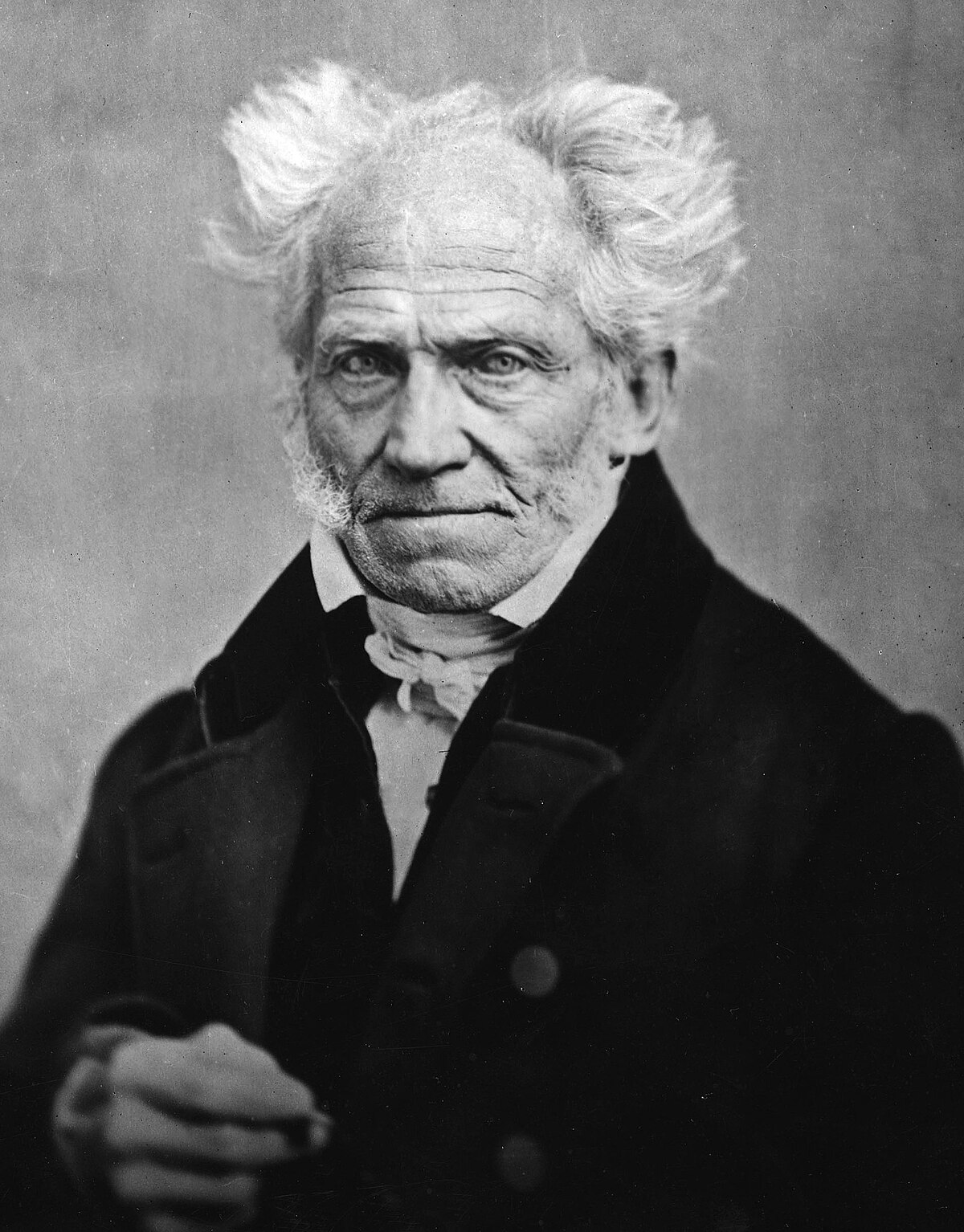
Arthur Schopenhauer
Dates: 1788–1860 Domain: Philosophy, Metaphysics, Aesthetics
Biography
Arthur Schopenhauer was born in Danzig in 1788, the son of a successful merchant and a novelist mother (Johanna Schopenhauer) who became more famous than he was during his lifetime — a source of considerable bitterness. He grew up in the merchant culture his father intended for him to enter, traveled extensively across Europe with his family, and after his father's probable suicide in 1805 began his academic career in earnest, studying classics and then philosophy at Göttingen and Berlin. The encounter with Kant was decisive: Schopenhauer accepted the phenomena-noumena distinction entirely and asked what the thing-in-itself might be, given that we can never know it through the forms of experience.
His answer is The World as Will and Representation (1818): the thing-in-itself is Will — not purposive human will but a blind, insatiable, undirected striving that underlies all phenomena, from gravity to hunger to the human desire for meaning. The individual body is the will made visible; the world of phenomena (Vorstellung, representation) is the will's self-display. The Hindu concept of maya: the veil of illusion that conceals the unity of Brahman — is Schopenhauer's gloss on what Kant called the phenomenal world: not the appearances the mind constructs. It is a cosmic deception, the will's self-concealment as multiplicity.
The book was ignored when published. Schopenhauer submitted the second volume as his Habilitationsschrift at Berlin and scheduled his lectures to coincide with Hegel's, in the conviction that their quality would draw students away from the most famous philosopher in Germany. It did not. He lectured to empty rooms, abandoned academic life, and spent the following decades in Frankfurt in a routine of solitary work, music, and the company of a sequence of poodles all named Atma (Sanskrit: the self). The second edition of The World as Will and Representation appeared in 1844, with a supplementary second volume, and by the 1850s he was beginning to attract serious attention. He died in 1860, having seen his reputation established.
His engagement with Eastern philosophy is serious and well-documented: he owned and read a Latin translation of the Upanishads (Oupnekhath, 1801) before he published his major work, and he described waking up each morning to read fifty pages of it. The convergence he found between his own conclusions and those of Vedanta and Buddhism is not casual comparative religion but systematic philosophical engagement — one of the earliest and most rigorous instances of European philosophy meeting Indian thought on equal terms.
Key Works (in library)
| Work | Year | Relevance |
|---|---|---|
| The World as Will and Representation | 1818/1844 | Central metaphysical statement; the veil of Maya in post-Kantian European terms |
| Essays and Aphorisms | 1851 | Schopenhauer's most accessible work; the philosophy in concentrated form |
| Parerga and Paralipomena | 1851 | Extended essays including key treatments of art, music, and the metaphysics of death |
Role in the Project
Schopenhauer is the Western Canon track's bridge figure between European philosophy and Eastern traditions. His identification of the thing-in-itself with will, and his reading of the phenomenal world as maya, makes him the most direct philosophical point of contact between Kant and the Upanishadic tradition. The project can use him to show that the convergence between Western post-Kantian philosophy and Vedantic metaphysics is not the forced comparison of Huxleyan perennialism but a genuine structural encounter: two philosophical traditions, working from different starting points, arriving at similar conclusions about the nature of appearance and reality.
His aesthetics are equally important for the project. Schopenhauer argues that aesthetic experience, particularly music, provides temporary release from the will's grip: in the moment of genuine aesthetic absorption, the individual will is silenced and the subject becomes a pure, will-less knower. This is the closest European philosophy comes, before the Romantic poets, to describing something like the initiatory suspension of the ordinary self — and Schopenhauer is the direct source from which Nietzsche drew his account of the Dionysian in The Birth of Tragedy.
Key Ideas
- Will as Thing-in-Itself: The blind, undirected striving that underlies all phenomena — not the human will specifically but the will that gravity, hunger, desire, and the cell's drive to replicate all express. Reality is will; appearance is will's self-representation.
- Maya and Representation: The phenomenal world is representation (Vorstellung) — the will's self-display as the multiplicity of apparent individuals. The veil of maya is not a religious metaphor but a metaphysical description of the relationship between phenomena and their underlying ground.
- Aesthetic Liberation: In aesthetic experience, especially music, the subject temporarily escapes individual willing and becomes a pure knower. This is Schopenhauer's secular analogue to nirvana: not permanent but real.
- Compassion and the Piercing of the Veil: The ethical consequence of recognizing that individuality is maya: the suffering of another is one's own suffering, because the apparent multiplicity of individuals conceals an underlying unity. Compassion (Mitleid, shared suffering) is the ethical recognition of metaphysical unity.
Connections
- Philosophical lineage: FIG-0075 Kant (Schopenhauer accepts Kant's phenomena-noumena distinction as his starting point), FIG-0072 Nietzsche (Nietzsche absorbed and then explicitly rejected Schopenhauer's pessimism — the eternal return is partly a response to Schopenhauer's will-as-suffering)
- Eastern connections: FIG-0097 Shankara (Advaita Vedanta as the Indian parallel; Schopenhauer read the Upanishads directly), FIG-0099 Nagarjuna (Buddhist sunyata as parallel to Schopenhauer's will-negation)
- Music as metaphysics: FIG-0083 Wagner (directly influenced by Schopenhauer's theory of music as the will's direct expression)
Agent Research Notes
[AGENT: perplexity | DATE: 2026-03-22] Schopenhauer's poodle anecdote and the Atma naming are well documented in biographical literature including David Cartwright's Schopenhauer: A Biography (Cambridge, 2010). The Oupnekhath he read was a Latin translation of fifty Upanishads by Anquetil-Duperron (1801–1802). Nietzsche's explicit acknowledgment of Schopenhauer's influence is in Schopenhauer as Educator (1874), the third of the Untimely Meditations. Bryan Magee's The Philosophy of Schopenhauer (Oxford, 1983) provides an accessible scholarly account.