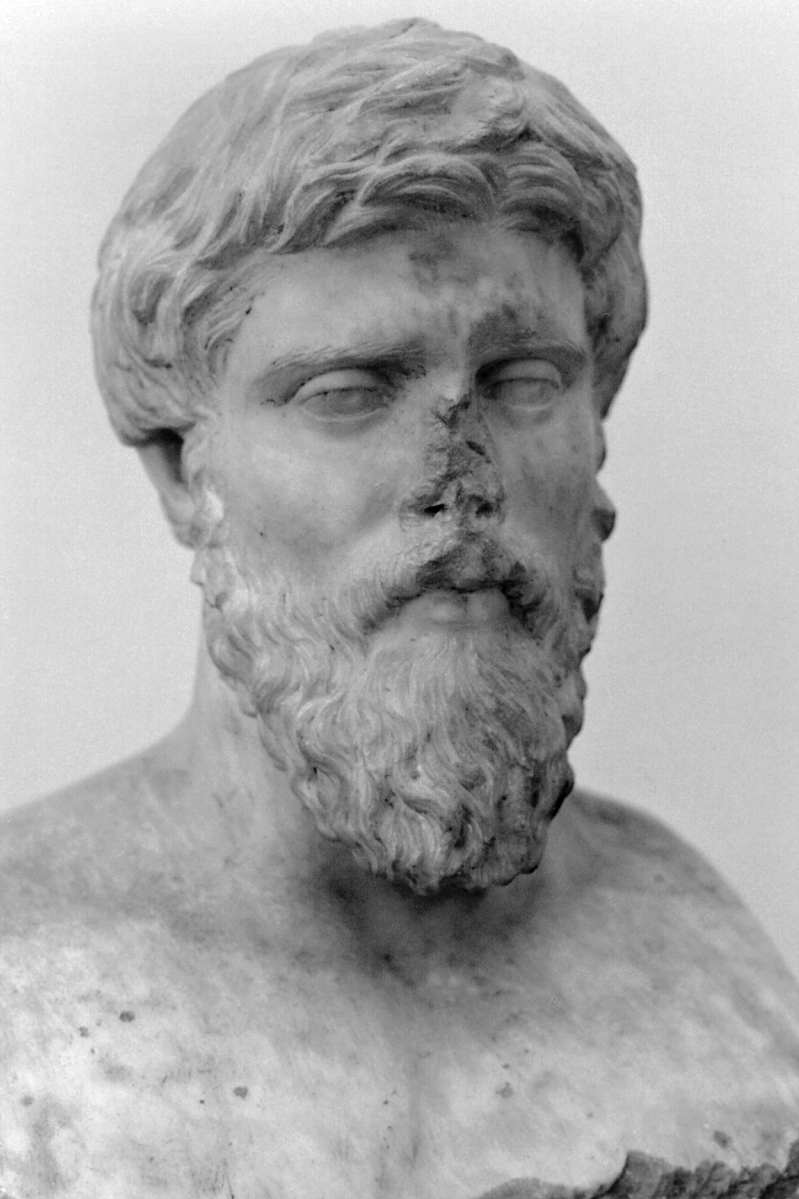
Plutarch
Dates: c. 46–c. 120 Domain: Philosophy, Biography, Theology, Comparative Religion
Biography
Plutarch was born in Chaeronea, Boeotia, around 46 CE, studied at the Academy in Athens under Ammonius, and spent most of his career divided between Chaeronea — where he remained attached to his hometown with persistent loyalty — and Delphi, where he served as a priest of Apollo for the last thirty years of his life. He visited Rome twice, knew Stoic and Epicurean philosophy from the inside (and rejected both), and read widely enough that his Moralia — eighty essays and dialogues on subjects ranging from table talk to the face on the moon — constitutes one of the most broadly informed documents of late Platonic antiquity.
His philosophical position is Middle Platonism: he believed the Platonic tradition was the most adequate philosophical account of reality available, combined it with a theology of the daemons (intermediate beings between gods and humans) that drew on both Plato and the mystery traditions, and served at Delphi in the genuine conviction that the oracle was a real contact with divine intelligence mediated through the pneuma that rose from a chasm beneath the temple. Whether the chasm was real, the geological evidence is disputed, is less important than the seriousness with which Plutarch took his priestly vocation.
On Isis and Osiris (part of the Moralia) is a systematic Platonic allegorization of the Egyptian Isis-Osiris myth, addressed to a priestess named Clea. Plutarch reads the myth not as history but as a philosophical allegory for the relationship between the divine principles (Osiris as the rational-intelligible, Typhon as the principle of discord and matter, Isis as the principle that seeks and recovers the divine logos). It is the primary exhibit for how a serious ancient philosopher engaged a foreign mystery tradition — taking its symbolic content seriously, translating it into Platonic categories without reducing it, and showing how the same philosophical territory can be mapped in different mythological languages.
Key Works (in library)
| Work | Year | Relevance |
|---|---|---|
| On Isis and Osiris | c. 100 CE | Platonic allegorization of the Egyptian mysteries by a Greek priest |
| On the E at Delphi | c. 100 CE | Philosophical meditation on the inscription "Know Thyself" |
| On the Daimon of Socrates | c. 100 CE | The intermediate beings; Socrates' daimonion as philosophical theology |
| Lives | c. 100–120 CE | Comparative biographical method; the character as philosophical document |
Role in the Project
Plutarch provides the Birth of Western Mind track with its primary first-person account of how a philosopher-priest navigated the relationship between philosophical thought and active religious practice — the same relationship the project's Neoplatonist entries (Plotinus, Iamblichus) engage from a later period. His position at Delphi during the oracle's final active centuries makes him the most direct ancient witness to an initiatory tradition in its later, reflective phase.
Key Ideas
- The Priest-Philosopher: Plutarch embodies the project's thesis that philosophy and religious practice were not opponents in the ancient world but complementary activities within a unified understanding of what human beings are and what they need.
- Daemonology: The theory of intermediate beings, daemons, that mediate between the divine and the human. Plutarch's daemonology is the ancient philosophical framework for understanding the mundus imaginalis, the Jungian archetypes, and the Islamic alam al-mithal as different descriptions of the same territory.
- Comparative Mythology as Philosophy: On Isis and Osiris shows that the ancients did comparative religion — that they recognized mythological parallels across traditions and interpreted them philosophically rather than anthropologically.
Connections
- Ancient World track: FIG-0034 Plato (Plutarch as Plato's practical inheritor at Delphi), FIG-0096 Heraclitus (Plutarch interprets the Delphic oracle against the Heraclitean background)
- Mystery traditions: FIG-0038 Apuleius (another Platonic philosopher engaged with the Isis mysteries), FIG-0037 Orpheus (Plutarch's treatment of Orphic mythology in the Moralia)
Agent Research Notes
[AGENT: perplexity | DATE: 2026-03-22] The question of the Delphic geological chasm has been reinvestigated: J.Z. de Boer and J.R. Hale published findings in 2001 suggesting traces of ethylene in groundwater near the temple (Geology, 2001). Plutarch's dates are not precisely known; the conventional c. 46 – c. 120 CE is based on internal evidence in his works. His Lives was the source for Shakespeare's Roman plays. Philip de Lacy and Benedict Einarson's Loeb edition of the Moralia is the scholarly standard.