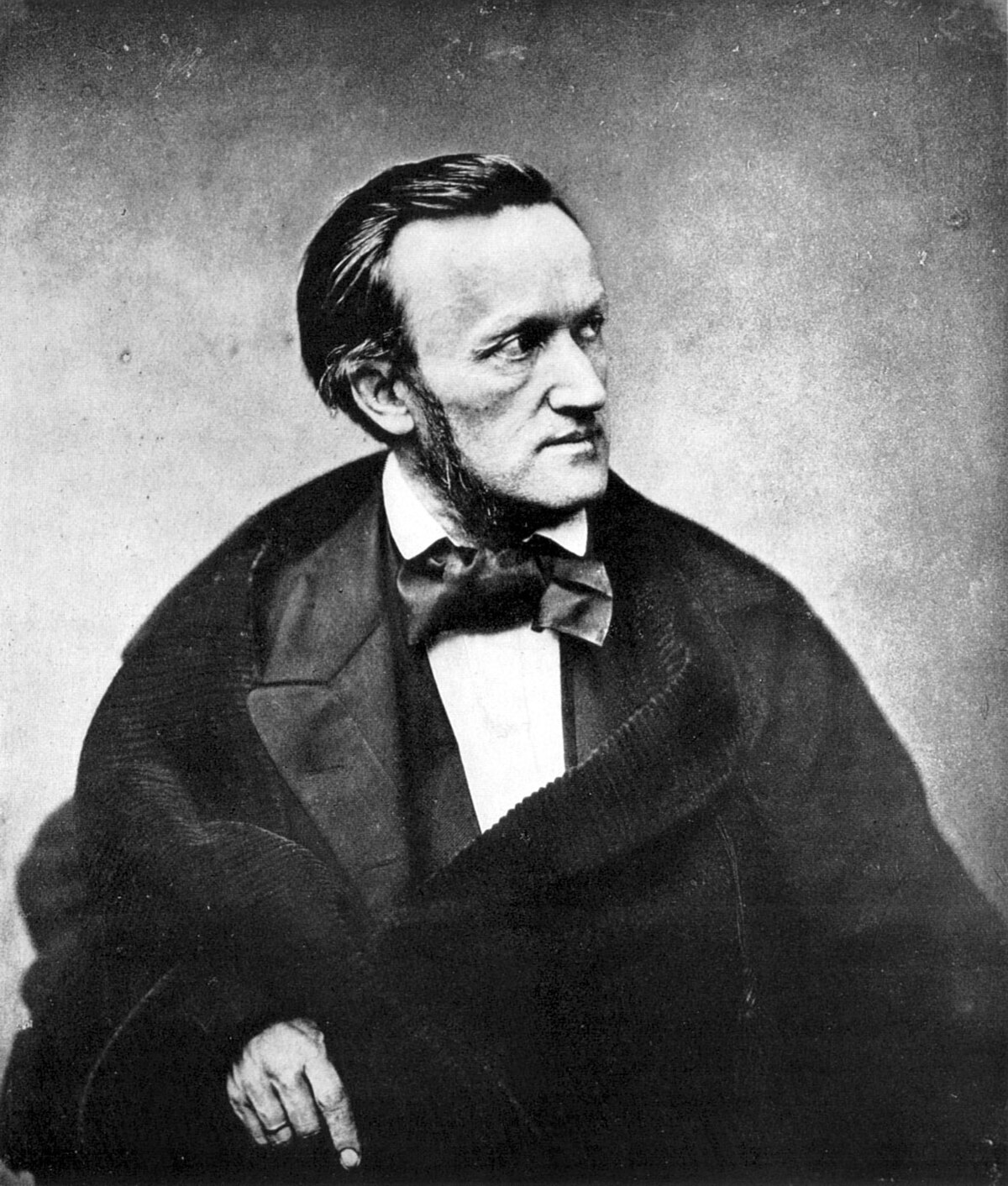
Richard Wagner
Dates: 1813–1883 Domain: Opera, Music Drama, Aesthetic Philosophy
Biography
Richard Wagner was born in Leipzig in 1813 and died in Venice in 1883, having spent the intervening years in a continuous state of grandiose ambition, financial crisis, political exile, erotic entanglement, and compositional achievement of extraordinary scope. His early operas (Rienzi, The Flying Dutchman, Tannhäuser, Lohengrin) established him as the leading operatic composer of the mid-nineteenth century. His involvement in the 1849 Dresden uprising — he helped fetch Bakunin from the hotel during the revolt — sent him into Swiss exile for twelve years and gave him the time to rethink the operatic form from its foundations.
The theoretical works of the exile period — Opera and Drama (1851), The Artwork of the Future (1849), A Communication to My Friends (1851) — articulate his vision of the Gesamtkunstwerk: the total artwork that unites poetry, music, visual art, drama, and physical performance in an integrated whole greater than any of its parts. The argument is explicitly related to Greek tragedy: Wagner believed that the ancient Greeks had possessed this unity and that modern European culture had fragmented it into specialist arts. His project was to reassemble the fragments by building a new unified form on the foundation of German myth and Schopenhauer's metaphysics of music.
Der Ring des Nibelungen — four operas spanning approximately fifteen hours of music — is the result: a cycle built on Norse mythology (the Eddas, the Nibelungenlied), telling the story of the ring forged from the Rhinegold and the catastrophic consequences of its power over gods, giants, dwarves, and humans. Wagner began writing the text from the end backward — he started with Siegfried's death and worked toward the beginning of the cycle — and spent twenty-six years completing the composition. The cycle premiered at Bayreuth in 1876 in the purpose-built Festspielhaus that Wagner had financed partly through Ludwig II's patronage.
Parsifal (1882), his final work, is the most explicitly initiatic. Based on Wolfram von Eschenbach's medieval Grail romance, it depicts the restoration of the Grail community by Parsifal — the "pure fool" who acquires Mitleid (compassion) through witnessing suffering and thereby becomes capable of healing the wounded Fisher King Amfortas and restoring the unveiled Grail to its community. Wagner called it a Bühnenweihfestspiel, a stage-consecration-festival-play, and forbade its performance anywhere other than Bayreuth for thirty years, insisting on its quasi-sacramental character.
Key Works (in library)
| Work | Year | Relevance |
|---|---|---|
| Der Ring des Nibelungen | 1876 (premiere) | Total initiatory artwork built on Germanic myth; secular mythology at operatic scale |
| Parsifal | 1882 | The Grail mystery as stage ritual; healing the Fisher King through compassion |
| Tristan und Isolde | 1865 | The Schopenhauerian dissolution of the will; erotic mysticism in musical form |
| Opera and Drama | 1851 | Theoretical statement of the Gesamtkunstwerk; Greek tragedy as model |
Role in the Project
The Western Canon track uses Wagner as the most ambitious nineteenth-century attempt to reconstruct, outside any initiatic institution, the social function that the ancient mystery cults performed. Whether the Bayreuth festival succeeded in this — whether the bourgeois opera audience experienced anything like what the initiands at Eleusis experienced — is one of the track's carrying questions. The comparison with Greek tragedy, which Wagner himself made, is analytically useful because it shows both what was recovered and what was missing: the communal preparation, the sacred context, the initiatic guide.
The Nietzsche-Wagner relationship is essential context: the young Nietzsche worshipped Wagner as the redeemer of German culture, saw The Birth of Tragedy partly as a manifesto for the Wagnerian project, and then turned against Wagner when he recognized in Parsifal the Christian-pity aesthetics that Nietzsche's philosophy was organized against. The break is the project's most instructive case of what happens when a thinker takes seriously the claim that the total artwork can revive ancient consciousness — and then decides the specific artwork cannot carry the weight.
Key Ideas
- Gesamtkunstwerk: The total artwork that unites all the arts — the restoration of the unity that Wagner believed Greek tragedy had possessed and that modern fragmentation had destroyed. The Ring is its most ambitious attempt.
- Leitmotif: The recurrent musical themes associated with characters, objects, and ideas, which interact and transform through the cycle. This is not merely a compositional technique but an initiatory language — the audience learns to hear meaning in the transformations.
- Parsifal as Fool-Who-Learns: The initiatory structure of Parsifal is explicit: the hero does not arrive with wisdom but acquires it through the willingness to be wounded by witnessing suffering. Compassion as the initiatory faculty.
- Schopenhauer's Music: Tristan and Isolde is Schopenhauer's metaphysics in musical form — the dissolution of the individual will into the undifferentiated continuity of the will-in-itself. The Liebestod is erotic death as ontological return.
Connections
- Philosophical foundations: FIG-0076 Schopenhauer (Wagner read World as Will and Representation in 1854 and described it as the most important book of his life), FIG-0072 Nietzsche (the relationship from worship to repudiation is the key exhibit for the limits of aesthetic initiation)
- Grail tradition: FIG-0081 Eliot (Waste Land uses the Fisher King mythology that Parsifal dramatizes)
- Total artwork context: FIG-0022 Goethe (Faust as the literary Gesamtkunstwerk that Wagner's operatic project attempted to fulfill in music)
Agent Research Notes
[AGENT: perplexity | DATE: 2026-03-22] Wagner died February 13, 1883 in Venice of a heart attack. Parsifal premiered July 26, 1882 at Bayreuth; Wagner's injunction against outside performance lasted until the copyright expired in 1913. The Ring cycle had its first complete performance August 13–17, 1876 at Bayreuth, attended by the Emperor of Germany, the Emperor of Brazil, and Nietzsche. Wagner completed the text of the Ring in reverse order 1848–1852, then composed the music 1853–1874 with a twelve-year interruption. Bryan Magee's Wagner and Philosophy (2000) provides the best account of the Schopenhauer relationship.