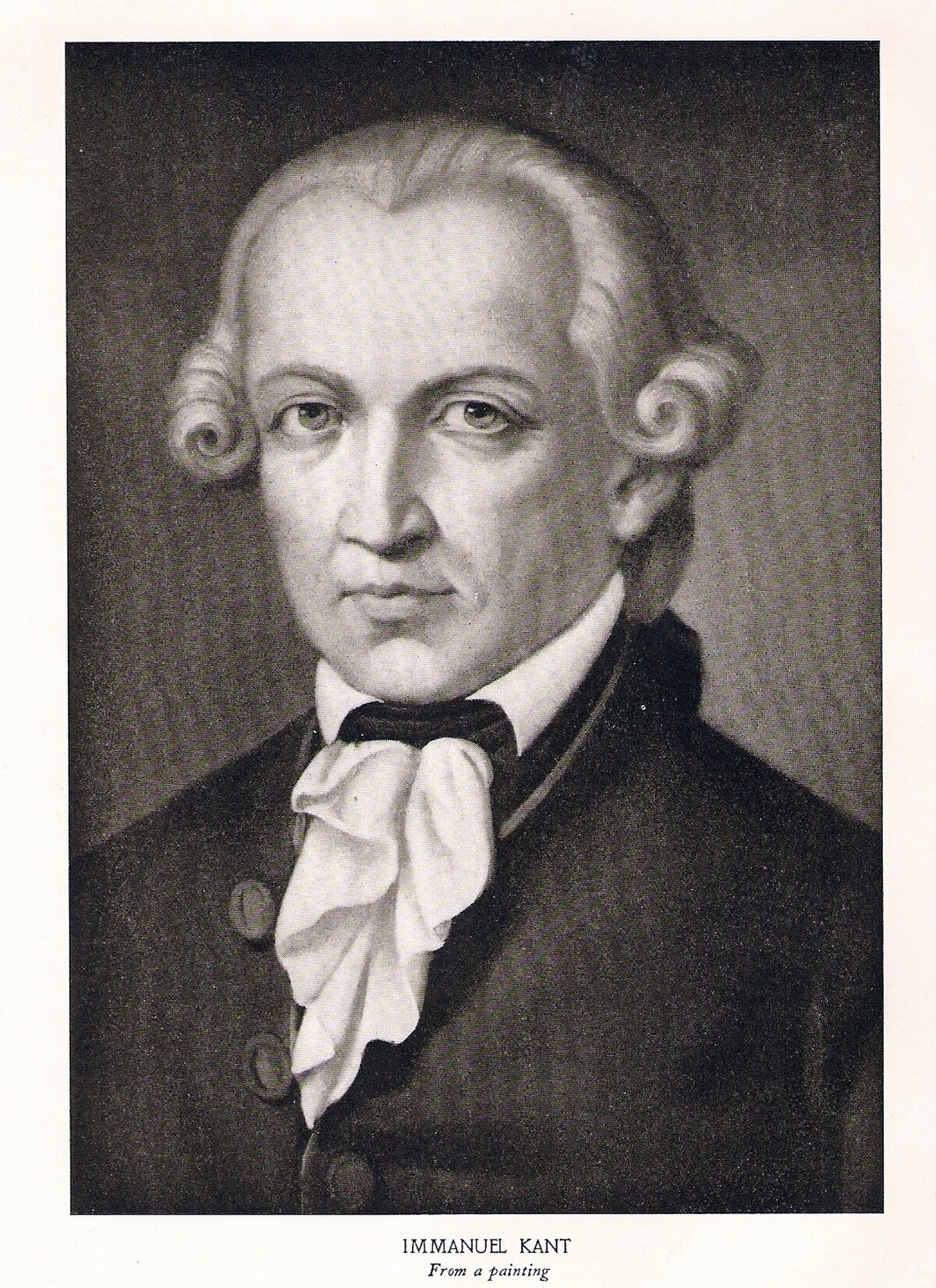
Immanuel Kant
Dates: 1724–1804 Domain: Philosophy, Epistemology, Ethics, Aesthetics
Biography
Immanuel Kant was born in Königsberg, Prussia, in 1724, and died there in 1804, having never traveled more than a hundred kilometers from the city of his birth. His regularity was so precise that Königsberg residents reportedly set their watches by his afternoon walks. He spent the first part of his career as a conventional university lecturer, writing in the manner of Wolffian rationalism, until a reading of David Hume's skepticism — which Kant famously said "awakened him from his dogmatic slumber" — precipitated the decade-long reconsideration that issued in the Critique of Pure Reason in 1781.
The Critique of Pure Reason is one of the most technically demanding and consequential works in the history of philosophy, and its core move is as decisive as it is difficult. Kant's "Copernican revolution" in epistemology was to argue that we can know how things must appear to us (the phenomena) because the forms of that appearance — space, time, the categories of the understanding — are contributions of the mind rather than features of the things themselves. This means we can have necessary and universal knowledge of experience (which is why mathematics and physics work) but we can never have knowledge of things as they are in themselves (das Ding an sich, the noumenon). The mind legislates to experience; it cannot legislate to reality.
The second and third Critiques — the Critique of Practical Reason (1788) and the Critique of Judgment (1790) — extend this analysis to morality and to aesthetic and teleological judgment. The moral law, in Kant's account, is legislated by the rational will to itself, the famous categorical imperative, rather than derived from divine command or natural inclination. The Critique of Judgment introduces the concept of the sublime — the experience of encountering something that exceeds the mind's capacity to comprehend it (a storm, a mountain range, the starry sky) — and Kant's account of this experience is philosophically central: it is the moment where Kantian epistemology opens onto something it cannot contain, the trace of the noumenal in experience.
He died in 1804, reportedly saying "Es ist gut", "It is good", at the end. He had not left Königsberg. He had restructured Western philosophy's self-understanding entirely.
Key Works (in library)
| Work | Year | Relevance |
|---|---|---|
| Critique of Pure Reason | 1781/1787 | The phenomena-noumena distinction; the epistemological wall |
| Critique of Practical Reason | 1788 | The moral law as the rational will's self-legislation; access to the noumenal through ethics |
| Critique of Judgment | 1790 | The sublime as the noumenal's trace in experience; beauty and purposiveness |
| Religion within the Limits of Reason Alone | 1793 | The rational residue of religion after its supernatural claims are removed |
Role in the Project
Kant's role in the Western Canon track is to be the thinker who formalized modernity's epistemological closure with maximum philosophical rigor. He is not the project's enemy — he is one of its most important diagnostic subjects. The phenomena-noumena distinction is the philosophical expression of what Barfield calls the loss of original participation: the consciousness that was once directly embedded in the world it perceived has reconstructed that world as a representation, and the question of what lies behind the representation is declared unanswerable.
The engagement with Kant follows from its engagement with Schopenhauer, Schelling, and the German Idealists who immediately responded to him: each represents a different way of attempting to reopen the door that Kant closed. Schopenhauer identifies the thing-in-itself with will (and finds it terrible). Schelling reaches for the absolute through natural philosophy. Hegel dissolves the thing-in-itself into the dialectical process of spirit knowing itself. None of these reopen the door to the Mysteries. But they show what it costs consciousness to live inside the Kantian enclosure, and they document the various escape attempts that modernity has made.
Key Ideas
- Phenomena-Noumena: The distinction between things as they appear to us (phenomena, knowable) and things as they are in themselves (noumena, unknowable in principle). This is the epistemological wall the project maps.
- The Copernican Revolution: Kant's inversion of the traditional epistemological question. Instead of asking how the mind conforms to objects, he asks how objects conform to the mind. The answer: objects must conform to the forms the mind brings to experience.
- The Sublime: The aesthetic experience of encountering something that exceeds the imagination's capacity to comprehend but that reason can surpass in concept. Kant's analysis of the sublime is the one point where his system touches the initiatic territory of awe and overwhelm.
- The Starry Sky and the Moral Law: Kant's most famous sentence: "Two things fill the mind with ever-increasing wonder and awe: the starry heaven above me and the moral law within me." This binary, cosmos and conscience, is the structure of his entire mature philosophy, and it is the structure from which Nietzsche would eventually wrench himself free.
Connections
- The Kantian legacy: FIG-0076 Schopenhauer (accepts the phenomena-noumena distinction and identifies the noumenon with will), FIG-0089 Hegel (dissolves the thing-in-itself into dialectical spirit), FIG-0048 Schelling (recovers nature from Kantian formalism)
- What Kant closes: FIG-0034 Plato (the Platonic Forms as knowable realities are exactly what Kant's epistemology forecloses), FIG-0005 Plotinus (henosis as direct contact with the One is formally impossible on Kantian terms)
- The Romantic response: FIG-0077 Keats (negative capability as the aesthetic recovery of what Kant's epistemology denies)
Agent Research Notes
[AGENT: perplexity | DATE: 2026-03-22] The first edition of the Critique of Pure Reason (A edition, 1781) differs substantially from the B edition of 1787, particularly in the treatment of the deduction of the categories. Hume's specific work that awakened Kant is generally identified as the Treatise of Human Nature or the Enquiry Concerning Human Understanding on causation. Paul Guyer and Allen Wood's Cambridge edition of the Critique is the standard scholarly translation. The "It is good" deathbed remark is reported in various sources; its authenticity is uncertain.