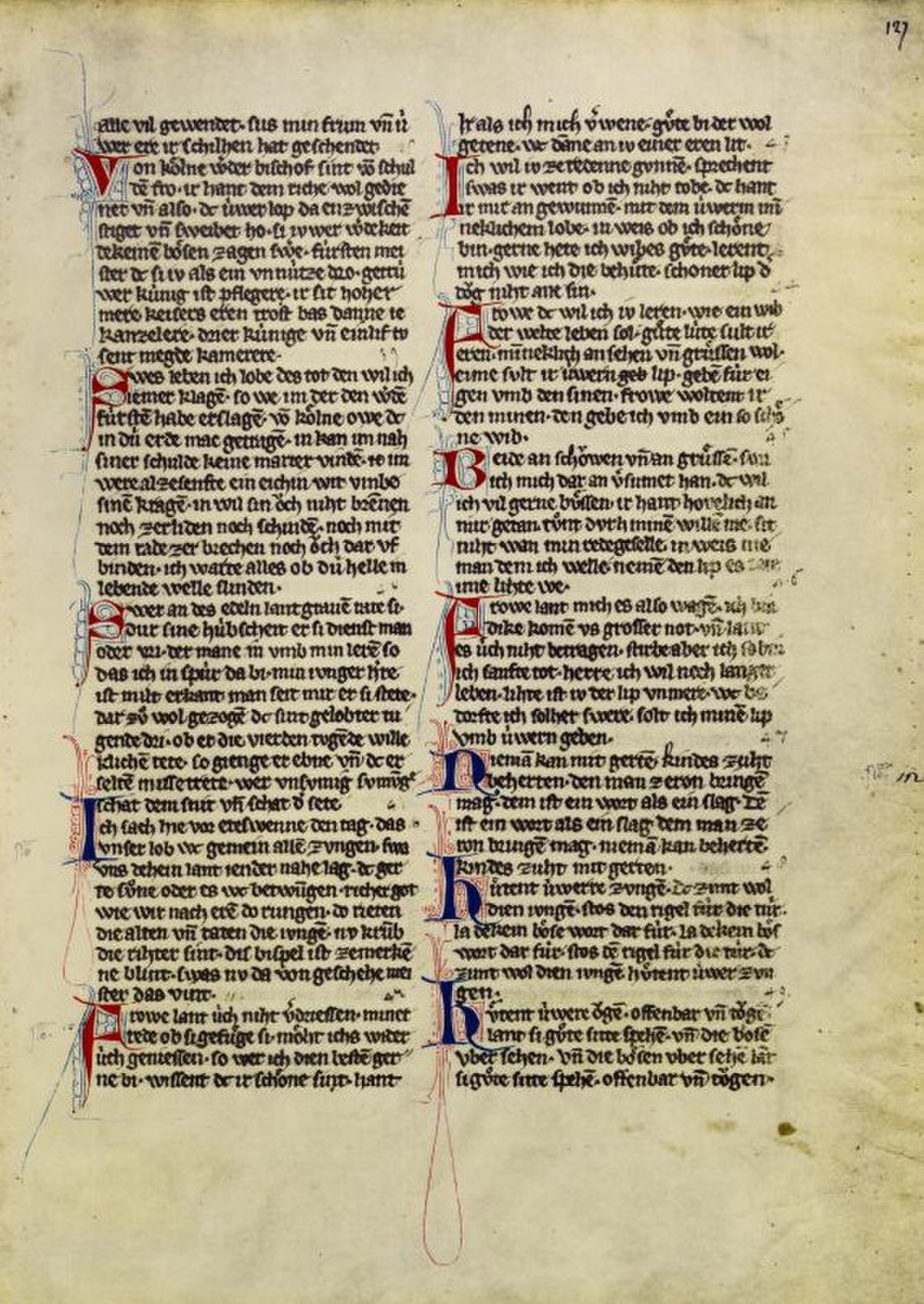
Courtly Love
Definition
Fin'amor (Occitan: refined, perfected love; also rendered as cortesia, courtly love) designates the distinctive conception of love developed in the troubadour poetry of Provence, Languedoc, and the neighboring regions from approximately 1100 to 1300 CE, and subsequently elaborated in the Italian dolce stil novo (sweet new style) tradition of Guido Cavalcanti, Guido Guinizelli, and Dante Alighieri. The conventions of fin'amor are specific: the lover is devoted to a Lady (domna) who is typically married to another, socially superior, and largely unattainable; the lover's devotion generates a progressive self-refinement (cortezia, courtesy, which means much more than good manners — it designates the entire moral and perceptual transformation that love produces); and the fulfillment of love, if it occurs, is not physical consummation but the transformation of the lover into someone worthy of the Lady's regard.
The academic debate about what fin'amor actually was has been running for a century without resolution. Some scholars treat it as purely a literary convention with specific formal rules; others as a social game of aristocratic courts; others as a sublimated theological expression; and a significant minority, following Denis de Rougemont and Ioan Couliano, as a disguised esoteric tradition with Cathar or Hermetic dimensions. The project engages Couliano's reading most seriously while holding it as a defensible interpretation rather than established fact.
Couliano's thesis, developed in Eros and Magic in the Renaissance (1984), extends and radicalizes Denis de Rougemont's earlier reading of the troubadour tradition (Love in the Western World, 1956). Rougemont argued that the troubadours' exaltation of unattainable love over fulfilled love expressed a Cathar or Manichean spiritual orientation: the soul yearns for its divine source and treats earthly love as a vehicle of that yearning rather than as an end in itself. Couliano pushed further: the troubadour's erotic imagination was not expressing an orientation. It is was itself a technology of consciousness transformation. By directing the full force of imagination and desire toward a specific object and deliberately refraining from fulfillment, the practitioner (the trovador) used eros to train the imagination (phantasia) in the way Hermetic and Neoplatonic philosophy required — as the vehicle for accessing higher levels of reality.
Historical Development
The troubadour tradition emerged in 11th century Aquitaine with Guillaume IX, Duke of Aquitaine (1071-1127), the first troubadour whose work survives. Over the following two centuries, the tradition developed across Provence, Languedoc, and northern Italy, with major figures including Guilhem de Peitieu, Bernart de Ventadorn, Raimbaut de Vaqueiras, Arnaut Daniel (Dante's "gran maestro d'amor"), and the trobairitz (women troubadours) including Comtessa de Dia. The tradition flourished in the same geographic area as Catharism — the dualist heresy that the Albigensian Crusade (1209-1229) was launched to destroy. Whether this geographic overlap reflects a theological connection remains disputed.
The Italian dolce stil novo transformed the Occitan tradition by giving it an explicitly philosophical dimension. Guido Guinizelli's canzone "Al cor gentil rempaira sempre amore" (Love always returns to the noble heart) established the argument that true love is possible only in the noble heart (cor gentile) — not as a social category but as a spiritual qualification. Dante's Vita Nuova (1294) and the entire architecture of the Commedia build on this foundation: Beatrice, the historical woman whom Dante loved and who died young, becomes the vehicle through which the poet's entire spiritual journey is structured. In the Commedia, Beatrice guides Dante through Paradise — the anima as spiritual guide elevated to cosmic proportions.
Diotima's ladder from Plato's Symposium stands behind the entire tradition: the soul that properly uses erotic love as a vehicle of ascent moves from the love of a single beautiful body through beautiful bodies in general through beautiful souls through beautiful practices through beautiful knowledge to the Beautiful Itself. The Symposium's movement is from particular to universal, from physical to metaphysical. Fin'amor's specific contribution is to locate the initiatory potential in the refusal of the physical — the intensification of desire through non-fulfillment that transforms the lover rather than satisfying them.
Key Distinctions
Fin'amor vs. Platonic Love: Both use the erotic relationship as a vehicle of ascent. The Platonic account (Socrates-Diotima, Symposium) moves toward the universal and ultimately leaves the particular beloved behind; fin'amor fixates on the particular Lady and finds the universal through rather than beyond her. Dante's Beatrice is irreducibly Beatrice — not merely a rung on the ladder that leads elsewhere.
Courtly Love vs. Romantic Love: Romantic love (in the post-Rousseau sense) seeks fulfillment through possession and union; its frustration is its failure. Fin'amor treats frustration and distance as the condition that makes the love's initiatory work possible. The difference is not between two styles of relationship but between two entirely different uses of desire.
Couliano's Reading vs. Literary Convention: The project holds Couliano's esoteric reading as a defensible interpretive hypothesis that illuminates real structural features of the tradition without insisting that every troubadour was a conscious esoteric practitioner. Some were; most were probably working within a convention they had inherited. The esoteric interpretation operates at the level of structural analysis — what the tradition does regardless of what its practitioners consciously intended.
Project Role
Courtly love connects the project's Western medieval track to its engagement with eros as an initiatory vehicle (CON-0075) and to the Jungian account of the anima as inner guide (CON-0071). It demonstrates that the Western tradition — usually associated with world-denial and body-rejection in its spiritual modes — has its own tradition of erotic initiation, one that uses the force of desire rather than renouncing it. The tradition also provides one of the clearest examples of esoteric content traveling in literary form — the mystery teaching in a literary carrier that protects it from direct suppression while maintaining its structural function.
Primary Sources
- Denis de Rougemont, Love in the Western World (1940; revised 1956): The foundational modern interpretation of courtly love as Cathar-inflected spiritual orientation.
- Ioan Couliano, Eros and Magic in the Renaissance (1984): The most philosophically sophisticated esoteric reading; extends de Rougemont into the Hermetic-Neoplatonic tradition.
- Dante Alighieri, Vita Nuova (c. 1294) and the Commedia (1308-1320): The supreme literary monument of the tradition, in which the erotic and mystical are inseparable.
- Roger Boase, The Origin and Meaning of Courtly Love (1977): Balanced scholarly survey of the academic debate.
Agent Research Notes
[AGENT: perplexity | DATE: 2026-03-22] The Cathar connection to troubadour love poetry has been argued and contested by multiple scholars; René Nelli's work and the broader Occitan cultural studies provide a more nuanced picture than de Rougemont's somewhat schematic argument. The project should be explicit that the esoteric reading is a defensible interpretation of the tradition's structural features rather than a claim about the conscious intentions of every troubadour. Couliano himself was careful to make this distinction.