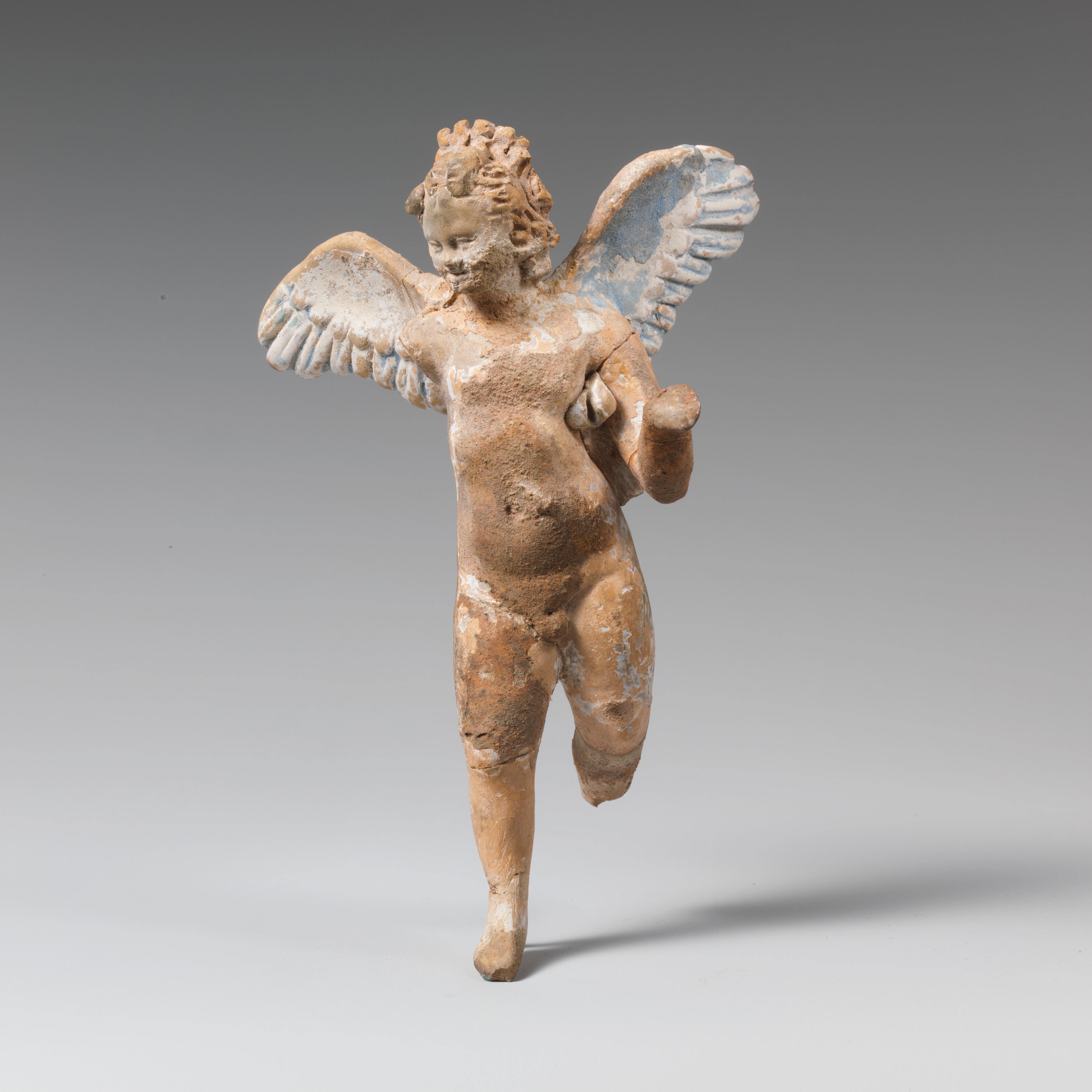
Eros (initiatory)
Definition
Eros in the initiatory sense is not the reduction of desire to sexual drive, nor its sublimation into something "higher" that has left the body behind. It is the primordial movement of consciousness toward what it lacks and recognizes as more fully real than itself, the pull toward beauty, wholeness, and truth that Plato identified as the soul's deepest orientation. In the Symposium, Socrates reports the teaching of Diotima of Mantineia: Eros is not a god but a daimon, a mediating being between the mortal and the divine, perpetually lacking what it seeks because perpetually driven toward it. It is the offspring of Poros (Plenty/Resource) and Penia (Poverty/Lack), sharing the nature of both: always reaching toward fullness from a position of deficit, always moving, never resting in satisfied possession.
This is the philosophical account that underlies the entire initiatory function of eros. The initiate moves into the unknown (into the underworld, the nigredo, the dark night of the soul) not because they are pushed by suffering alone but because they are drawn by something they have glimpsed and cannot leave behind. The Eleusinian descent is preceded by the zēsis (seeking, longing) for Persephone, the specific erotic charge that makes the procession to Eleusis something other than a civic obligation. The alchemist's commitment to the opus is involves a passion for the material that borders on love. The Sufi's longing for the Beloved, the central emotional register of Rumi's Masnavi, is not metaphor for a calmer philosophical aspiration; it is genuine eros directed at the divine.
Couliano's analysis in Eros and Magic in the Renaissance extends this to a theory of the Renaissance magician: the adept who understood the mechanism of eros: the way the imagination (phantasia) is the seat of desire and the medium through which erotic force operates, possessed the technology for transforming consciousness at the deepest level. What the Renaissance church ultimately suppressed, in Couliano's reading, was not "magic" in the superstitious sense but the knowledge of this eros-technology: the capacity to direct desire's force toward liberation rather than toward mere object-acquisition.
Georges Bataille's analysis in Erotism: Death and Sensuality (1957) approaches the same territory from a different angle: eroticism (which Bataille distinguishes from mere sexuality through the element of transgression) is the experience of continuity, the dissolution of the isolated, separate self into something larger. The moment of erotic dissolution dissolves the boundary between self and other, between the limited and the unlimited, which is why it involves a kind of "little death" (la petite mort) and why Bataille links eros structurally to the sacred and to death. Bataille is not mysticism; he is philosophy that has not turned away from what desire actually does at its most extreme.
Historical Development
The Platonic tradition establishes the philosophical foundation. In the Symposium (c. 385 BCE), the ladder of ascent that Diotima describes moves through stages: from the love of a single beautiful body to the love of beautiful bodies in general to the love of beautiful souls to the love of beautiful practices and laws to the love of beautiful knowledge, and finally to the sudden vision of Beauty Itself, the form of beauty that all particular beautiful things participate in and that draws eros irresistibly toward it. This is not the renunciation of eros but its education: each rung of the ladder redirects the erotic energy toward a more adequate object, with the final vision being the adequate object, what eros was always seeking through all its partial objects.
The Neoplatonic tradition transformed this into a metaphysics of emanation: Plotinus's Enneads describe the soul's movement toward the One as erotic; the soul that turns toward the Intellect is moved by beauty; the Intellect that turns toward the One is moved by what exceeds beauty. The cosmos is held together by Eros in this Neoplatonic sense: the downward movement of emanation and the upward movement of return are both erotic in character. Proclus systematizes this in his Elements of Theology: every level of reality desires the level above it and is desired by the level below.
The troubadour tradition and the dolce stil novo represent the medieval elaboration of initiatory eros in literary form. Dante's Commedia is the supreme monument: what drives the journey from the dark wood through Hell through Purgatory to the highest heaven is not philosophical duty but erotic necessity, the love of Beatrice that has transformed from the love of a historical woman into the love of the divine wisdom she mediates.
Key Distinctions
Initiatory Eros vs. Sexuality: The initiatory understanding of eros does not reduce it to sexuality, nor does it require the rejection of sexuality. The question is whether the erotic force is serving the movement of consciousness toward greater reality or merely circulating within the ego's self-maintenance. Sexuality can be either; what transforms it into initiatory eros is the direction of awareness.
Eros vs. Agape: The Christian tradition's distinction between eros (possessive, ascending, motivated by lack) and agape (self-giving, descending, motivated by abundance) is useful as a first approximation but overstated in much Christian apologetics. Plotinus's Eros in the highest sense, the soul's return to the One, has nothing possessive about it; it is a movement of recognition and return. Conversely, the agape of mystical Christianity is not without its erotic intensity: the bridal mysticism of Bernard of Clairvaux reading the Song of Songs is unmistakably erotic.
Eros vs. Will: The initiatory function of eros differs from the will's function. The will pushes; eros pulls. The will exerts force; eros recognizes what draws. The difference is not trivial: the will applied to spiritual development easily becomes spiritual self-improvement, the fortification of the persona under new titles. Eros dissolves the persona by drawing consciousness toward what is more real than the persona's image of itself.
Project Role
Initiatory eros is the project's account of what moves the initiate in the first place, what makes the descent voluntary rather than merely compelled. It connects the Greek philosophical tradition (the Symposium, the Neoplatonic eros of return) with the medieval erotic tradition (courtly love, Dante) and with the modern psychological account (Jung's anima as the carrier of erotic pull toward the unconscious, Hillman's anima mundi as the erotic charge of the world's beauty). It is also the concept that explains why initiation cannot be simply willed: it requires being drawn, being pulled into something larger than the self that presents itself for initiation.
Primary Sources
- Plato, Symposium: The foundational text: Diotima's speech is the philosophical account of erotic ascent.
- Ioan Couliano, Eros and Magic in the Renaissance (1984): The most sophisticated modern account of eros as initiatory technology.
- Georges Bataille, Erotism: Death and Sensuality (1957): The philosophical analysis of erotic dissolution as continuity-experience.
- Plotinus, Enneads III.5 (On Eros): The Neoplatonic account of eros as the soul's movement toward its source.
Plato's Erotic Ascent (Symposium and Phaedrus)
Plato's two great erotic dialogues present eros as the engine of initiatory transformation. In the Symposium, Diotima's "ladder of love" (210a-212a) traces the ascent from desire for a single beautiful body through desire for beauty in all bodies, then to beauty of soul, beauty of knowledge, and finally to the direct vision of Beauty itself (auto to kalon), "pure, unalloyed, uncontaminated by human flesh and color and all that mortal rubbish." The ascent is erotic throughout: what drives the philosopher upward is desire, not duty or argument. Each rung of the ladder redirects the same erotic energy toward a more adequate object. In the Phaedrus (249d-252c), Plato describes the philosopher's encounter with beauty as a recollection (anamnesis) of the soul's pre-natal vision of the Forms. The sight of a beautiful person triggers a "shuddering" (phrike) and "sweating," the same symptoms ancient sources attribute to initiands at Eleusis. Plato explicitly uses mystery terminology: the philosopher is "initiated into the most blessed of mysteries" (teleten teleisthai). The eros that drives the ascent is not overcome or transcended but educated: it remains desire, but desire that has found its proper object.
Agent Research Notes
[AGENT: perplexity | DATE: 2026-03-22] Couliano was murdered in 1991 under still-unexplained circumstances. His death is part of his own story, and the project's engagement with him should acknowledge this. His thesis about the suppression of eros-technology by the Reformation requires careful handling: it is one of the most fascinating speculative extensions in the project's interpretive architecture and should be identified as such. Anne Carson's Eros the Bittersweet (1986) provides a beautiful literary-philosophical complement to Couliano's analysis.