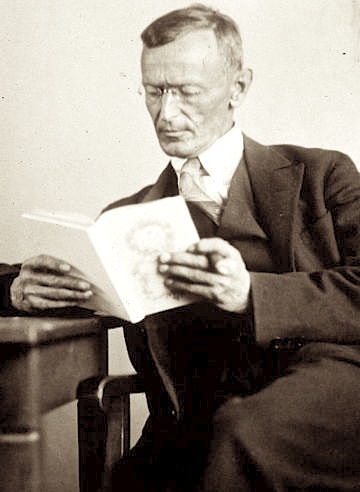
Hermann Hesse
Dates: 1877–1962 Domain: Fiction, Literature, Spiritual Autobiography
Biography
Hermann Hesse was born in Calw, Württemberg, in 1877, the son of a Pietist missionary father and a mother who had grown up in India. Both parents had spent years in the East, and the household was saturated with a Christianity that took Eastern spirituality seriously rather than dismissing it. Hesse rebelled against institutional religion as a teenager — he briefly attended the seminary at Maulbronn and escaped from it — but the questions his household had posed never left him. He spent his career working through them in fiction.
His early fame rested on Peter Camenzind (1904) and Beneath the Wheel (1906) — novels of the sensitive youth against institutional coercion that resonated widely in Wilhelmine Germany. The crisis of World War I, during which Hesse worked for German prisoners of war welfare from Switzerland while writing antiwar editorials that made him a pariah in Germany, precipitated a psychological breakdown and his analysis with J.B. Lang (a student of Jung's) in 1916–1917. The Jungian engagement was permanent: Demian (1919), published pseudonymously and initially attributed to a young veteran, shows Jungian individuation worked into fiction with such density that Jung himself later acknowledged the correspondence.
Siddhartha (1922) is Hesse's most direct East-West synthesis: a narrative set in the time of the Buddha (though the Buddha himself appears only briefly) following a young Brahmin's search for liberation through renunciation, worldly experience, and final enlightenment by a river. The ending's image — Vasudeva the ferryman who has listened to the river for decades, who has dissolved his individual self into that listening, and who departs smiling when Siddhartha is ready to replace him — is one of the key images for how a tradition transmits itself through individual lives.
The Glass Bead Game (Das Glasperlenspiel, 1943), his final major novel, written over twelve years and awarded the Nobel Prize in 1946, posits a future province called Castalia devoted entirely to the Glass Bead Game — a formal language that allows the synthesis of all human knowledge: music, mathematics, philosophy, linguistics. The novel's hero, Joseph Knecht (whose name means "servant"), becomes the Game's supreme player (Magister Ludi) and then, at the height of his achievement, resigns and enters the outside world as a private tutor. He drowns shortly after. The novel is a meditation on the relationship between synthesis (the Game) and life (the world Castalia excludes).
Key Works (in library)
| Work | Year | Relevance |
|---|---|---|
| The Glass Bead Game | 1943 | The synthesis institution and its limits; the Magister Ludi's departure as necessary incompletion |
| Siddhartha | 1922 | East-West synthesis through biographical narrative; transmission through listening |
| Steppenwolf | 1927 | The modern consciousness split between bourgeois and wolf; the Magic Theatre as liminal space |
| Narcissus and Goldmund | 1930 | Contemplation and creative action as complementary paths |
Role in the Project
Hesse belongs in the Modern Labyrinth series rather than the Eastern Traditions track because his project is the problem the Western consciousness faces when it has absorbed Eastern wisdom: not the Eastern answer but the Western question about what to do with it. The Glass Bead Game is the fictional version of the question the project itself inhabits: what does it mean to hold Plato, the Upanishads, Bach, and the Rhineland mystics in simultaneous view? And the Game's answer — that the synthesis is a beautiful achievement but not a life, not a transmission, not an initiation — is the project's honest acknowledgment of its own limitations.
Knecht's departure from Castalia is the project's image for what happens when the synthetic intelligence has to descend from its pure play into actual engagement with a specific human being in specific need. The Game can hold all traditions simultaneously; the descent into embodied transmission requires choosing one moment, one relationship, one river. This is the Modern Labyrinth series' central tension, and Hesse dramatizes it with full awareness of both sides.
Key Ideas
- The Glass Bead Game as Synthesis: A formal language that allows the creative synthesis of all knowledge domains. Structurally parallel to the project's method of holding multiple frameworks simultaneously — but fictional, and Hesse's point is that its fictional character reveals something true about the synthesis project's limits.
- Castalia's Insufficiency: The province of pure synthesis is beautiful, rigorous, and ultimately unable to transmit wisdom across the boundary between knowledge and life. Knecht leaves not because he fails but because he succeeds completely.
- The River as Transmission: In Siddhartha, the river teaches what cannot be taught through discourse. Vasudeva simply ferries people across; the river does the work. This is Hesse's model of genuine transmission — the guide who provides conditions rather than doctrines.
- Steppenwolf and the Magic Theatre: The disintegration of the bourgeois self and the encounter with the multiplicity beneath it — the Magic Theatre as the liminal space where all the selves that the unified persona has suppressed are revealed.
Connections
- East-West synthesis: FIG-0019 Huxley (perennial philosophy as the synthesis framework; Hesse is more skeptical), FIG-0076 Schopenhauer (Schopenhauer-Vedanta connection as Hesse's philosophical starting point)
- Jungian parallels: FIG-0021 Jung (Hesse's analysis with Jung's student was formative; Demian, Steppenwolf, and the Glass Bead Game are all individuation narratives)
- Transmission question: FIG-0097 Shankara, FIG-0098 Patanjali (the Eastern traditions whose synthesis Castalia attempts)
Agent Research Notes
[AGENT: perplexity | DATE: 2026-03-22] Hesse received the Nobel Prize in Literature in 1946 (announced for 1946, awarded December 10, 1946). Das Glasperlenspiel was published November 1943 in Zurich (not Germany, where it could not be published under the Nazis). His analysis with J.B. Lang lasted approximately 72 sessions in 1916–1917; Lang was a close associate of Jung. Hesse's second Jungian analysis was with Jung himself in 1921. Joseph Mileck's Hermann Hesse: Life and Art (1978) is the standard scholarly biography.