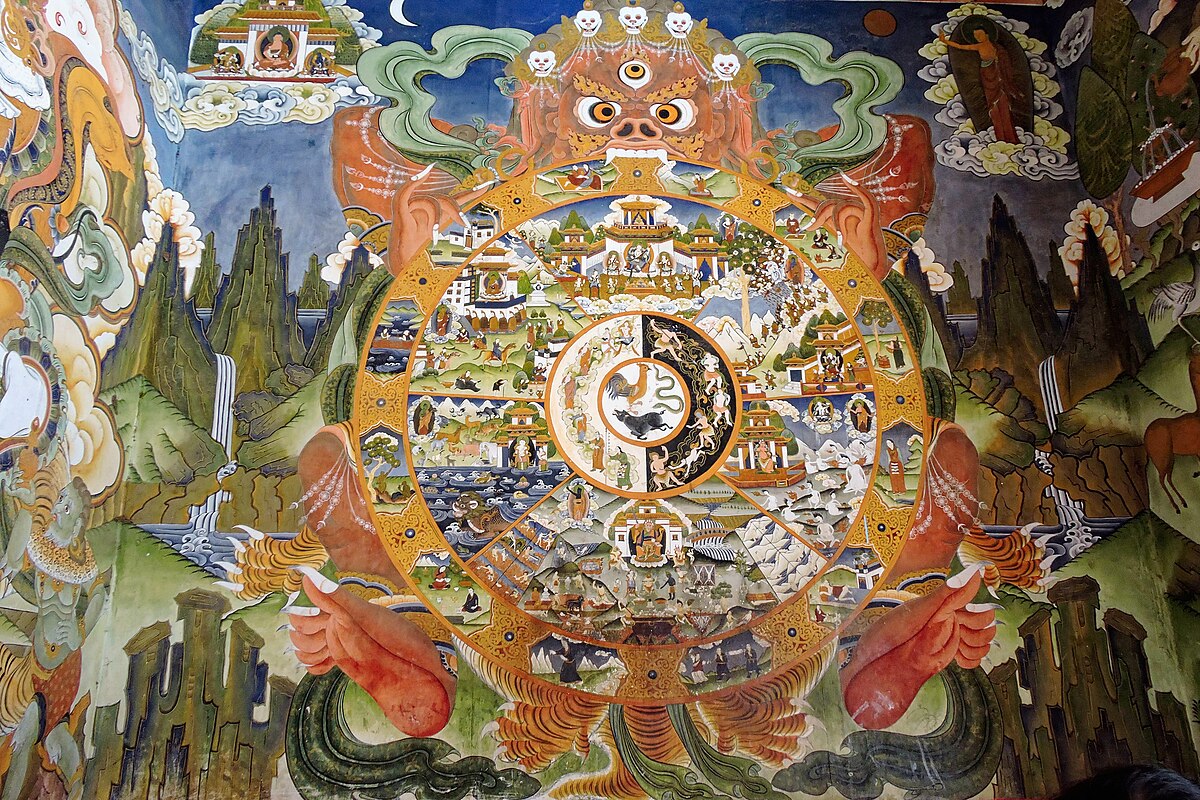
Dependent Origination
Definition
Pratityasamutpada (Sanskrit), paticca-samuppada (Pali), "dependent origination" or "dependent co-arising" — the teaching that all conditioned phenomena arise in dependence on conditions and cease when those conditions cease. The formula appears repeatedly in the Pali Canon: "When this exists, that exists; when this arises, that arises; when this does not exist, that does not exist; when this ceases, that ceases." At its most compressed, the teaching asserts that nothing has svabhava — intrinsic, independent, self-sufficient nature. Everything that arises, arises dependently.
The most elaborated form of the teaching is the twelve-link (nidana) chain of dependent origination, which maps the genesis of the suffering-generating cycle from its root in ignorance through its full elaboration in conditioned existence. The twelve links are: (1) avidya (ignorance); (2) samskara (formations/volitional activities); (3) vijnana (consciousness); (4) nama-rupa (name-and-form, the psychophysical organism); (5) shadayatana (the six sense-bases); (6) sparsha (contact); (7) vedana (feeling-tone — pleasant, unpleasant, neutral); (8) tanha (craving); (9) upadana (clinging/grasping); (10) bhava (becoming/existence); (11) jati (birth); (12) jara-marana (old age and death, with their attendant suffering). The chain operates in both directions: followed forward from ignorance, it generates the cycle of suffering; reversed, from the cessation of ignorance, it generates the cessation of the whole cycle.
The teaching has both a pragmatic and a metaphysical dimension. Pragmatically, it identifies the specific link in the chain where intervention is possible: between feeling-tone and craving. Every experience has a feeling-tone (pleasant, unpleasant, or neutral) that is beyond ordinary control; but the move from feeling-tone to craving — the grasping at pleasant experience and the aversion from unpleasant — is where conditioning begins and where training can interrupt the automatism. This is the psychological core of Buddhist meditation practice. Metaphysically, the teaching asserts something far more radical: that the very categories we use to analyze experience (self, world, causality) arise dependently and have no independent standing.
Historical Development
The Buddha presented pratityasamutpada as his central teaching. In the Majjhima Nikaya, the monk Kaccayana asks the Buddha about "right view" (samma-ditthi) and receives the answer in the language of dependent origination: the world is not as it appears to either the eternalist or the annihilationist; experience arises dependently, and the one who sees this sees the Dhamma. The teaching was understood from early on as foundational: the Samyutta Nikaya (SN 12) contains an entire chapter devoted to nidana-samyutta (the connected discourses on dependent origination) that elaborates the teaching in multiple registers.
The Abhidharma scholastic traditions (approximately 3rd century BCE to 5th century CE) systematized pratityasamutpada within their taxonomies of conditioned and unconditioned dharmas. The Sarvastivada school's analysis of causality — particularly its teaching that past, present, and future dharmas all "exist" in some sense — generated a position that Nagarjuna would target in his Mulamadhyamakakarika.
Nagarjuna's Madhyamaka philosophy (2nd century CE) represents the most rigorous philosophical elaboration of dependent origination in Buddhist history. Nagarjuna's demonstration that svabhava is self-contradictory — that any claim to intrinsic existence generates paradoxes — established sunyata (emptiness of intrinsic existence) as the correct interpretation of pratityasamutpada. Crucially, emptiness is not itself a new entity or ultimate ground: it too arises dependently and is empty of intrinsic existence. The Madhyamaka "two truths" doctrine — conventional truth (the world as ordinarily experienced) and ultimate truth (sunyata) — preserves the pragmatic dimension of the teaching while denying any substantial foundation.
Chandrakirti's Prasangika Madhyamaka (7th century CE) pushed this logic further, arguing that even consciousness as described by the Yogacara school (vijnanavada, mind-only) involves residual claims to substantial existence that dependent origination undermines. The debate between Madhyamaka and Yogacara over whether vijnana (consciousness) is ultimately real or ultimately empty represents the most sophisticated philosophical exchange in classical Buddhist thought.
The Hua-yen school in Chinese Buddhism (7th-8th centuries CE) developed the implications of pratityasamutpada into a vision of total interpenetration — the Avatamsaka Sutra's image of Indra's Net, in which each jewel reflects all others, expressing the mutual co-arising of all phenomena. This goes beyond the Madhyamaka account, which holds dependent origination and emptiness as two perspectives on the same reality, toward an explicitly positive characterization of interdependence as the basic structure of reality.
Key Distinctions
Dependent Origination vs. Causality: Western causal analysis typically posits independently existing entities that stand in causal relations — billiard balls, Humean constant conjunctions, Kantian causal categories. Pratityasamutpada denies the independent existence of the entities that enter causal relations: the "things" that "cause" other "things" are themselves constituted by their causal relations. This is not merely a refinement of causal analysis; it undermines the category of independent substance that Western causal analysis presupposes.
Dependent Origination vs. Process Philosophy: Whitehead's process philosophy (and its derivatives) shares with pratityasamutpada the insistence that reality is constituted by processes rather than substances. The parallel is genuine. The difference is that Whitehead posits a divine primum mobile, God, as the ground of creative advance. Pratityasamutpada makes no such posit; the dependent arising is not grounded in any independent reality. Process philosophy replaces one substance (matter) with another (process/God); pratityasamutpada denies independent grounding altogether.
Dependent Origination vs. Holism: Ecological and systems-theoretic holism emphasizes the interdependence of parts within a whole. Pratityasamutpada applies at a more fundamental level: not merely that parts are interdependent but that the very distinction between part and whole arises dependently and has no independent standing. Buddhist dependent origination is not systems holism with Sanskrit terminology.
Project Role
Dependent origination functions in the project as Buddhism's most radical challenge to the assumptions about consciousness that run through most of the other concepts in the KB. The Hermetic tradition's sympatheia, Neoplatonism's henosis, Steiner's threefold human being, Barfield's participation — all of these presuppose, at some level, that consciousness has a nature, a real character that can be cultivated, transformed, or returned to its source. Pratityasamutpada denies that consciousness has independent nature at all. The project does not resolve this confrontation. It holds it as one of the live tensions that makes the comparative work genuinely difficult and genuinely worth doing.
Primary Sources
- The Nidana-Samyutta (SN 12): The Pali Canon's definitive collection of teachings on dependent origination, including the formula, the twelve-link chain, and the Buddha's refusals of both eternalist and annihilationist interpretations.
- Nagarjuna, Mulamadhyamakakarika (c. 2nd century CE): The philosophical demonstration that all dharmas are empty of intrinsic existence (svabhava) because they arise dependently. Chapter 26 returns to the twelve-link chain and its reversal as the path to liberation.
- Candrakirti, Madhyamakavatara (7th century CE): The clearest presentation of the Prasangika Madhyamaka interpretation, including the critique of Yogacara residual substance-claims.
- Thomas Kasulis, Zen Action, Zen Person (1981) and Jay Garfield's translation of Nagarjuna: Reliable scholarly introductions to the philosophical dimensions of the teaching.
Agent Research Notes
[AGENT: perplexity | DATE: 2026-03-22] The tension between Madhyamaka and Yogacara on whether consciousness is ultimately real or ultimately empty remains a live philosophical debate in contemporary Buddhist scholarship and among Tibetan Buddhist scholars. The project should treat this as an unresolved internal debate within the tradition rather than presenting a single "Buddhist view of consciousness." Jay Garfield (particularly in Engaging Buddhism, 2015) provides sophisticated contemporary philosophical engagement with these questions that would be useful for the project's treatment of consciousness.