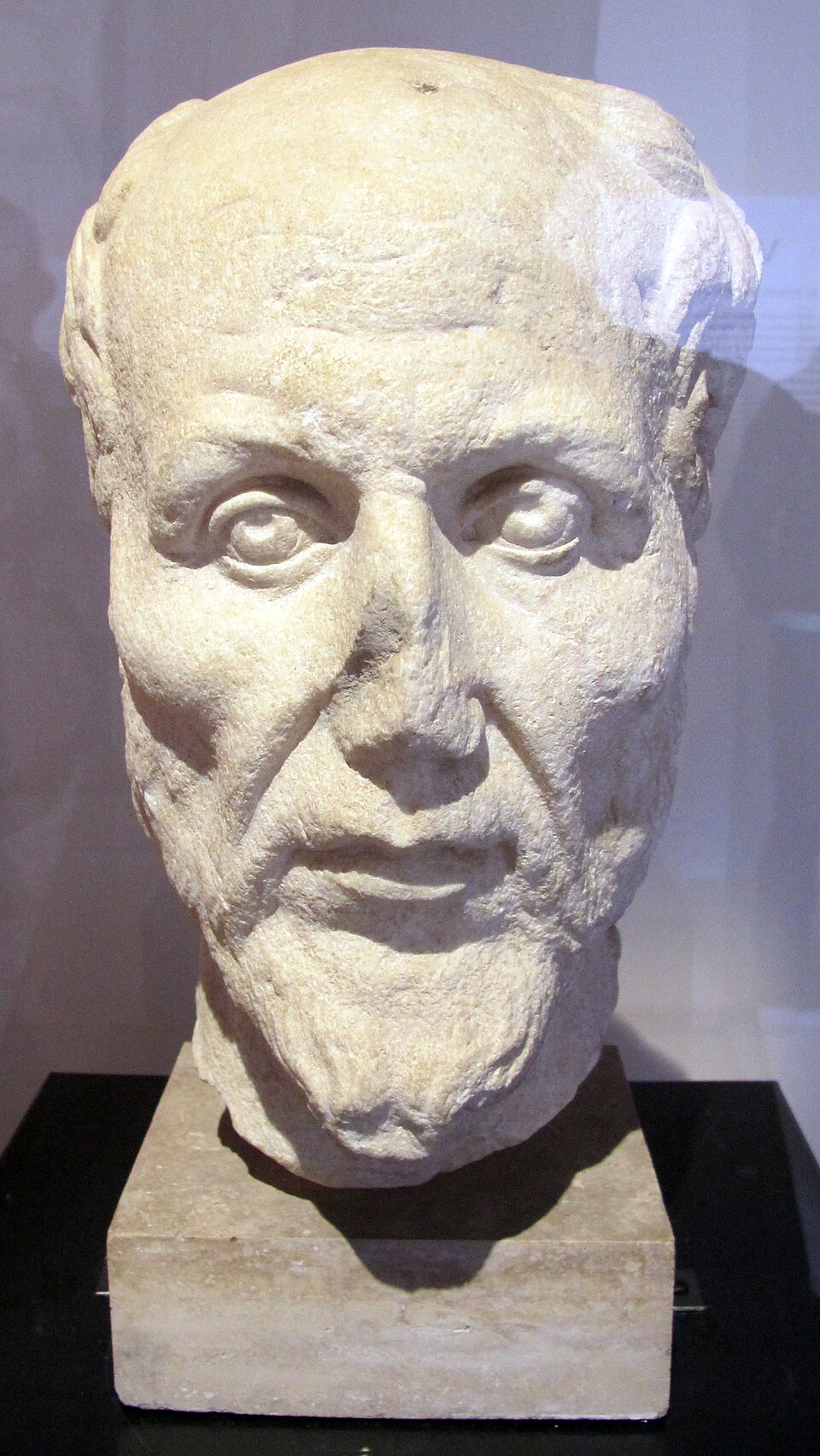
Plotinus
Dates: c. 204–270 CE Domain: Neoplatonist Philosophy, Mysticism, Metaphysics
Biography
Plotinus was born around 204 CE, possibly in Lycopolis, Egypt (though this is uncertain; ancient sources are vague about his origins, which he is said to have been reluctant to discuss). He studied philosophy at Alexandria under Ammonius Saccas for eleven years, then joined the ill-fated Persian campaign of Emperor Gordian III in an attempt to learn Persian and Indian philosophy firsthand. After the campaign's collapse, he settled in Rome around 244 CE, where he established a philosophical school that attracted the educated elite of the city, including senators, physicians, and the emperor Gallienus himself. His student and editor Porphyry collected and arranged his fifty-four treatises into the Enneads (Greek for "groups of nine") after Plotinus's death from illness in 270 CE.
Plotinus is the founder of what later scholars called Neoplatonism: the rigorous philosophical synthesis of Plato, Aristotle, and Pythagorean mathematics that dominated the intellectual world of late antiquity and shaped both Christian mystical theology and Islamic philosophy for centuries thereafter. His system begins from a single, radical principle: the One, which is beyond being, beyond intellect, and beyond all qualification. The One does not think, because thinking implies duality (a subject thinking an object), and the One is absolute unity. From the One, through a process of emanation (proodos), there proceeds Nous (Intellect), the realm of Platonic Forms and perfect self-thinking thought, and from Nous there proceeds Psyche (Soul), which generates the material world as its lowest expression.
The practical and spiritual dimension of Plotinus's philosophy is an account of the soul's return (epistrophē) to its source. The soul has descended into matter and become identified with the body, but it retains an inner connection with Nous and, through Nous, with the One. The path of return proceeds through moral purification, philosophical contemplation, and finally the ecstatic union with the One that Plotinus called henosis, an experience he himself reportedly achieved on several occasions in Porphyry's presence, during which all distinction between seer and seen dissolved. His famous description of this goal, "the flight of the alone to the Alone" (phygē monou pros monon, Enneads VI.9.11), has become one of the most quoted phrases in the history of mysticism.
The word "alone" is significant in both directions. The soul must become "alone," stripped of all external attachments, bodily identifications, and even intellectual content, to meet the One that is "Alone" in its absolute self-sufficiency. This has led critics (including the Christian theologian Andrew Louth and others) to charge Plotinus with a solipsistic or antisocial mysticism, a concern that the project must engage. Recent scholarship has complicated this reading, arguing that the Plotinian "ascent" increases rather than diminishes the soul's integration with all other beings, insofar as the One is the ground of all unity.
Key Works (in library)
| Work | Year | Relevance |
|---|---|---|
| The Enneads | c. 253–270 CE (ed. Porphyry c. 301 CE) | Complete philosophical system; the account of emanation, the soul's descent and return, and union with the One (LIB-0254) |
Role in the Project
Plotinus functions in the project primarily as a foil and interlocutor for Iamblichus (FIG-0004), defining one pole in the foundational debate about whether contemplation alone suffices for spiritual transformation. He is not simply wrong: his systematic account of the metaphysical structure of reality (the One, Nous, and Soul) provides indispensable scaffolding for understanding how mystery initiations were understood to work philosophically in late antiquity. His account of the soul's descent into matter and aspiration to return to the One is also the context within which Iamblichus's insistence on theurgy becomes intelligible: both philosophers agree on the problem (the soul is lost in matter); they disagree about the solution (intellect alone vs. embodied ritual). This debate to raise the broader question of what relationship between body and spirit any serious spiritual path must negotiate.
Key Ideas
- The One: The first and highest principle: beyond being, beyond intellect, absolute unity. All things emanate from it and aspire to return to it.
- Emanation (proodos): The process by which Nous proceeds from the One, Soul from Nous, and matter from Soul; a necessary outflowing, not a deliberate creation.
- Return (epistrophē): The soul's aspiration to return to its source through moral purification, philosophical contemplation, and mystical union.
- Henosis: Mystical union with the One; the dissolution of all duality in which the soul discovers it was never separate from its source.
- "Flight of the alone to the Alone": The famous formula for mystical union: the soul stripped of all particularity meeting the One in absolute simplicity.
- The undescended soul: Plotinus's controversial claim that a part of the soul always remains in contact with Nous and never fully descends into matter. This is the point Iamblichus disputes.
Against the Gnostics
One treatise of the Enneads (II.9, given the title "Against the Gnostics" by Porphyry) is a sustained polemic, and it marks the boundary of Plotinus's thought as clearly as anything he wrote. The Gnostics shared much of his vocabulary: a transcendent source, a fallen soul, a longing to return. But they held that the material cosmos was the botched work of an ignorant or malicious lower power, a prison to be despised and escaped.
Plotinus attacks this with unusual heat. The cosmos, he insists, is the work of Soul, which never ceased contemplating Nous; it is the best possible image of the intelligible, and to call it evil is both ungrateful and incoherent. Evil is not a power and not a place; it is privation, the thinning of the Good at the furthest reach of emanation. He charges the Gnostics with spiritual arrogance: they flatter themselves that they alone are children of God while despising the sun, the stars, and the order of the whole. A soul that cannot see the beauty of the visible cosmos, he argues, is in no condition to ascend to the beauty above it.
For the project this treatise fixes Plotinus's position precisely. His mysticism is world-affirming. The ascent to the One is not a flight from a hated material world but a movement through a cosmos that is itself good, the lowest radiance of the source. Against the Gnostics is the clearest available contrast between Neoplatonic contemplative ascent and the dualist world-rejection the project is careful not to conflate it with (LIB-0254).
Connections
- Influenced by: Plato (primarily Parmenides, Timaeus, Republic), Aristotle (the Metaphysics), Pythagorean philosophy, Numenius of Apamea, Ammonius Saccas
- Influenced: Porphyry (disciple), FIG-0004 (Iamblichus: defining himself against Plotinus), Proclus, Augustine (significantly, via Marius Victorinus), FIG-0010 (Pseudo-Dionysius: the negative theology is Plotinian throughout), Islamic Neoplatonism (al-Farabi, Avicenna), FIG-0009 (Corbin: Plotinus's hierarchy of worlds underlies the imaginal realm framework)
- In tension with: FIG-0004 (Iamblichus: the soul's descent and the necessity of theurgy vs. the sufficiency of contemplation)
Agent Research Notes
[AGENT: perplexity | DATE: 2026-03-20] LIB-0254 (The Enneads) is in the library. The standard English translation is by Stephen MacKenna (1917–1930), still widely used for its literary quality; the A. H. Armstrong Loeb Classical Library translation (7 vols., 1966–1988) is the standard scholarly text. Plotinus's nationality is difficult to specify: he was born in Roman Egypt, educated in Alexandria, and lived in Rome, writing in Greek. He is best described as a Roman philosopher of Egyptian origin writing in the Greek tradition. He is often called the founder of Neoplatonism, though the term was coined by nineteenth-century scholars; he would have regarded himself simply as a Platonist. The "flight of the alone to the Alone" comes from the very last line of the Enneads as arranged by Porphyry (VI.9.11), suggesting it was intended as the crowning formulation of the whole system.
[AGENT: claude-code | DATE: 2026-04-03] Deepened with material from LIB-0254 (Plotinus, The Enneads). Added "Against the Gnostics," on Ennead II.9 and Plotinus's world-affirming rejection of Gnostic dualism, which fixes the contrast between Neoplatonic ascent and dualist world-rejection. Existing content was not rewritten.