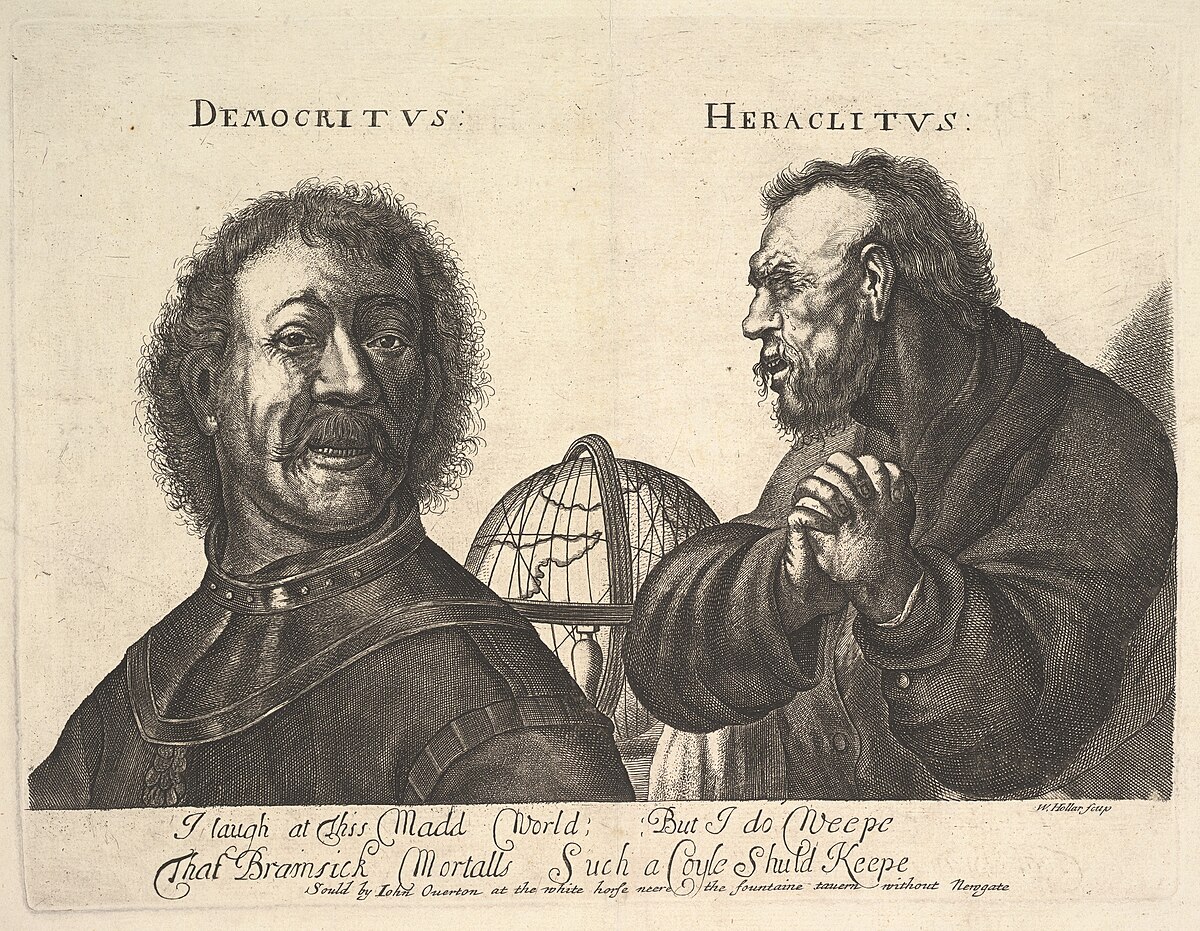
Heraclitus
Dates: c. 535–c. 475 BCE Domain: Pre-Socratic Philosophy, Cosmology, Logos Theory
Biography
Heraclitus of Ephesus is known almost entirely through approximately 130 fragments preserved in other ancient authors who quoted or paraphrased him — and through his reputation in antiquity as "the Obscure" (ho Skoteinos), a figure whose deliberately difficult aphoristic style was taken even by ancient readers as a sign of aristocratic disdain for ordinary comprehension. He was born in Ephesus around 535 BCE, is said to have declined the position of civic lawgiver in favor of philosophical withdrawal, and reportedly deposited his work in the temple of Artemis at Ephesus, where it could be read but would be difficult. He died around 475 BCE.
The fragments divide into three groups: cosmological (fire as the primary element, the Logos as the principle of cosmic order), epistemological (on the unreliability of the senses and the rarity of wisdom), and anthropological (on sleep, death, the soul, and the relationship between waking and dream states). The interconnections between these groups are the work of interpretation, and they are rich.
The Logos is the most philosophically significant concept: "Although the Logos is common, the many live as though they had a private understanding." The Logos is what governs the cosmic flux — not a mind separate from the world but the principle of order within the flux itself. Everything flows; the river into which you step twice is not the same river and you are not the same person — and yet something remains identical through the change, which is the Logos.
Peter Kingsley's reading (Ancient Philosophy, Mystery, and Magic, 1995) connects Heraclitus to the tradition of incubatio: the practice of lying in darkness or in sacred caves in a state between sleep and waking — and argues that his deliberate obscurity is the literary form of the initiatic silence (echemythia). Whether this reading is correct in its historical specifics, it is philosophically productive: it places Heraclitus within the same tradition that produced the Mysteries rather than as a forerunner of rationalist philosophy.
Key Works (in library)
| Work | Year | Relevance |
|---|---|---|
| On Nature (fragments) | c. 500 BCE | The Logos, flux, fire, opposites — the foundational pre-Socratic metaphysics |
Role in the Project
Heraclitus provides the Birth of Western Mind track's philosophical foundation that precedes Plato: the earliest Greek thinker who formulated the relationship between flux and order, between the surface of change and the underlying Logos, in a way that is structurally related to what the Mysteries were enacting in ritual. His statement that "the path up and the path down are one and the same" is the project's earliest Greek philosophical statement of coincidentia oppositorum.
Key Ideas
- The Logos: The underlying principle of order within cosmic flux — not a divine mind separate from the world but the rational principle of the world's own self-organization.
- The Unity of Opposites: "The path up and the path down are one and the same." Opposites are not contradictory but define each other — day and night, hot and cold, the living and the dead. The Logos is what holds them in tension.
- Flux and Permanence: "You cannot step into the same river twice." The river is always flowing; it is never the same water. Yet it is recognizably the same river. This is the primary ancient statement of the problem of identity through change.
- The Sleeping and the Waking: Heraclitus's fragments on sleep and death suggest that the boundary between waking consciousness and other states was philosophically significant to him — which is the connection to the mystery tradition that Kingsley develops.
Connections
- Pre-Socratic foundations: FIG-0034 Plato (Plato's Heraclitean opponent Cratylus in the Cratylus dialogue; Plato absorbed Heraclitean flux into his own metaphysics), FIG-0035 Pythagoras (contemporary; both working in the pre-Socratic synthesis of cosmology and religious practice)
- Logos tradition: FIG-0104 Boehme (the Ungrund as Boehme's version of the principle beneath cosmic flux), CON-0018 Sympatheia (Stoic pneuma as the rationalized version of the Heraclitean Logos)
Agent Research Notes
[AGENT: perplexity | DATE: 2026-03-22] The fragments are conventionally numbered by Diels-Kranz as B-fragments (Berlin, 1903–1910); Charles Kahn's The Art and Thought of Heraclitus (Cambridge, 1979) provides the best philosophical commentary with Greek text. Kingsley's argument about incubatio is in Ancient Philosophy, Mystery, and Magic (Oxford, 1995) and the more popular In the Dark Places of Wisdom (1999). The "river fragments" are conventionally numbered B12, B49a, and B91.