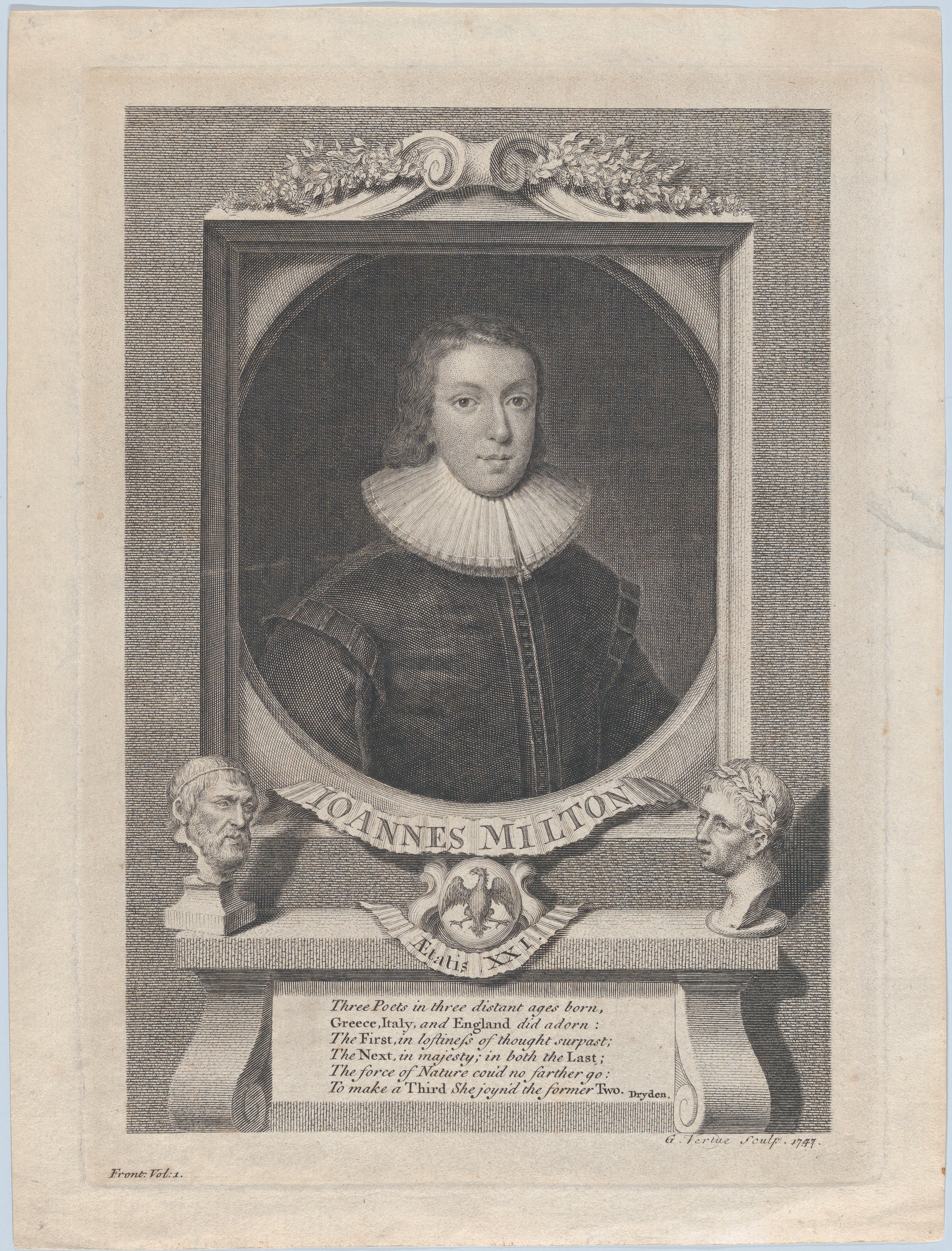
John Milton
Dates: 1608–1674 Domain: Poetry, Theology, Political Philosophy
Biography
John Milton was born in London in 1608, the son of a scrivener who was also a talented amateur musician. He received a thorough classical and humanistic education at St. Paul's School and Christ's College, Cambridge, mastering Latin, Greek, Hebrew, Italian, and eventually Old English. The early poetry, including Comus (a masque) and Lycidas, shows a poet of enormous technical skill working in established genres. He spent most of the 1640s and 1650s writing political prose — treatises on divorce, press freedom (Areopagitica, 1644), and the defense of the regicide — as Latin secretary to Oliver Cromwell's government, doing work for which he went blind by 1652. When the Commonwealth collapsed and Charles II was restored in 1660, Milton was briefly imprisoned and then released, returning to poetry in obscurity and ill health.
Paradise Lost was composed in blindness, dictated to his daughters and to secretaries, and published in 1667 in ten books (expanded to twelve in 1674). It is the last great English epic poem and, for the project's purposes, a document of a consciousness transition: the attempt to justify the ways of God to men by narrating the Fall as a cosmological event that illuminates, rather than merely condemning, the choice that produced it. Milton's God is consistently the least dramatically interesting figure in the poem; Satan is the most interesting. This is not carelessness but a consequence of Milton's own artistic intelligence recognizing what the poem's subject required.
Satan's opening speeches in Books I and II — "The mind is its own place, and in itself / Can make a Heaven of Hell, a Hell of Heaven" — are the founding statements of the modern subject: the consciousness that defines its reality through its own determination rather than through acceptance of what is given. Blake was right that this is heroic. He was also right that Milton didn't know how heroic he was making it — or perhaps he knew and couldn't help it, because the poem's artistic demands required that Satan be compelling. Either reading confirms the project's analysis: Paradise Lost is a document of the consciousness transition it describes.
The Fall itself, in Books IX and X, is the central episode: Eve's encounter with Satan, her decision, Adam's decision to share her fate, and the expulsion from Eden into a world where labor, suffering, and the knowledge of death are permanent conditions. Whether this is tragedy (as Blake read it) or theodicy (as Milton intended) is a question the project holds open.
Key Works (in library)
| Work | Year | Relevance |
|---|---|---|
| Paradise Lost | 1667/1674 | The Fall as consciousness event; Satan as the founding document of the modern subject |
| Paradise Regained | 1671 | Christ's resistance to temptation in the desert; the restored consciousness as apophatic refusal |
| Samson Agonistes | 1671 | The initiatory pattern: capture, blindness, descent, final act |
| Areopagitica | 1644 | Freedom of the press as the political application of the Paradise Lost argument |
Role in the Project
Milton belongs in the Western Canon track at the precise point where the Renaissance Hermetic tradition (FIG-0026 Bruno, FIG-0017 Yates) gives way to the Protestant epic and the Puritan consciousness. He is the hinge figure: educated in the same humanist tradition as the Renaissance magi, steeped in Plato and the Neoplatonists, committed to an understanding of reason and freedom that draws on those sources — but embedded in a Puritan theological framework that forecloses the initiatic possibility of direct divine access.
The project's specific argument about Milton follows Blake's reading: Satan's heroic self-definition in Books I–II, and God's legalistic justice throughout, document the emergence of the modern subject as the Fall's product rather than its cause. The consciousness that defines itself through opposition, that "makes" its own heaven or hell, is the post-Edenic consciousness that the Mysteries were designed to supplement or transform — and that Milton documents in the act of trying to justify its existence.
Key Ideas
- The Fall as Consciousness Event: Not primarily a moral failure but the event through which the capacity for self-definition, independent judgment, and the experience of good and evil as distinct becomes available. This is a cost that may also be a gain.
- Satan and the Modern Subject: Satan's speeches in Books I–II are the founding texts of the consciousness that defines reality through its own determination. "Better to reign in Hell than serve in Heaven" is the modern subject's founding declaration.
- Milton's God: Deliberately cold, legalistic, and dramatically flat — which is either a flaw in the poem or a precise portrait of what omniscient divine rationality looks like from the perspective of the newly individuated human.
- Paradise Regained as Apophatic: Christ's temptation in the desert resisted through systematic refusal — refusing Satan's offers of bread, wealth, glory, and power — is Milton's version of the apophatic path: knowing God through what God is not.
Connections
- Epic tradition: FIG-0085 Virgil (Aeneid katabasis as the epic template Milton inherits), FIG-0033 Dante (Commedia as the medieval Christian katabasis Milton is responding to)
- Blake's reading: FIG-0023 Blake (The Marriage of Heaven and Hell is partly a reading of Paradise Lost)
- Consciousness evolution: CON-0005 Consciousness Evolution (the Fall as the event that Gebser's structures map around)
Agent Research Notes
[AGENT: perplexity | DATE: 2026-03-22] Milton went blind approximately 1651–1652; the cause was probably glaucoma. Paradise Lost first published in ten books (1667), revised to twelve (1674) by splitting Books VII and X. The dedication to Samuel Simmons gave Milton £5 on publication, £5 after each of three further printings of 1300 copies each. Blake's comment about Milton being "of the Devil's party without knowing it" is from The Marriage of Heaven and Hell, plate 6. William Empson's Milton's God (1961) makes the anti-theodicy case most forcefully.