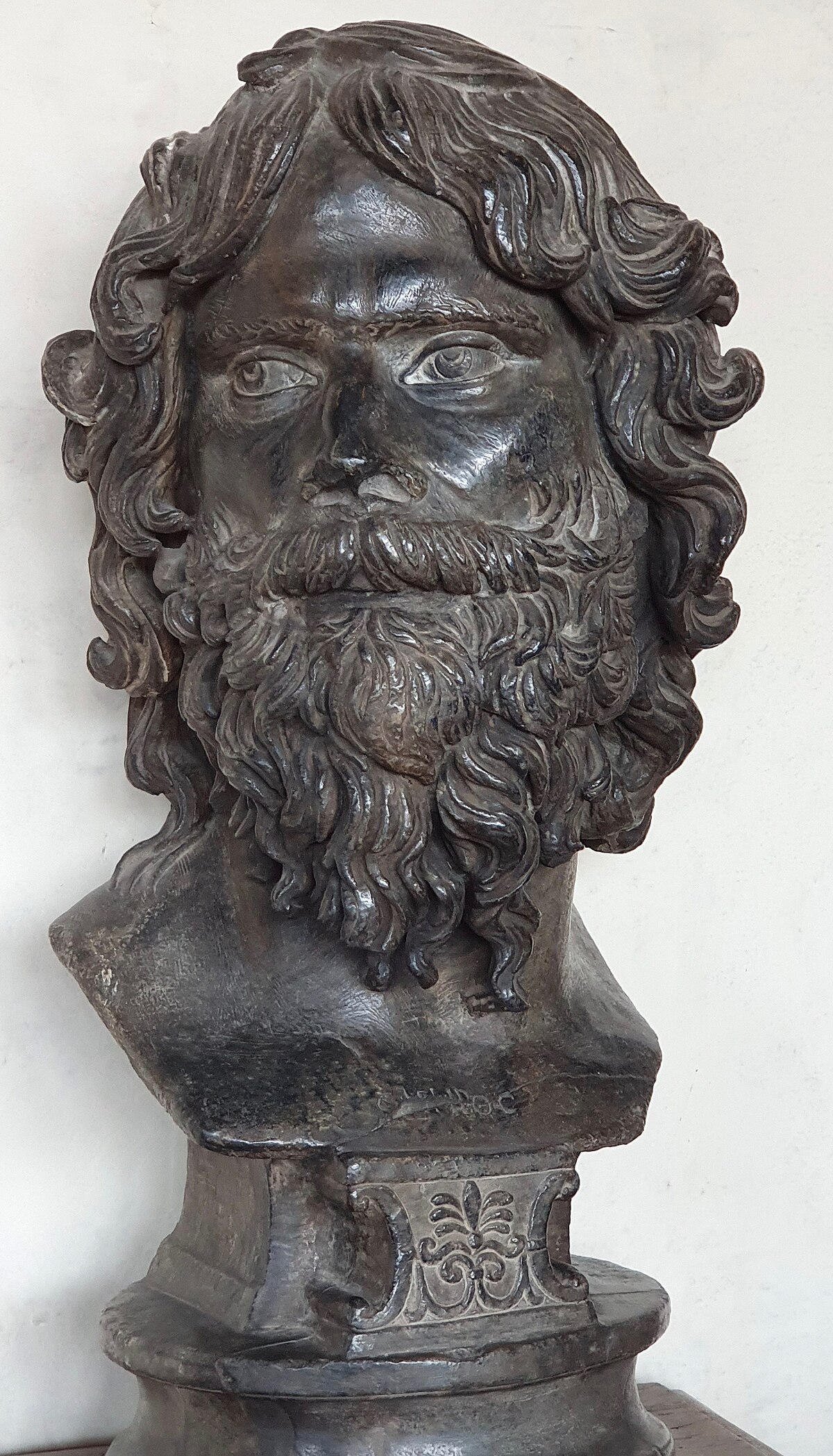
Homer
Dates: c. 8th century BCE Domain: Epic Poetry, Oral Tradition, Greek Mythology
Biography
Homer is a name attached to two of the foundational texts of Western literature, and the question of who or what "Homer" was — a single poet, a tradition, a redactor of existing oral material — has occupied classical scholarship since antiquity. The ancient Greeks had no doubt: Homer was the blind poet of Chios (or Smyrna, or one of several other cities that claimed him), and the Iliad and Odyssey were his. Modern scholarship, beginning with Milman Parry's work in the 1930s, established that the poems exhibit the formulaic structure of oral composition: epithets, repeated scenes, conventional phrases that allowed a singer (aoidós) to compose in performance using pre-formed building blocks. This does not mean Homer was not a single great poet. It means that, if he was, he worked within and shaped a tradition of oral performance that preceded him by centuries and in which his poems were exceptional products.
The Iliad is a poem about the consequences of anger — specifically, the rage of Achilles and what it costs. The famous first word, menis, is used in Greek for the anger of gods; its application to a mortal in the poem's opening line signals immediately that Achilles is operating in a register beyond ordinary human emotion. The Iliad is not an initiation narrative in the structural sense — it does not move its hero through separation, liminality, and incorporation. It is rather an extended meditation on the consciousness that heroic pride produces and the encounter with death that opens it into something else. Achilles's mourning for Patroclus, his recognition at the poem's end of Priam as a man like his own father, constitutes a transformation — not into wisdom but into the capacity for grief that heroic identity had prevented.
The Odyssey is the primary Homeric text. Odysseus's ten-year return from Troy is structured as a series of encounters with the non-human — with Circe who turns men into animals, with Calypso who offers immortality, with the Sirens whose song stops consciousness in its tracks, with the Cyclops who has no concept of hospitality, with the dead in Book XI who drink blood and speak the truth about what they knew in life. Each encounter tests a different human capacity: craft, desire, the limits of hearing, the relationship to those no longer living. The descent to the dead in Book XI (Nekuia) is the structural center of the poem — a katabasis that is also a consultation of the dead for the knowledge only the dead possess. Tiresias tells Odysseus how to get home. The living cannot give this information. Only the dead know the way back to the living world.
The Homeric Hymns — particularly the Hymn to Demeter, which is the primary literary source for the Eleusinian Mysteries — show the mythological substrate in which both epics operate. The grain goddess's grief for Persephone, her withdrawal from the world, the negotiations that restore the agricultural cycle — this is the same mythological territory as the Odyssey's return narrative, and both belong to the same symbolic world in which descent, loss, and return are the fundamental rhythm of meaningful existence.
Key Works (in library)
| Work | Year | Relevance |
|---|---|---|
| The Iliad | c. 8th century BCE | Heroic consciousness and its encounter with mortality; the transformation grief produces |
| The Odyssey | c. 8th century BCE | Primary katabasis narrative; the descent to the dead as initiatory center |
| Homeric Hymn to Demeter | c. 7th–6th century BCE | Primary literary source for the Eleusinian Mysteries |
Role in the Project
The Birth of Western Mind track needs Homer to establish that initiatic structure is prior to philosophy in the Greek tradition — that when Plato theorized the ascent of the soul and the philosopher's katabasis into the cave, he was working within a framework that Homer had already put in narrative form. The Odyssey's structure of descent and return, of trials that strip the hero of every previous identity until he arrives home as a stranger in his own house, is the mythological matrix from which the Platonic philosophy of the soul's journey draws its imagery.
Homer also raises the most important question about oral tradition and consciousness: the Odyssey was composed and performed before widespread literacy, in a mode of consciousness that Owen Barfield would call original participation: a consciousness not yet separated from the world it perceived. What does it mean that this consciousness produced a narrative about exactly the kind of stripping-away and transformation that mystery initiation enacted? The project's answer, carried rather than resolved, is that the mythological structure was doing the same work as the Mysteries — maintaining access to the transformative knowledge of death and return — but through communal narrative rather than individual ritual.
Key Ideas
- Nostos as Initiation: The nostos (return) narrative is structurally isomorphic with the initiatic journey: separation from the home world, traversal of non-human territories, encounter with death, and incorporation into a transformed homecoming. Odysseus comes home as a stranger and must prove himself anew.
- Nekuia — The Descent to the Dead: Book XI of the Odyssey is the oldest surviving katabasis in Western literature — predating Virgil's Aeneid Book VI by seven centuries, predating Dante's Commedia by a millennium and a half. The dead provide knowledge unavailable to the living.
- The Sirens and the Limit of Hearing: Odysseus's binding himself to the mast to hear the Sirens without being destroyed by them is an image of the initiatory ordeal's logic: controlled exposure to what would otherwise be annihilating.
- Oral Consciousness: The formulaic structure of Homeric composition suggests a different relationship between memory, performance, and knowledge — one that participates in the material rather than observing it from outside. Reading Homer is not the same cognitive act as hearing Homer performed.
Connections
- The project's other ancient foundational texts: FIG-0034 Plato (the philosopher who reconfigured Homer's mythological framework into dialectical philosophy), FIG-0037 Orpheus (the parallel katabasis tradition), FIG-0085 Virgil (the Roman katabasis that directly inherits Homer's Nekuia)
- Eleusinian context: CON-0002 Katabasis (the Homeric Nekuia as its earliest literary instance)
- Consciousness structure: CON-0004 Participation (the pre-philosophical mode of consciousness that produced the epics)
Agent Research Notes
[AGENT: perplexity | DATE: 2026-03-22] Milman Parry's oral-formulaic theory is in his collected papers, The Making of Homeric Verse (Oxford, 1971). The Homeric Hymn to Demeter is the primary text for Eleusinian scholarship; critical edition by Nicholas Richardson (Oxford, 1974). Peter Kingsley's work on pre-Socratic connections to initiatory traditions, particularly In the Dark Places of Wisdom (1999), is relevant to the project's argument that Homer stands within the same tradition as the Mysteries. Gregory Nagy's work on the performance tradition (Homer's Text and Language, University of Illinois, 2004) provides the contemporary scholarly framework.