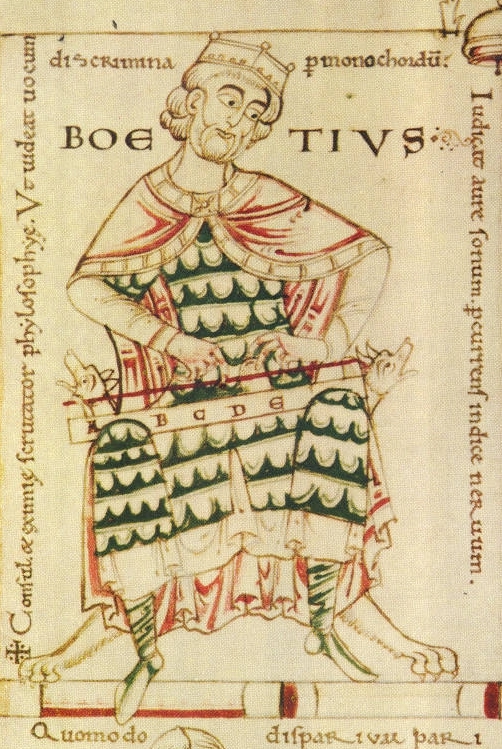
Boethius
Dates: c. 477–524 CE Domain: Philosophy, Theology, Mathematics, Logic
Biography
Anicius Manlius Severinus Boethius was born in Rome around 477 CE into one of the most distinguished families of the late Roman aristocracy. Orphaned early, he was raised in the household of the senator Symmachus (whose daughter he later married) and received the finest education available: thorough in Greek philosophy, Latin rhetoric, mathematics, and logic. He aspired to translate the complete works of Plato and Aristotle into Latin, a project he never completed but which, in its partial realization, transmitted key logical and philosophical texts to a Latin West that was losing its Greek. For centuries, Boethius's translations and commentaries on Aristotle's logical works were the primary source of Aristotelian logic in Western Europe.
He rose rapidly in the service of Theodoric, the Ostrogothic king who ruled Italy after the formal end of the Western Roman Empire. He was appointed consul in 510, held the highest office in Theodoric's court, and appeared set for a distinguished career as statesman and philosopher. In 523 he was accused of treason — the specific charges involved alleged communication with Constantinople and possibly defense of a senator accused of similar charges — and was imprisoned in Pavia. He was executed, probably by bludgeoning, in 524, around age forty-five. His father-in-law Symmachus was executed shortly after.
The Consolation of Philosophy was written in prison between his condemnation and his execution — a period of months. It is not a Christian text in any obvious sense: it does not mention Christ, scripture, or the sacraments. It is a Platonic-Stoic meditation on fortune, Providence, and the nature of the good, written in a classical form alternating prose and verse (the prosimetrum). Lady Philosophy appears to the imprisoned Boethius as a tall woman of indefinite age, with eyes that see further than ordinary human vision, dressed in a gown that bears the letters Π (practical philosophy) at the hem and Θ (theoretical philosophy) at the neck, connected by steps she herself has torn. She has come to console the prisoner — to lead him, through a series of dialogues that move from diagnosis to therapy to the final contemplation of Providence, from his initial grief and self-pity to a transformed understanding.
The figure of Lady Philosophy is, immediately recognizable as an Isis-figure: the feminine personification of divine wisdom who appears to the suffering, imprisoned, near-death figure and initiates him into a higher understanding. Compare Apuleius's Isis appearing to Lucius in his despair. The parallel is not coincidental; both figures draw on the late-antique tradition of the feminine divine as guide and teacher, and both use the dialogue form (the initiate's questions answered by the guide) that characterizes the initiatory instruction genre. Boethius, the last figure in the ancient philosophical tradition who had access to Greek learning and was writing for Latin readers, was translating the initiatory pattern into the mode that would survive into the medieval Christian world.
The doctrine of Fortune and Providence at the heart of the Consolation is philosophically serious. Fortune, Lady Philosophy explains, is not a goddess who owes humans anything; she turns her wheel because that is what she does. The complaint that Fortune has abandoned a man is based on a misunderstanding of what Fortune is. What Fortune cannot take away is the inner good — the soul's orientation toward the genuine Good — and that orientation is in the prisoner's power regardless of external circumstances. This is Stoic consolation, but Boethius gives it a Platonic metaphysical grounding: the genuine Good is not Fortune's gift but the soul's own deepest nature, accessible through the rational ascent that Lady Philosophy is conducting.
Key Works (in library)
| Work | Year | Relevance |
|---|---|---|
| The Consolation of Philosophy | 524 CE | The bridge text from ancient to medieval; the initiatory dialogue in extremis |
| De Institutione Musica | c. 500 CE | The transmission of Pythagorean music theory to the medieval West |
| De Institutione Arithmetica | c. 500 CE | The transmission of Pythagorean number theory |
Role in the Project
The project reads the Consolation as evidence for a specific claim: that the initiatory pattern is not merely a feature of deliberate mystery schools but a structural necessity that emerges spontaneously under conditions of extreme pressure. Boethius was not, as far as we know, a member of any esoteric tradition. He was a Christian Platonist who, when faced with unjust execution, found himself writing a text that enacts the full initiatory movement from death-consciousness to transformed understanding — without explicitly initiatic content, because the initiatory structure had become so fully absorbed into the Platonic tradition that it expressed itself naturally in anyone who thought seriously from within that tradition. The Consolation is also the project's evidence for the productive role of confinement: Boethius's prison is the condition for the work. Compare Andreev (FIG-0052) writing The Rose of the World in Soviet prison; compare Dante's exile.
Key Ideas
- Lady Philosophy as Isis: The feminine personification of divine wisdom as initiatory guide — appearing to the suffering prisoner as teacher, leading him through dialogue from confusion to the direct apprehension of the Good.
- Fortune's Wheel: The personification of contingency — the principle that external circumstances turn without regard for desert; the correct response is not bitterness but the recognition that Fortune cannot touch the inner good.
- Providence vs. Fate: Providence is the divine plan seen from eternity; Fate is that same plan as it appears to human temporal experience. The prisoner who understands Providence is no longer a victim of Fate.
- The Prisoner's Turn: The movement from grief and complaint (the opening of the Consolation) through philosophical instruction to the final contemplation of divine order — a movement structurally parallel to the initiatory descent and return.
- The Bridge Text: The Consolation carries the Platonic-Hermetic inheritance across the threshold of the ancient world into medieval Christian culture — in a form that was acceptable to both pagan and Christian readers.
Connections
- Influenced by: FIG-0034 Plato (the dominant philosophical source), Cicero's Tusculan Disputations, Stoic consolation literature, Neoplatonic commentary tradition
- Influenced: FIG-0033 Dante (who cites Boethius in Il Convivio), the entire medieval tradition of fortune literature, Chaucer (Troilus and Criseyde draws heavily on the Consolation), Jean de Meun
- In tension with: Strictly orthodox Christianity (the Consolation's silence on specifically Christian doctrines has puzzled commentators ever since), and the despair it was written to overcome
Agent Research Notes
[AGENT: perplexity | DATE: 2026-03-22] Boethius's dates are uncertain; c. 477–524 CE is the standard scholarly estimate. The exact method of execution is debated; the traditional account (bludgeoning to death) comes from later sources. The Consolation is preserved in an enormous number of medieval manuscripts — over 400 survive — testifying to its importance as a school text throughout the medieval period. King Alfred the Great translated it into Old English; Chaucer translated it into Middle English. The standard modern scholarly edition is by H. F. Stewart and E. K. Rand (Loeb Classical Library, 1918; revised 1973). John Marenbon's Boethius (2003) is the best modern intellectual biography.