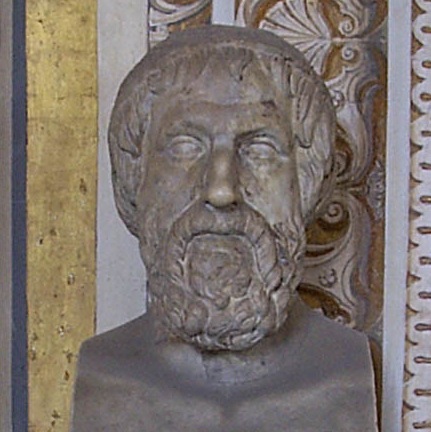
Pythagoras
Dates: c. 570–c. 495 BCE Domain: Philosophy, Mathematics, Religion, Cosmology
Biography
Pythagoras of Samos was born on the island of Samos around 570 BCE and emigrated to Croton, in the Greek colonial world of southern Italy (Magna Graecia), around 530 BCE. He left no writings, at least none that survived, and what we know of him comes from sources written centuries after his death: Iamblichus's On the Pythagorean Way of Life (c. 300 CE), Porphyry's Life of Pythagoras, and Diogenes Laertius's Lives of the Eminent Philosophers. These are hagiographic accounts that freely blend historical fact, legend, and later Neoplatonic elaboration. Separating the historical Pythagoras from the Pythagorean tradition is one of the most difficult problems in ancient intellectual history, and the project does not need to solve it. The tradition that formed around Pythagoras's name is what matters — and that tradition is consistent in its main features.
The school at Croton was not an academy in the modern sense but a religious and philosophical community with an initiatic structure. Members were divided into two grades: the akousmatikoi (hearers), who received the teachings in summary form as prescriptions and prohibitions (akousmata) to be followed without explanation; and the mathematikoi (learners), who received the full teaching with explanatory rationale. This two-tiered structure — an outer teaching available to beginners and an inner teaching accessible only after demonstrated commitment and moral preparation — is the structure found in the Eleusinian Mysteries, in Neoplatonic schools, and in the esoteric traditions the project is tracking. The content of the akousmata, as reported, includes the famous "beans are prohibited" (a prohibition whose meaning is disputed but which clearly has ritual rather than dietary significance), various prescriptions about behavior toward the gods and one's fellows, and numerological assertions about the structure of reality.
The central Pythagorean claim — the one that makes the tradition philosophically consequential rather than merely interesting as religious history — is that number is constitutive of reality. The cosmos is mathematical not in the sense that its behavior can be described in mathematical terms (which is Newton's claim) but in the sense that number is the very principle of its order and being. When Pythagoras (or his school) discovered that musical harmonies, the octave, the fifth, the fourth, correspond to simple numerical ratios (2:1, 3:2, 4:3), this was not understood as an interesting empirical fact about string vibrations; it was understood as a revelation of the mathematical structure of the cosmos itself. Sound is order made audible; the cosmos is order made visible; both are expressions of the same mathematical principles that the disciplined mind can know directly.
The doctrine of the harmony of the spheres extends this: the planets, moving through their orbits at different speeds, produce a music — inaudible to ordinary ears but audible to the purified soul — that reflects the mathematical ratios underlying their motions. This is not merely a beautiful metaphor; it is a claim about the isomorphic relationship between the purified human soul (capable of perceiving mathematical truth), the mathematical structure of the cosmos, and the divine principle that that structure expresses. To know mathematics truly is to be in contact with the divine order — not as an abstract exercise but as a form of union.
The doctrine of transmigration (metempsychosis) — the soul's passage through multiple bodies, including animal bodies — grounds the ethical and dietary prescriptions of the community. If souls transmigrate between human and animal bodies, then the killing of animals involves the same moral weight as the killing of humans, and the prohibition on eating meat (and beans, which were associated with the souls of the dead) follows. The ethical structure of the community is thus cosmologically grounded: the right way to live follows from the true nature of the soul and the cosmos.
Key Works (in library)
| Work | Year | Relevance |
|---|---|---|
| On the Pythagorean Way of Life (Iamblichus) | c. 300 CE | The fullest account of the Pythagorean school as a form of life |
| Life of Pythagoras (Porphyry) | c. 300 CE | Parallel source, more sober in tone |
| The Presocratic Philosophers (Kirk, Raven, Schofield) | 1957 | Standard scholarly edition of the fragments and testimonia |
Role in the Project
Pythagoras's school at Croton is the project's model for what a functional Mystery school looked like: not merely a philosophical discussion group but a community organized around the transformation of its members, with graduated access to teaching, dietary and behavioral practices that reflect cosmological commitments, and a vision of mathematics as the language in which the divine order is most directly legible. The two-tiered structure (outer/inner teaching), the dietary prescriptions, the vows of silence, the initiatic grades — these features recur throughout the traditions the project studies. Pythagoras is the point at which they appear most clearly attached to a specific named community and a specific philosophical content. The tension between mathematics as mystical practice (Pythagorean) and mathematics as descriptive tool (modern) is one of the central fault lines.
Key Ideas
- Number as Constitutive of Reality: Not the claim that mathematics describes the world but that the world is mathematical — number is the principle of order that makes the cosmos intelligible and beautiful.
- Harmony of the Spheres: The planets produce an inaudible music through their motions; the purified soul can hear it; this is the goal of Pythagorean education.
- Transmigration (Metempsychosis): The soul travels through multiple forms of life, accumulating and discharging karmic debt; this grounds both the ethical community and the aspiration to final liberation.
- Initiatic Grades: The two-tiered structure of the school (akousmatikoi/mathematikoi) as a model for graduated access to teaching — the outer form and the inner reason.
- The Pythagorean Way of Life: Mathematics, music, dietary practice, and communal discipline as a single integrated form of existence aimed at the alignment of the human soul with the mathematical order of the cosmos.
Connections
- Influenced by: Egyptian and Babylonian mathematical-religious traditions (reportedly studied in Egypt), the Orphic mysteries (FIG-0037), possibly Zoroastrian sources
- Influenced: FIG-0034 Plato (the mathematical cosmos, transmigration, and the two-tiered teaching are all Platonic), FIG-0004 Iamblichus (who wrote the fullest account of the Pythagorean life), FIG-0005 Plotinus (the mathematical structure of emanation)
- In tension with: The Sophists (who denied that mathematical truths are binding), Heraclitean flux (where number is fixed, flux is constant), modern scientific mathematics (which is descriptive rather than ontological)
Agent Research Notes
[AGENT: perplexity | DATE: 2026-03-22] Pythagoras's dates are typically given as c. 570–c. 495 BCE; all dates are approximate. The school at Croton was reportedly destroyed by political opponents around 510–490 BCE, with members killed or scattered. The mathematical discoveries attributed to Pythagoras (the Pythagorean theorem, the musical ratios) may be the work of the school rather than of Pythagoras himself. Walter Burkert's Lore and Science in Ancient Pythagoreanism (1972) is the definitive modern scholarly account and is essential for the project's engagement with the historical Pythagoras vs. the Pythagorean tradition.