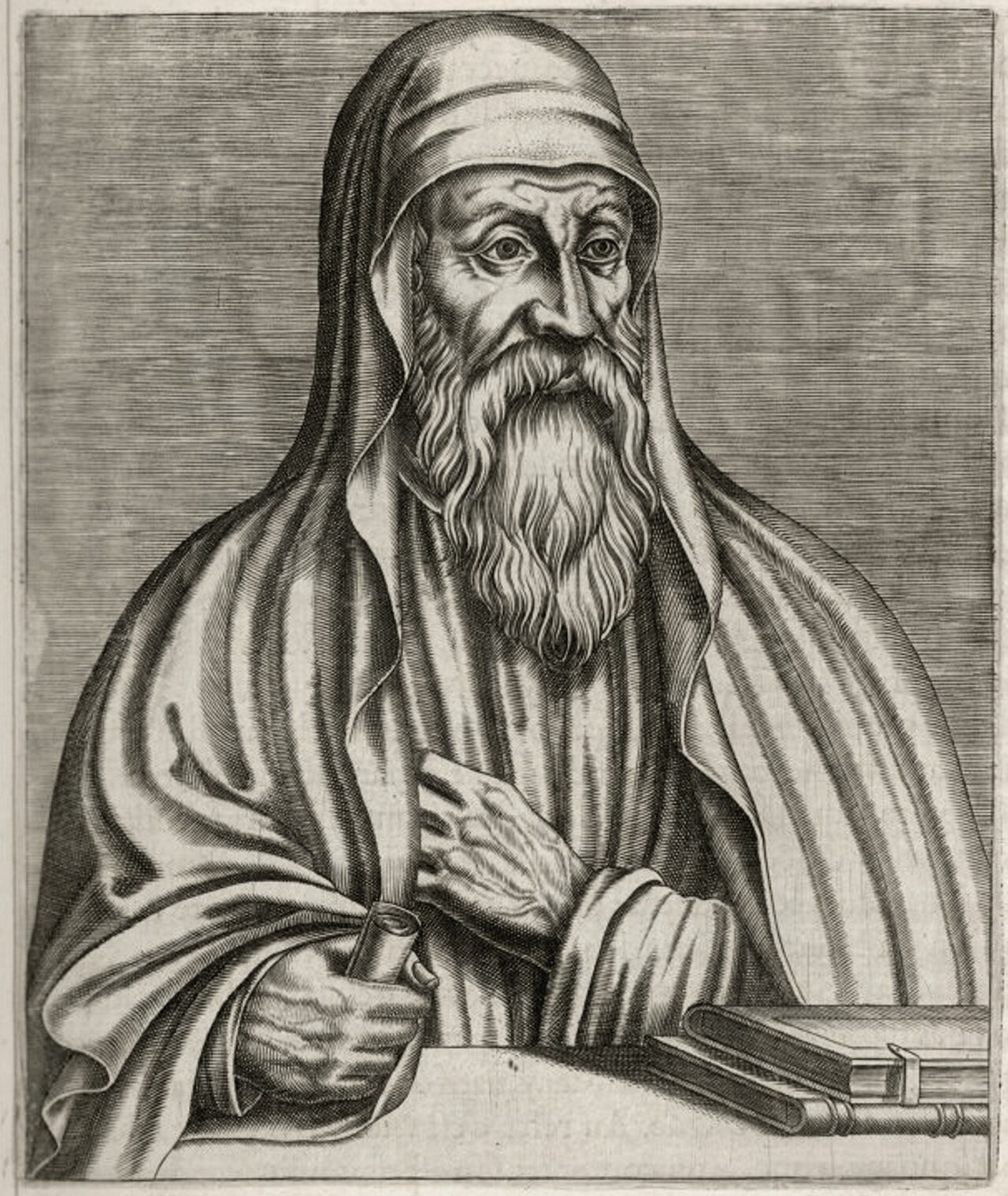
Origen
Dates: c. 185–c. 253 Domain: Christian Theology, Biblical Interpretation, Neoplatonism
Biography
Origen was born in Alexandria around 185 CE, probably to a Christian family — his father Leonidas was martyred under Septimius Severus in 202, and the young Origen reportedly had to be physically restrained from presenting himself for martyrdom alongside him. He studied at the Catechetical School of Alexandria under Clement, took over its direction around 203, and spent years in prodigious textual and theological labor: he produced the Hexapla (a six-column comparison of Hebrew and Greek biblical texts), wrote commentaries on most of the books of the Bible, and developed a theological system of extraordinary scope and Platonic depth.
De Principiis (c. 220–230) is his systematic theological work: a four-book treatment of God, the rational creatures (souls and angels), the world, and Scripture. Its philosophical framework is explicitly Platonic: God is the One from which everything proceeds; the Logos is the second hypostasis through which the world is created; souls pre-existed their current embodied condition and fell into matter through a cooling of their original ardor. The doctrine of apocatastasis: the final restoration of all things, including ultimately all rational souls (and possibly even the devil) to their original condition in God — follows logically from this framework: if souls descended from God, they must ultimately return to God, and the process is potentially universal.
This made him controversial from the start. He was condemned posthumously at the Second Council of Constantinople in 553, well after a century of debate, and his works survive largely in Latin translations by Rufinus that softened the most provocative passages.
Key Works (in library)
| Work | Year | Relevance |
|---|---|---|
| De Principiis | c. 220–230 | Systematic Platonic-Christian theology; apocatastasis, pre-existence of souls |
| Commentary on the Song of Songs | c. 240 | Allegorical mystical interpretation; the Song as the soul's ascent to God |
| Against Celsus | c. 248 | Defense of Christianity against Platonic criticism; reveals the synthesis's tensions |
Role in the Project
The Underground Stream track needs Origen to establish that the synthesis of Platonic philosophy with Christian theology was attempted seriously and competently within the Christian tradition — and that the attempt was suppressed. The condemnation of his most characteristic doctrines (pre-existence of souls, apocatastasis, the subordination of Christ to the Father) marks the institutional closure of the space in which that synthesis operated. What survives afterward — Pseudo-Dionysius's apophatic theology, Eriugena's Neoplatonism, Eckhart's Rhineland mysticism — is the underground stream that Origen's condemned synthesis fed.
Key Ideas
- Apocatastasis: The final restoration of all things to their origin in God. Not a sequential eschatology but a cyclical one: all souls descend, all souls ultimately return. The project engages this doctrine as the most radical Christian universalism.
- Pre-existence of Souls: Souls existed before their embodied condition as rational beings (logikoi); their entry into bodies was a fall caused by the cooling of their original ardor for God. This is Platonism with a Christian gloss.
- Allegorical Scripture: Origen's method of biblical interpretation — historical, moral, and spiritual (anagogical) senses layered within the same text — is the hermeneutic that allows him to read the Song of Songs as the soul's mystical ascent.
Connections
- Platonic synthesis: FIG-0005 Plotinus (roughly contemporary; both working in Alexandria's intellectual milieu), FIG-0034 Plato (the framework Origen adapts)
- Underground stream: FIG-0010 Pseudo-Dionysius (the apophatic tradition that descends from Origen through Neoplatonism), FIG-0040 Eckhart (Rhineland mysticism as the medieval heir of this current)
Agent Research Notes
[AGENT: perplexity | DATE: 2026-03-22] Origen was condemned at the Second Council of Constantinople (Fifth Ecumenical Council) in 553, though the anathemas may have been directed at Origenism rather than Origen himself — a distinction scholars still debate. He reportedly castrated himself in literal fulfillment of Matthew 19:12, though Eusebius reported this and its accuracy is disputed. He died around 253–254, possibly as a consequence of imprisonment and torture under Decius. Joseph Trigg's Origen (1998) is a good modern scholarly introduction.