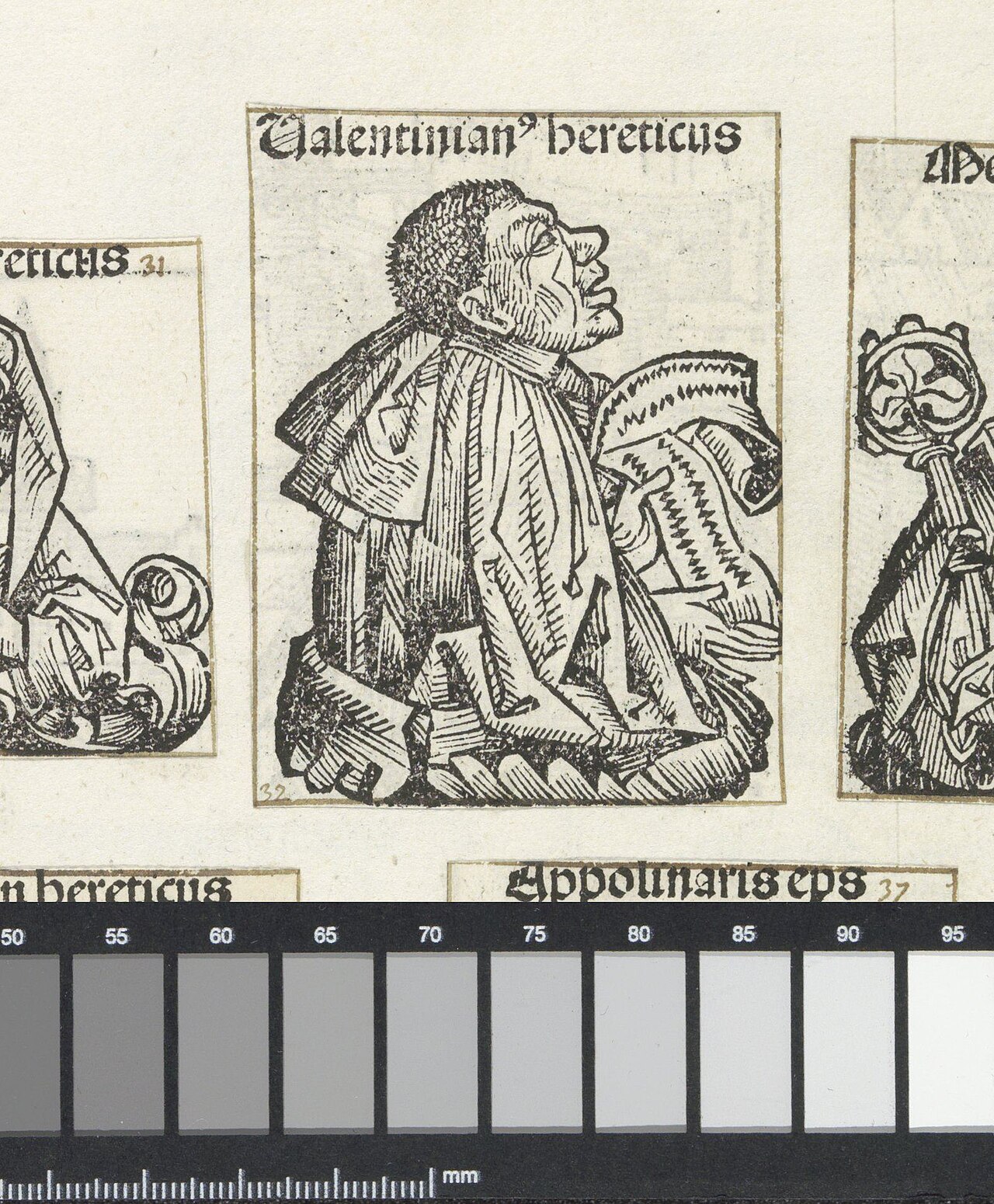
Valentinus
Dates: c. 100–c. 160 Domain: Gnostic Theology, Christian Philosophy, Mystical Epistemology
Biography
Valentinus was born in Alexandria around 100 CE, received his education in that city's extraordinary intellectual environment (Platonic philosophy, Jewish scriptural exegesis, and early Christian theology all in dynamic proximity), and traveled to Rome, where he became the most prominent Gnostic teacher of the second century and reportedly came close to being elected bishop. His school produced a lineage of systematic thinkers, Ptolemy, Heracleon, Theodotus, whose works survive in Clement's Stromateis and Origen's commentaries, and the Gospel of Truth (Nag Hammadi Codex I) is almost certainly his, though the attribution is not certain.
The Valentinian system is the most elaborate and philosophically sophisticated Gnostic cosmology. The Pleroma, the divine fullness, is a hierarchy of divine emanations (aeons) including pairs (syzygies) such as Depth and Silence, Mind and Truth, Word and Life. The crisis arises when Sophia (Wisdom), the last and youngest aeon, attempts to comprehend the incomprehensible Father without her consort — an act of epistemological hubris whose product is a defective intention (enthymesis) that falls out of the Pleroma and becomes, eventually, the Demiurge: the craftsman-god who shapes the material world in ignorance of the higher realities that he is below. The material world is not created by the true God but by a lesser, ignorant deity — and within the human creature, a divine spark (the pneuma) is trapped, awaiting the gnosis that will recognize its true origin and enable its return.
Key Works (in library)
| Work | Year | Relevance |
|---|---|---|
| Gospel of Truth | c. 140–180 | Attributed to Valentinus; the experience of receiving gnosis as homecoming |
| Valentinian System (reconstructed) | c. 150–200 | Pleroma, Sophia's fall, Demiurge — the complete cosmological architecture |
Role in the Project
Valentinus provides the Ancient World track with the Gnostic answer to the central theodicy question: if the divine is real and good, why is the world as it is? The Valentinian answer — because the world was made by a lesser, ignorant deity — is philosophically consistent and experientially grounded in the Gnostic community's practice of gnosis as the recognition of one's true origin. Whether this answer is satisfying is the project's open question; what is not in question is that it is serious.
Key Ideas
- Pleroma and Kenoma: The divine fullness and the material void — the two poles of Valentinian cosmology. The soul falls from Pleroma into Kenoma and is restored through gnosis.
- Sophia's Fall: The act of unauthorized epistemological ambition that produced the material world. Not evil but ignorant — Sophia wanted to know what only the Father can know, and the product of this wanting became the world.
- The Demiurge: The craftsman-god who created the material world in ignorance of the higher realities. Not evil but limited. The world he created is not evil but impoverished.
- The Divine Spark: The pneuma within the human — the fragment of divine fullness that fell into matter and that gnosis activates and restores to its source.
Connections
- Gnostic tradition: FIG-0046 Dick (the VALIS experience as a twentieth-century encounter with the same Gnostic cosmology), FIG-0044 Couliano (scholarly analysis of the Gnostic imagination as a cognitive technology)
- Neoplatonic parallels: FIG-0005 Plotinus (the Plotinian hypostases as the non-Gnostic response to the same Alexandrian cosmological questions), FIG-0093 Origen (the Christian Platonist response)
- CON-0009 Gnosis (the concept entry of which Valentinus is the primary ancient exemplar)
Agent Research Notes
[AGENT: perplexity | DATE: 2026-03-22] The Gospel of Truth was identified among the Nag Hammadi texts (discovered 1945) by Gilles Quispel in 1956. Irenaeus's Against Heresies (c. 180 CE) is the primary hostile source for Valentinian doctrine. Elaine Pagels' The Gnostic Gospels (1979) remains the most accessible scholarly introduction. Michael Williams' Rethinking Gnosticism (1996) provides the revisionary scholarly framework.