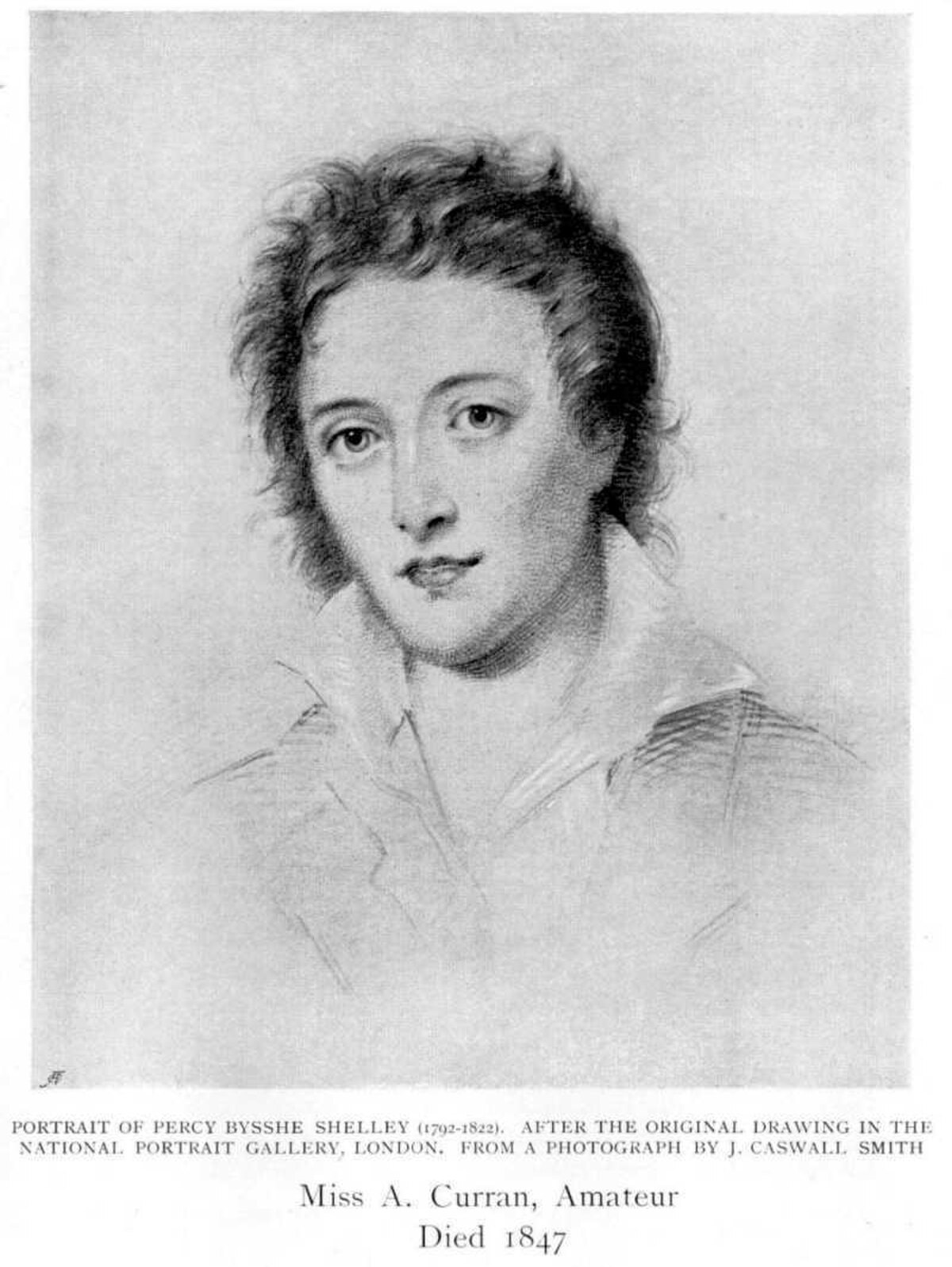
Percy Bysshe Shelley
Dates: 1792–1822 Domain: Poetry, Romanticism, Political Philosophy, Platonic Philosophy
Biography
Percy Bysshe Shelley was born in 1792 at Field Place, Sussex, into a wealthy landed family. He was expelled from Oxford in 1811 for co-writing The Necessity of Atheism and sending it to all the college heads; he eloped with sixteen-year-old Harriet Westbrook almost immediately afterward; his subsequent career was a sequence of departures — from England, from Harriet (who drowned herself in the Serpentine in 1816), from conventional behavior, from conventional thought — until he drowned in a storm in the Bay of Spezia on July 8, 1822, four months short of his thirtieth birthday, his unfinished poem The Triumph of Life on his desk.
His radicalism was not primarily political in the conventional sense, though he held political views (democracy, vegetarianism, atheism, free love) that scandalized his contemporaries. It was epistemological: he believed that the imagination — not empirical observation and not religious faith — was the faculty through which human beings accessed the real. This position, derived partly from Platonic philosophy (he was a serious student of Plato, reading him in Greek) and partly from his own phenomenological experience of composition, is his central contribution to the project.
Prometheus Unbound (1820) is his lyrical drama of the Promethean liberation, and it is the opposite of Aeschylus's version, from which it departs deliberately. In Shelley's version, Prometheus does not compromise with Zeus; he waits out the cycle of time in suffering until Jupiter's own internal logic dissolves his tyranny from within. The liberation is not a heroic act but a refusal — Prometheus refuses the curse he laid on Jupiter at the beginning of the drama, and in that refusal, the tyranny loses its grip. This is initiatic logic: the oppressive structure collapses not because it is overcome but because the consciousness that sustained it withdraws its support.
A Defence of Poetry (written 1821, published 1840) is Shelley's manifesto for the imagination as the primary human cognitive faculty. The argument moves from the observation that poetry is the expression of the imagination to the claim that the imagination is the faculty through which we recognize our identity with others and with the world — that it is, in other words, the faculty of participation. Reason classifies and separates; imagination synthesizes and connects. The poets are therefore the unacknowledged legislators of the world, not because they hold power but because they shape the forms within which human life becomes meaningful.
The Triumph of Life, the unfinished poem written in the months before his death, is his darkest and most complex work: a vision of the triumphal procession of Life (conceived as an enslaving force, not a vital one) dragging all human greatness behind its chariot, with only Rousseau offering fragmentary testimony about what he saw before the light took him. It is a katabasis without a guide, a vision without a resolution — and its unfinishedness is structurally expressive of what it describes.
Key Works (in library)
| Work | Year | Relevance |
|---|---|---|
| Prometheus Unbound | 1820 | The Promethean liberation through refusal; initiatic patience over heroic action |
| A Defence of Poetry | 1840 (written 1821) | The imagination as primary cognitive faculty; poets as unacknowledged legislators |
| Ode to the West Wind | 1819 | The poet's self-dissolution and rebirth through elemental force |
| The Triumph of Life | 1822 (unfinished) | Katabasis without resolution; the procession of Life as enslaving force |
Role in the Project
Shelley is the Romantic Initiates track's most explicitly political figure — the one who draws the connection between initiatic liberation and social transformation with the greatest force. His argument in A Defence of Poetry that the imagination is the faculty that enables the recognition of our common humanity is the Romantic tradition's closest approach to what Turner calls communitas: the dissolution of social hierarchy into direct person-to-person recognition. For Shelley, this is not a mystical state but the basic operation of good poetry on its reader.
His Platonic commitments make him the track's bridge between the Romantic movement and the ancient tradition: he read Plato seriously, translated the Symposium, and believed that Plato's account of the soul's ascent through beauty toward the good described something real about human consciousness. The Defence of Poetry's argument is Platonic in structure, filtered through Shelley's radical politics and his phenomenology of composition.
Key Ideas
- Imagination as Primary Faculty: Shelley's central claim — that the imagination, not reason or empirical observation, is the faculty through which we access what is most real and most good. Reason is the instrument of analysis; imagination is the instrument of synthesis, recognition, and participation.
- Prometheus as Refusal: Shelley's Prometheus does not fight the gods; he refuses to compromise and waits for the inner logic of tyranny to dissolve. Liberation comes not from heroic action but from the withdrawal of the consciousness that sustained oppression.
- Poets as Legislators: Not politicians, not priests, but poets — those who shape the forms within which human life becomes meaningful — are the actual legislators of the world, though unacknowledged. This is a political claim with initiatic implications.
- The Wind as Initiatory Force: Ode to the West Wind stages the poet's request to be taken up as a leaf, a cloud, a wave — dissolved into the elemental force and scattered as seeds of new life. Death and rebirth as elemental participation.
Connections
- Romantic Initiates track: FIG-0077 Keats (different modes of poetic knowledge), FIG-0090 Coleridge (Coleridge's philosophical idealism and Shelley's Platonism are parallel projects)
- Promethean lineage: FIG-0023 Blake (Blake's Los as parallel Promethean figure), FIG-0022 Goethe (Faust as another version of the figure who refuses divine limits)
- Platonic foundation: FIG-0034 Plato (Symposium and the ascent through beauty; Shelley translated it), CON-0004 Participation (the Defence of Poetry as argument for participatory imagination)
Agent Research Notes
[AGENT: perplexity | DATE: 2026-03-22] Shelley's translation of Plato's Symposium was completed in 1818 but not published until 1840. His expulsion from Oxford for The Necessity of Atheism (co-authored with Thomas Jefferson Hogg) is documented in university records. He drowned on July 8, 1822 in a storm off Livorno; his body was cremated on the beach with Byron and Leigh Hunt present. Richard Holmes's two-volume biography (Shelley: The Pursuit, 1974; Shelley: The Man Who Could Have Changed the World, never completed) is the standard modern life. The manuscript of The Triumph of Life was found on his desk after his death.