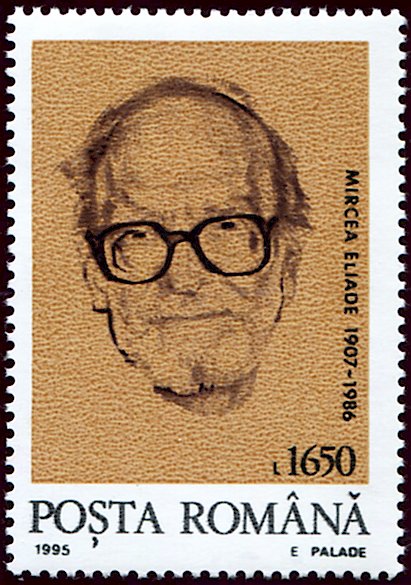
Mircea Eliade
Dates: 1907–1986 Domain: History of Religions, Comparative Mythology
Biography
Mircea Eliade was born in Bucharest, Romania, in 1907 and went on to become one of the most influential and controversial scholars of religion in the twentieth century. After formative years studying Sanskrit and Indian philosophy at Calcutta under Surendranath Dasgupta (1928–1932), he returned to Romania to complete a doctorate on Yoga. During the 1930s and 1940s, Eliade pursued a dual career as a novelist and scholar while entangled in the political turbulence of interwar Romania, associations that would later attract sustained critical scrutiny. After the war, he moved to Paris, where he taught at the École Pratique des Hautes Études, before being appointed to the University of Chicago in 1956, where he remained until his death in 1986. He served as the founding editor of the Encyclopedia of Religion (1987), the standard reference work in the field.
Eliade's central theoretical contribution was his phenomenology of the sacred. Drawing on an enormous cross-cultural archive, he argued that religious experience everywhere is structured by the encounter between the sacred and the profane: two modes of being in the world that are qualitatively incommensurable. The sacred manifests through hierophanies (manifestations of something wholly other that breaks into ordinary space and time), and religious behavior is characterized by what Eliade called the eternal return: the ritual re-enactment of primordial, mythic events that restores contact with sacred origins. His morphological method traced structural parallels across vastly different cultures and historical periods, finding the same death-and-rebirth schema in Siberian shamanic initiation, Australian puberty rites, and Hellenistic mystery religions alike.
His most important works for the Mystery Schools project are Rites and Symbols of Initiation (1958), in which he synthesized the universal morphology of initiation (separation, ordeal, symbolic death, and rebirth into a new mode of being), and Shamanism: Archaic Techniques of Ecstasy (1951), which established the shaman as the specialist of altered states and the archetype of the initiated guide. The Sacred and the Profane (1957) provides his most accessible theoretical synthesis, while the three-volume A History of Religious Ideas (1978–1983) demonstrates his synthetic scope across the full range of world religions.
Eliade's work did not escape serious criticism. Post-colonial scholars questioned his uncritical universalism and the erasure of specific cultural context. Others noted his romanticization of archaic religion and a tendency to privilege the "primitive" as spiritually superior to modernity. Most substantially his structuralism has been criticized for importing Western categories onto non-Western materials and for subordinating historical particularity to a timeless morphological schema. These critiques are not dismissed but productively engaged: Eliade's patterns are real and useful as heuristics, but they require supplementation by historical context and by a philosophy of consciousness evolution (supplied by Barfield and Gebser) that Eliade himself lacked.
Key Works (in library)
| Work | Year | Relevance |
|---|---|---|
| Rites and Symbols of Initiation | 1958 | Core morphology of initiation for project framework (LIB-0293) |
| A History of Religious Ideas, Vol. 1 | 1978 | Broad historical context from Stone Age to Eleusinian Mysteries (LIB-0290) |
| A History of Religious Ideas, Vol. 2 | 1982 | From Gautama Buddha through rise of Christianity (LIB-0291) |
| A History of Religious Ideas, Vol. 3 | 1983 | From Muhammad to the Reformation (LIB-0292) |
Note: Shamanism: Archaic Techniques of Ecstasy and The Sacred and the Profane do not appear to be in the current library index (LIB-0001–0329) and may be candidates for addition.
Role in the Project
Eliade is the unavoidable starting point for any comparative study of initiation. The project draws heavily on his morphological schema (the death-and-rebirth pattern, the role of the initiatory ordeal, the axis mundi, the hierophany) as descriptive tools for mapping what mystery traditions share. LIB-0293 matters here because it is his most concentrated statement of that morphology, and therefore the clearest place to learn both his strength and his limit.
At the same time, the project treats his structuralism as a methodological first step that must be overcome. Eliade maps the forms of initiation cross-culturally but cannot account for why those forms vary historically, or why consciousness itself might be undergoing transformation. Here the project pivots to Barfield (for a developmental account of participation) and Gebser (for a structural account of consciousness mutation) to supply what Eliade's morphology cannot: a theory of the direction of initiatory experience through history. He remains indispensable as a comparer of patterns, but insufficient as a final historian of difference.
Key Ideas
- Hierophany: Any manifestation of the sacred in the profane world; the stone, the tree, the ritual space all become carriers of ontologically different reality.
- Sacred/Profane dichotomy: The two fundamental modes of being in the world; religious man lives in a sacralized cosmos, modern man in a desacralized one.
- Eternal Return: The ritual repetition of primordial sacred events that abolishes profane time and restores mythic time of origins.
- Initiation morphology: Death-and-rebirth schema as the universal structure underlying all initiatory rites, from puberty ceremonies to mystery school admissions.
- Axis mundi: The cosmic pillar or world-center that connects the three levels (underworld, earth, and heaven) across which shamans and initiates travel.
- Homo religiosus: The archetype of religious man, for whom the sacred is an irreducible dimension of experience irreducible to any social, psychological, or economic explanation.
Connections
- Influenced by: Rudolf Otto (the numinous), James George Frazer, Marcel Mauss, Wilhelm Schmidt
- Influenced: Jonathan Z. Smith (critically), Wendy Doniger, FIG-0006 (Tarnas, as background framework)
- In tension with: FIG-0002 (Barfield; Eliade lacks developmental/evolutionary account of consciousness), FIG-0003 (Gebser; Eliade collapses temporal structures of consciousness that Gebser distinguishes)
Rites and Symbols of Initiation: The Initiatory Morphology
Rites and Symbols of Initiation (1958, translated from the French Naissances mystiques) is Eliade's most concentrated treatment of initiation as a cross-cultural structure. The book identifies three fundamental types of initiation — puberty rites, admission to secret societies, and mystical-shamanic vocation — and argues that all three share the same morphological core: separation from the profane world, ordeal (often involving symbolic death), and reintegration in a transformed status. The project draws on this morphology as a scaffolding while resisting its tendency toward structural uniformity. Where Eliade sees convergence, the project also attends to divergence: the specific content of what the Eleusinian epoptes saw, for instance, cannot be derived from the cross-cultural pattern alone, and the attempt to do so flattens the very particularity that makes historical inquiry necessary.
Agent Research Notes
[AGENT: cursor | DATE: 2026-03-21] Assigned thematic image IMG-0023 as imagery.primary. No portrait available in corpus. Portrait acquisition needed.
[AGENT: perplexity | DATE: 2026-03-20] Eliade's work is thoroughly documented in the library under LIB-0290 through LIB-0293. Shamanism (1951) and The Sacred and the Profane (1957) are not present in the library index and should be flagged as priority acquisitions. Eliade's political entanglements (association with the Romanian Iron Guard in the 1930s) are well-documented and occasionally surface in academic critiques of his work; the project may wish to have a position on this. His contribution to the concept of the hierophant (see CON-0010) is directly relevant. His dates are sometimes cited as 1907–1986; he was born March 9, 1907 in Bucharest and died April 22, 1986 in Chicago.
[AGENT: cursor | DATE: 2026-03-25]
Sharpened the role section so Eliade's contribution is anchored more explicitly in LIB-0293 and framed as necessary morphology rather than final explanation.