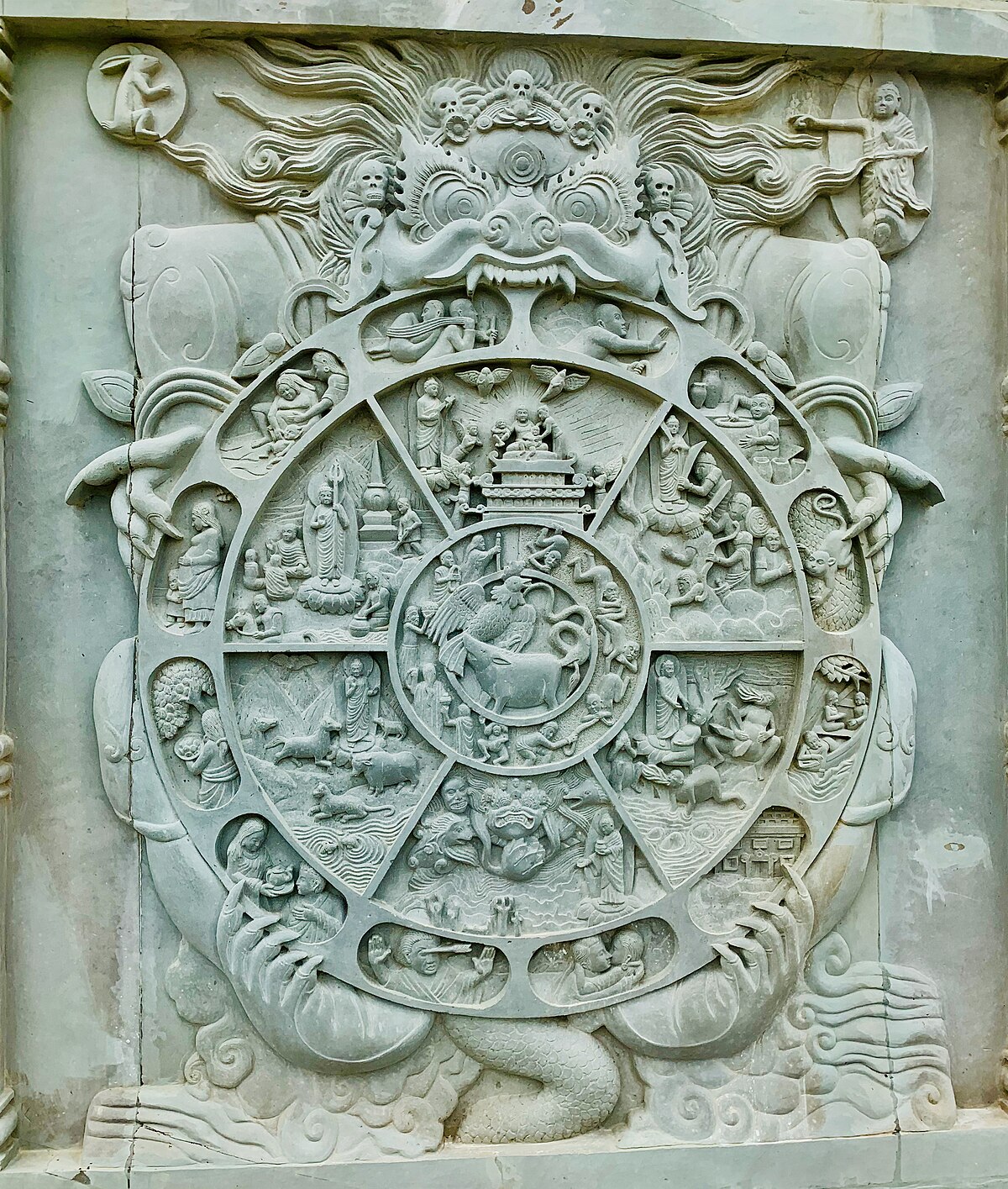
Samsara
Definition
Samsara (Sanskrit: saṃsāra, "wandering through") designates the cycle of conditioned existence — the ceaseless round of birth, aging, death, and rebirth driven by karma (action and its fruits) and klesha (the mental afflictions: craving, aversion, and ignorance). The term appears across the Hindu, Buddhist, and Jain traditions and carries a broadly shared structural meaning: conscious beings are bound to repeated existence in various states or planes, with the specific circumstances of each life determined by the accumulated effects of actions in prior lives. What varies significantly across traditions is the metaphysical account of what transmigrates, the mechanism of karmic causality, the number and nature of the planes of rebirth, and above all the nature of liberation from the cycle.
In the Upanishads and subsequent Hindu Vedantic thought, samsara is the condition of the jiva (individual soul) that has forgotten its identity with Brahman (the absolute ground of being) and is caught in the cycle through avidya (ignorance) and the resultant attachment. Liberation (moksha) is the recognition, not an achievement but a recognition, that the jiva was never truly bound; the cycle was always a movement within maya, the creative power of misperception. In Advaita Vedanta as Shankara articulated it, samsara has no ultimate reality; the apparent multiplicity of rebirths is itself part of the cosmic dream from which jiva awakens into the recognition of its identity with Atman-Brahman.
Buddhist analysis of samsara proceeds from different metaphysical premises. The Buddha's teaching, as presented in the Pali Canon and elaborated in later Abhidharma analysis, identifies samsara as the condition generated by the three roots of suffering — lobha (greed), dosa (hatred), and moha (delusion) — and specifically by tanha (craving) as the proximate cause of continued rebirth. The Buddhist account denies a substantial self that transmigrates: what continues is not a soul but a continuity of consciousness shaped by karma, comparable to a flame that lights another flame before extinguishing. Liberation (nirvana) is the cessation of the conditions that generate rebirth — not reunion with an absolute but the unconditioned that lies beyond the conditioned cycle.
Jain analysis adds a third framework. In Jainism, the jiva (soul) is a real, individual substance that accumulates karma as a form of subtle matter adhering to the soul through its actions. Samsara is the soul's condition of embodiment under the weight of accumulated karmic matter. Liberation (moksha) involves the complete cessation of new karma and the gradual exhaustion of accumulated karma through tapas (austerity) and ahimsa (non-harming). The liberated soul (siddha) rises to the apex of the universe, free from all karmic matter. The Jain account differs from both Hindu and Buddhist framings in treating karma as a quasi-material substance rather than a causal law, and in positing a plurality of genuinely individual liberated souls rather than absorption into an absolute.
Historical Development
The earliest Vedic literature (the Rigveda, the Atharvaveda) does not contain a systematic doctrine of rebirth; the Vedic afterlife is largely a matter of reaching the domain of the ancestors or of the gods. The samsara concept emerges in the Upanishads, most clearly in the Brihadaranyaka and Chandogya Upanishads (approximately 8th-6th centuries BCE), where the doctrine of karma and rebirth is presented as esoteric knowledge shared selectively — it was not for general broadcast. The Katha Upanishad's encounter between the young Nachiketa and Yama (Death) explores the distinction between the soul's true nature and its apparent subjection to the cycle, establishing the fundamental Vedantic framing: the soul is not truly in bondage; bondage is a condition of ignorance.
Buddhism's engagement with the samsara concept (5th-4th century BCE) took the doctrine of karma and rebirth from the surrounding Hindu milieu but reframed it through the no-self analysis. The Buddha is represented in the Pali Canon as refusing certain metaphysical questions about the cycle — whether it has a beginning, whether the world is eternal — as unskillful rather than answerable. What matters is the diagnosis of suffering and the path to its cessation. The detailed Abhidharma cosmology that elaborated the planes of rebirth, the specific mechanisms of karmic causality, and the phenomenology of consciousness at death and rebirth came in later centuries as a systematic elaboration of the original teaching.
The Mahayana development introduced a complication into the straightforward samsara-vs-nirvana binary. The Prajnaparamita literature and the philosophy of Nagarjuna (2nd century CE) introduced the teaching of the identity of samsara and nirvana from the standpoint of ultimate reality (paramartha satya). The famous lines from the Heart Sutra, "form is emptiness, emptiness is form", point toward a non-dual understanding in which the cycle and liberation are not two separate territories but two perspectives on a single reality. This does not dissolve the practical distinction (suffering beings still require liberation), but it shifts the metaphysical relationship between the cycle and what lies beyond it.
The transmission of the rebirth doctrine to ancient Greece — which several scholars have argued occurred through Pythagoras and possibly through contact with Indian thought — produced its own version of the cycle in the Orphic-Pythagorean-Platonic tradition: the kyklos tēs geneseōs (circle of generation) from which initiation and philosophy offer liberation. The parallel to samsara is real. Whether it reflects historical contact or independent development from similar observations about consciousness remains debated.
Key Distinctions
Samsara vs. Eternal Return: Eliade's eternal return designates the sacred pattern of cosmic and ritual repetition — the liturgical re-enactment of the first time, the in illo tempore that gives profane time its meaning by pointing to sacred time. The cosmological cycle is the structure within which human existence finds its orientation. Samsara designates a cycle that generates suffering and from which conscious beings seek escape. The same structure, cyclical time, carries opposite valences: sacred orientation versus imprisonment. This reversal is structural, not incidental, and it marks a fundamental difference in how each tradition relates human existence to time.
Samsara in Hinduism vs. Buddhism: The Hindu framing assumes a real individual soul (jiva, atman) that transmigrates and ultimately recognizes its identity with the absolute. The Buddhist framing denies the substantial self: no atman migrates; a continuity of conditioned consciousness reproduces itself through karma. Liberation in the Hindu framing is recognition of the self's true nature; liberation in the Buddhist framing is the cessation of the conditions that produce a self at all. These are not two descriptions of the same process.
Samsara vs. The Hardening: Steiner and Barfield's concept of "the hardening" describes a progressive congealment of consciousness away from participatory openness into rigid subject-object separation — a historical process, not an individual's karmic trajectory. Samsara describes an individual consciousness's entrapment in a cycle driven by its own karmic momentum. Both diagnose a problematic condition of consciousness, but the level of analysis, the mechanism, and the proposed remedy differ entirely.
Project Role
Samsara gives the project its sharpest case study in how traditions that share structural features — cyclical time, consciousness entrapment, liberation as a goal — differ irreducibly at the metaphysical level. The project cannot say "samsara and the hardening are the same thing" without falsifying both. It can say: both diagnose a condition in which consciousness is not fully itself, and both propose practices aimed at recovering what consciousness actually is. The gap between the two diagnoses — what the condition is, what causes it, what liberation looks like — is as informative as the parallel.
The concept also serves as the necessary context for understanding nirvana (CON-0058) and dependent origination (CON-0059): neither concept is legible without understanding the cycle they respond to.
Primary Sources
- The Brihadaranyaka Upanishad (c. 8th-6th century BCE): Contains the earliest systematic exposition of karma and rebirth in Hindu thought, attributed to Yajnavalkya.
- Dhammapada and Majjhima Nikaya: The Pali Canon's most direct presentations of the Buddha's analysis of conditioned existence and the path to its cessation.
- Nagarjuna, Mulamadhyamakakarika (c. 2nd century CE): Chapter 25 explicitly addresses the identity of samsara and nirvana from the standpoint of sunyata.
- Shankara, Vivekachudamani (Crest-Jewel of Discrimination): The most accessible Advaita Vedanta treatment of the soul's apparent bondage and its liberation through jnana (knowledge).
Agent Research Notes
[AGENT: perplexity | DATE: 2026-03-22] The historical question of whether the doctrine of karma and rebirth was imported into Buddhism from Hinduism or developed independently is actively debated. Johannes Bronkhorst's Greater Magadha (2007) argues that the karma-rebirth complex originated in the shramana (renunciant) movements of Greater Magadha rather than in Vedic Brahmanism — a revisionary thesis that bears on understanding Buddhism's relationship to the Hindu tradition it is usually presented as inheriting from. The project should note this scholarly complexity rather than assuming a simple Hinduism-to-Buddhism transmission.