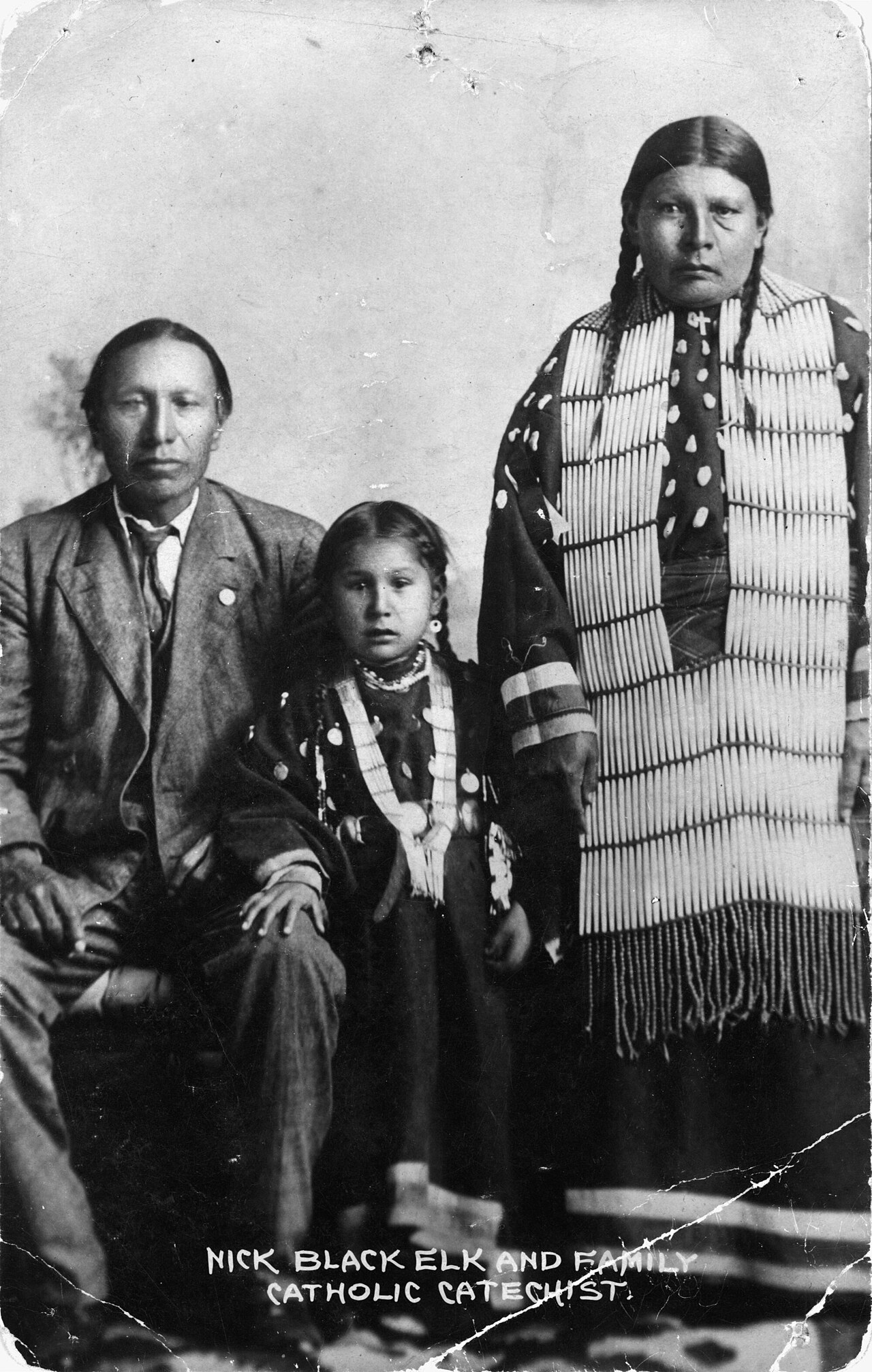
Black Elk
Dates: 1863–1950 Domain: Oglala Lakota Spiritual Leadership, Visionary Experience, Ceremony
Biography
Black Elk, Heȟáka Sápa, was born in 1863 on the Little Powder River and was nine years old when he fell gravely ill and received the vision that would define the rest of his life. During the illness, which lasted twelve days and was understood by his people as a visionary journey, he was taken to the cloud world of the Six Grandfathers, the great powers of the cosmos, and given a vision of the tree of life, the sacred hoop of his people, and a task: to restore the hoop that was breaking. He returned to his body not knowing whether he had dreamed or actually traveled, in great distress, and found that the sickness had left him. He did not tell anyone the full content of his vision for years, carrying it privately while his world collapsed around him: the Battle of the Little Bighorn (1876, which he fought in as a young warrior), the assassination of Crazy Horse (1877), the Ghost Dance movement (1890), and the Wounded Knee Massacre (December 29, 1890), which he witnessed.
John G. Neihardt, a poet from Nebraska who had been researching Plains Indian life, came to Pine Ridge in 1930 specifically to interview Black Elk. The conversations they conducted, with his son Ben Black Elk translating, became Black Elk Speaks (1932). The book is a transcription of oral narrative, edited and shaped by Neihardt, and the question of how much editorial transformation occurred is a live scholarly debate. What is not debated is that the voice that comes through is of extraordinary force: an old man describing a lifetime spent in the shadow of a vision too large to fulfill, in a world that had been systematically dismantled before he could attempt the fulfillment.
In the 1940s, Black Elk spoke with Joseph Epes Brown, a Traditionalist-influenced scholar who recorded the seven sacred rites of the Oglala Lakota in The Sacred Pipe (1953). This account is more ceremonially focused than Black Elk Speaks: where the Neihardt book is personal autobiography and visionary narrative, the Brown book is systematic exposition of ritual structure. Together they provide both the phenomenological and the ceremonial dimensions of Lakota spiritual life. Black Elk converted to Roman Catholicism and was baptized Nicholas Black Elk in 1904; he served as a catechist and was reportedly active in spreading Catholic Christianity on the reservation. This Catholic period has complicated his reception, and scholars continue to debate whether his traditional teachings and his Catholic commitment were in tension or integrated.
Key Works (in library)
| Work | Year | Relevance |
|---|---|---|
| Black Elk Speaks | 1932 | The Great Vision and its failed fulfillment; autobiography as initiatory narrative |
| The Sacred Pipe | 1953 | Seven sacred rites of the Oglala Lakota; ceremonial structure and meaning |
Role in the Project
The Living Traditions series requires a figure who demonstrates that the initiatic structure is not historical but contemporary — that vision quests are occurring now (or were occurring within living memory), that the results of genuine initiatory experience are not confined to antiquity, and that the transformative knowledge the Mysteries cultivated has not disappeared from human cultures even if it has largely disappeared from the cultures the project tracks most closely.
Black Elk provides this demonstration in a form that is uniquely powerful because it is simultaneously a record of successful visionary reception and a record of incomplete fulfillment. The Great Vision was received; the task it set could not be accomplished. This is not a failure of technique but a testimony to the conditions that make genuine initiatic work possible: conditions that require a living community, an intact cosmological framework, and a world that is not in the process of being systematically destroyed. Black Elk's grief maps the territory of loss that the project's entire inquiry inhabits.
Key Ideas
- The Great Vision: Received at age nine during a near-death illness; a complex cosmological vision of the tree of life, the sacred hoop, and a task that Black Elk spent his life attempting to fulfill. The vision was not chosen but imposed.
- The Hoop and the Tree: The sacred hoop is Black Elk's central image for the wholeness of his people and, by extension, of all peoples — a circle that, when intact, shelters all life at the world tree's center. Its breaking is not metaphorical but actual: Wounded Knee is the hoop breaking.
- Vision Quest (Hanbleciya): The Lakota practice of going alone to a high place without food or water for four days and nights, seeking a vision through endurance, prayer, and openness. The hanbleciya is the individual initiatory practice from which Black Elk's Great Vision was the most extreme departure: the vision came unsought, during illness, and on a cosmic rather than personal scale.
- The Problem of Transmission: Black Elk received a vision that could not be transmitted without the conditions that made it meaningful — the living community, the intact ceremony, the world the vision was meant to heal. This is the project's exemplary case of the loss that occurs when initiatic conditions dissolve.
Connections
- Living Traditions track: FIG-0101 Maya Deren (another figure who received a tradition without being born into it and documented it from the inside)
- Initiatic structure: FIG-0065 Van Gennep, FIG-0069 Turner (the hanbleciya as paradigmatic rite of passage)
- The question of transmission: CON-0001 Initiation (the conditions under which transmission is possible vs. impossible)
- Scholarly framework: FIG-0001 Eliade (Shamanism: Archaic Techniques of Ecstasy is the comparative framework for Black Elk's kind of visionary experience)
Agent Research Notes
[AGENT: perplexity | DATE: 2026-03-22] Black Elk died August 19, 1950. The debate about Neihardt's editorial role is addressed in Clyde Holler's Black Elk's Religion: The Sun Dance and Lakota Catholicism (1995) and Raymond DeMallie's The Sixth Grandfather: Black Elk's Teachings Given to John G. Neihardt (1984), which publishes the stenographic notes from the original 1930–1931 interviews. The tension between Black Elk's Catholic period and his traditional teachings is treated sympathetically in DeMallie's introduction. Joseph Epes Brown had connections to Frithjof Schuon and the Traditionalist school; this inflects his framing of The Sacred Pipe in ways the project should acknowledge.