Vajrayana
Definition
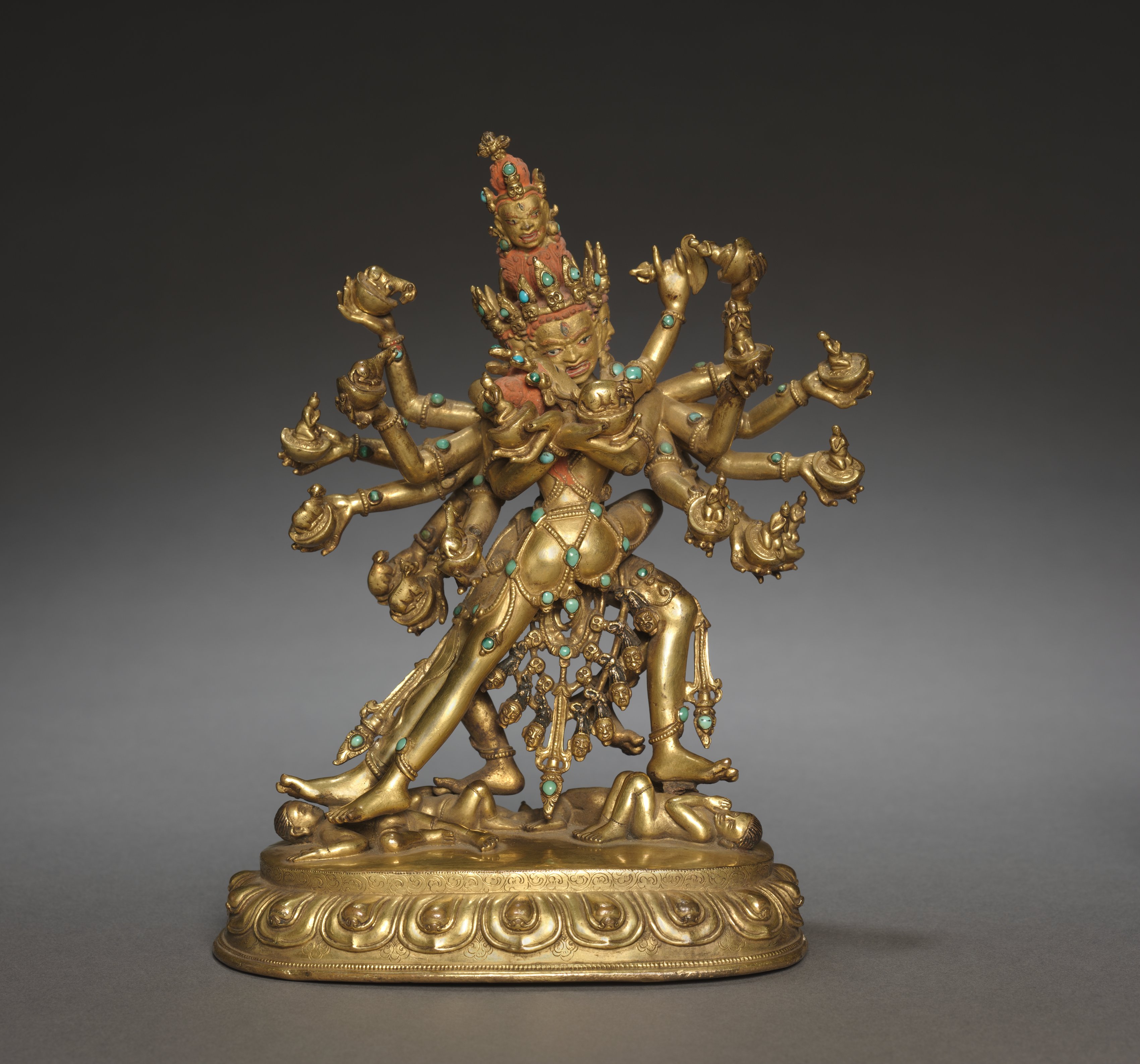
Vajrayana (Sanskrit: "diamond vehicle" or "thunderbolt vehicle") designates the tantric stream of Buddhism that claims to offer a direct path to awakening within a single lifetime through the use of specific techniques unavailable in the Sutrayana (the vehicle of the sutras, encompassing both Theravada and standard Mahayana). Vajra (diamond/thunderbolt) is the emblem of indestructibility and of the awakened mind — both hard enough to cut all obstacles and empty of intrinsic existence. The vehicle's claim is not that it has a different goal from Mahayana but that it has more rapid and powerful means: the use of visualization, deity yoga, mantra, mudra (ritual gesture), mandala, and, in certain traditions, sexual yoga and other transgressive practices that transform rather than suppress the energies that ordinarily bind consciousness in samsara.
The structural center of Vajrayana practice is deity yoga (devata-yoga): the practitioner does not merely contemplate or venerate a buddha or bodhisattva but identifies with them — visualizing their form with complete clarity, reciting their mantra, inhabiting their state of mind, and ultimately recognizing that the deity's nature is not other than the practitioner's own awakened nature. This is not performance; it is ontological identification. The deity is not an external power being invoked but a form of one's own awakened mind being recognized through the vehicle of visualization. The practice thus works at the level of identity rather than supplication — a fundamental difference from devotional theism even when the outer form may appear similar.
Entry to Vajrayana practice requires abhisheka (empowerment/initiation) — a transmission from a qualified teacher (vajracharya or lama) that authorizes and enables the practice. Without this transmission, the practices are held to be ineffective at best and harmful at worst. The initiatic requirement is not a gatekeeping formality but a claim about how the teaching works: certain practices require an activated transmission of realization that cannot be communicated through text or instruction alone.
Historical Development
The origins of Vajrayana Buddhism are complex and contested. The earliest Buddhist tantric texts (Mahavairocana Tantra, Tattvasamgraha) appear in India by the 7th century CE, though some scholars place the beginnings of tantric Buddhist literature earlier (5th-6th century). The tradition locates its ultimate origin with the Adibuddha (primordial Buddha) and presents the tantras as teachings given by the Buddha in a sambhogakaya (enjoyment body) form — teachings not accessible to ordinary practitioners, which accounts for their apparent absence from the earlier canon. This is a theological claim that the tradition makes about its own origins; historically, the tantras emerged in the context of wider Indian Tantric culture that crossed Hindu and Buddhist lines.
The transmission of Vajrayana to Tibet occurred in two major waves. The first (7th-9th centuries CE) was associated with Padmasambhava, Shantarakshita, and the founding of Samye monastery — the Nyingma (old translation school) lineage. The second (10th-12th centuries CE) included figures such as Marpa (who brought the Kagyu transmission from Naropa), establishing the Sarma (new translation) schools (Kagyu, Sakya, and eventually Gelug). Each lineage developed distinct practices, texts, and emphases while sharing the fundamental framework.
The great Siddhas (mahasiddhas) of India — 84 in the canonical list, including Tilopa, Naropa, Virupa, and Saraha — represent the Vajrayana tradition's most distinctive practitioner type: figures who achieved awakening not through monastic discipline and gradual study but through direct transmission and intensive practice, often in unconventional social settings. Their dohas (spontaneous songs of realization) articulate Vajrayana insights in compressed, paradoxical language that resists systematic paraphrase. Saraha's Dohakosha ("Treasury of Songs") is among the most philosophically dense of these texts.
Japan received a distinct Vajrayana transmission through Kukai (Kobo Daishi, 774-835 CE), who studied esoteric Buddhism in China and founded the Shingon school. Shingon developed its own elaborate ritual and philosophical system centered on the two mandalas — the Diamond Realm (Kongokai) and Womb Realm (Taizokai) — and the teaching that awakening is achieved through the three mysteries: body, speech, and mind identified with the Buddha's three mysteries through mudra, mantra, and visualization.
Key Distinctions
Vajrayana vs. Tantra: Vajrayana is the Buddhist instantiation of tantric practice; "Tantra" (CON-0062) designates the broader cross-traditional category that includes Hindu Shaiva, Shakta, and Vaishnava tantric traditions. The two share structural features — initiation, transgressive techniques, embodied transformation — but differ in their metaphysical frameworks, cosmologies, and ultimate goals. Hindu Shaiva Tantra aims at union with Shiva; Vajrayana aims at the recognition of one's own buddha-nature. The project must maintain this distinction rather than treating "Tantra" as a unified category.
Vajrayana vs. Theurgy: Both are initiatic technologies that use material objects, images, sounds, and ritual actions as vehicles for the transformation of consciousness toward a divine or awakened state. Both require transmission from a qualified teacher. Both claim that the external form participates in the reality it invokes. The difference: Iamblichean theurgy operates within a hierarchical Neoplatonic cosmos in which the practitioner ascends toward divine powers; Vajrayana's deity yoga dissolves the distinction between practitioner and deity through the recognition that both are empty of intrinsic existence. The surface similarity is significant; the metaphysical divergence is equally significant.
Vajrayana vs. Gradual Path: The Vajrayana claim to offer awakening within a single lifetime is not a claim to shortcut the work — the practices are demanding, require years of preparation, and depend on perfect transmission. The "rapidity" is not laziness but a claim about the efficacy of working directly with the mind's awakened nature rather than approaching it gradually through accumulated merit and intellectual understanding.
Project Role
Vajrayana functions in the project as the most complete Buddhist initiatic system and therefore the appropriate Buddhist parallel for the Western initiatic systems the project examines (Hermetic Order of the Golden Dawn, Rosicrucianism, Freemasonry). The comparison illuminates what is shared across these systems — the requirement of transmission, the use of embodied and imaginal techniques, the grades of initiation — and what differs: the cosmological frameworks, the relation to social structure, and above all the metaphysical account of what initiation achieves. No other Buddhist concept in the KB holds this specifically comparative-initiatic position.
Primary Sources
- Padmasambhava, Lamrim Yeshe Nyingpo (The Light of Wisdom, translated by Erik Pema Kunsang): A compressed presentation of the Vajrayana path from ground to result, with commentary by Jamgon Kongtrul.
- Naropa, Mahamudra: The Six Yogas of Naropa and the Mahamudra teachings transmitted through Marpa to Milarepa — the root of the Kagyu lineage's distinctive practice.
- Tsongkhapa, Tantra in Tibet: The Gelug systematization of Vajrayana philosophy, arguing for the compatibility of tantric practice with Madhyamaka metaphysics.
- David Snellgrove, Indo-Tibetan Buddhism (1987): The best scholarly historical overview of the development of Vajrayana from Indian origins through Tibetan elaboration.
Agent Research Notes
[AGENT: perplexity | DATE: 2026-03-22] The question of whether Vajrayana is doctrinally continuous with Mahayana or represents a significant departure is contested both within the tradition and in scholarship. The tradition presents it as a more effective vehicle toward the same goal; critics argue that deity yoga, the use of transgressive practices, and the emphasis on a living guru represent a different soteriological structure. Ronald Davidson's Indian Esoteric Buddhism (2002) is the most rigorous current historical treatment of Vajrayana's Indian origins and its relationship to Hindu tantric culture.