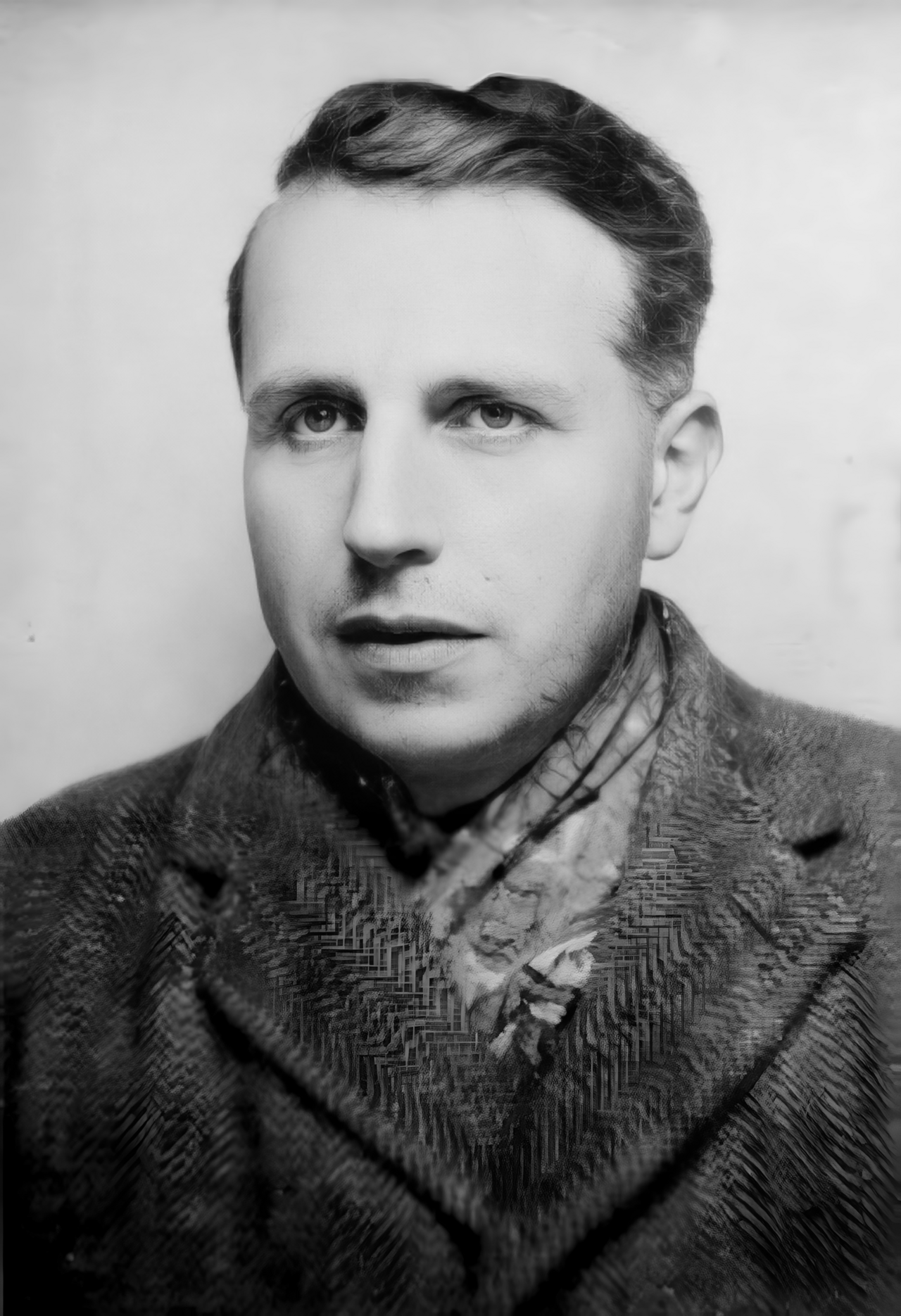
Georges Bataille
Dates: 1897–1962 Domain: Philosophy, Literature, Anthropology, Economics, Eroticism
Biography
Georges Bataille was born in Billom, Puy-de-Dôme, in 1897, to a syphilitic father who went blind and mad and died during the First World War — an opening biographical fact that Bataille returned to obsessively throughout his life, not as wound but as philosophical datum. He trained as a librarian and medievalist, worked at the Bibliothèque nationale de France for most of his adult life, and produced in his off hours a body of philosophical and erotic writing that his contemporaries found variously scandalous, brilliant, and incoherent. Jean-Paul Sartre's 1943 review of Inner Experience — dismissing it as "a new mysticism" by a man who had mistaken anguish for transcendence — is one of the more revealing misreadings in twentieth-century philosophy, because it shows exactly where existentialist categories fail to catch what Bataille was doing.
The theoretical foundation is laid in The Accursed Share (1949), which Bataille considered his most important work and which he spent twelve years writing. Its argument begins with solar economics: the sun gives without return, energy floods the biosphere in excess of what life can productively use, and the fundamental problem of every economy and every civilization is what to do with the surplus. Restrictive economies (capitalism, rationalized production) reinvest everything in future accumulation; general economies consume the surplus in non-productive expenditure — festival, war, sacrifice, erotic excess. Initiation, in this framework, is an instance of general economy: it produces nothing, it consumes the initiate's former identity, it returns the self to the continuity from which individual existence is a temporary discontinuity.
Erotism: Death and Sensuality (1957) deploys this framework in its most concentrated form. Bataille's central argument is that individual existence is a condition of discontinuity — each person is bounded, sealed off from others by the gap of skin and selfhood. Death and erotic experience both press against this discontinuity from the outside. In death, the boundary dissolves definitively; in eroticism, it dissolves temporarily and recoverable. The key claim — which the project engages on its merits rather than reducing to provocation — is that what draws human beings to erotic experience is not primarily pleasure but the momentary dissolution of the isolated self back into the continuity that underlies all individual forms. This is not a psychological claim about ecstasy's emotional quality. It is a claim about the ontology of the self and what it is oriented toward at the deepest level.
Inner Experience (1943) and Guilty (1944), his two most direct mystical texts, record sustained attempts at what Bataille called the expérience intérieure — not a mystical union with God (which he rejected as still a form of object-hunger) but a dissolution into the groundlessness beneath both self and God. He read Meister Eckhart carefully; he read John of the Cross. His conclusion was that the mystical traditions went far enough to destroy the self but not far enough to abandon the concept of God as the Self's final destination. Inner Experience pushes past this: the abyss at the end of the descending path is not a divine ground but an emptiness without consolation. This position needs to be engaged rather than set aside.
Key Works (in library)
| Work | Year | Relevance |
|---|---|---|
| Erotism: Death and Sensuality | 1957 | Central philosophical statement on eroticism as dissolution of the bounded self |
| The Accursed Share | 1949 | General economy theory; sacrifice, festival, and initiation as sovereign expenditure |
| Inner Experience | 1943 | The mystical dimension pushed past God into groundless abyss |
| Theory of Religion | 1974 (posthumous) | Animal immanence, human transcendence, and what sacrifice restores |
Role in the Project
Bataille's role in the Ape of God series is to provide a secular philosophical account of what initiation does that neither Jung's psychological framework nor the traditions' own theological frameworks can provide alone. He asks: what structural feature of human existence is addressed by sacrifice? His answer — that individual discontinuity creates an ontological wound, and that all sacred experience presses against that wound by dissolving the self's boundary back into continuity — is a genuine philosophical claim, not a sensationalized position. Whether that answer is sufficient, or whether it reduces the sacred to a compensation mechanism for existential pain, is a question the project holds open.
His connection to the anthropological framework — Bataille read Mauss on the gift, Durkheim on the sacred, and Hubert and Mauss on sacrifice — means that his philosophy is also a theory of ritual. Combined with Van Gennep (FIG-0065) and Turner (FIG-0069), Bataille provides the missing philosophical dimension: not just the structure of initiation (Van Gennep) or its social function (Turner) but the claim about what the initiand is actually experiencing during the liminal phase when their former self dissolves.
Key Ideas
- Discontinuity and Continuity: Each individual exists in isolation, sealed off from others by the discontinuity of individual selfhood. Beneath all individual forms lies the continuity of existence — not a substance but the ground from which individual forms arise and to which they return. Eroticism and death both press toward that ground.
- Sovereign Expenditure: Against the productive economy that reinvests everything in future utility, Bataille posits the sovereign act as one that consumes without return — sacrifice, festival, the potlatch, the gift that cannot be reciprocated. Initiation is sovereign expenditure: the initiate's former self is consumed.
- The Sacred as Transgression: The sacred is not the domain of the pure but the zone where normal prohibitions are suspended — where the boundary between self and world, between the permitted and the forbidden, is crossed. Sacred experience is always transgressive; the transgression is constitutive of its sacred character.
- Inner Experience Beyond God: Bataille's push past Eckhart and John of the Cross to an abyss that offers no divine consolation — not the soul's union with God but the dissolution of both soul and God into the emptiness that precedes them.
Connections
- Theoretical dialogue with: FIG-0001 Eliade (sacred vs. profane, but Bataille refuses Eliade's nostalgia for the archaic), FIG-0065 Van Gennep (rites of passage structure that Bataille reinterprets through expenditure theory), FIG-0069 Turner (communitas as momentary dissolution of social discontinuity)
- Philosophical kinship with: FIG-0040 Eckhart (Bataille read him carefully and departed from him deliberately), FIG-0013 Heidegger (both attending to what modern rationality excludes, by different routes)
- In the Ape of God series with: FIG-0086 Tarkovsky, FIG-0103 Kenneth Anger
Agent Research Notes
[AGENT: perplexity | DATE: 2026-03-22] Bataille co-founded the Collège de Sociologie with Roger Caillois and Michel Leiris in 1937–1939, a study group devoted to the sociology of the sacred that produced important texts alongside Acéphale, the secret society Bataille ran simultaneously. L'Érotisme published by Éditions de Minuit, 1957; English translation by Mary Dalwood, 1962. Sartre's review appeared in Situations I (1947); Bataille responded in Method of Meditation. Denis Hollier edited the Collège de Sociologie documents (University of Minnesota Press, 1988). Stuart Kendall's recent biography is a useful secondary source.