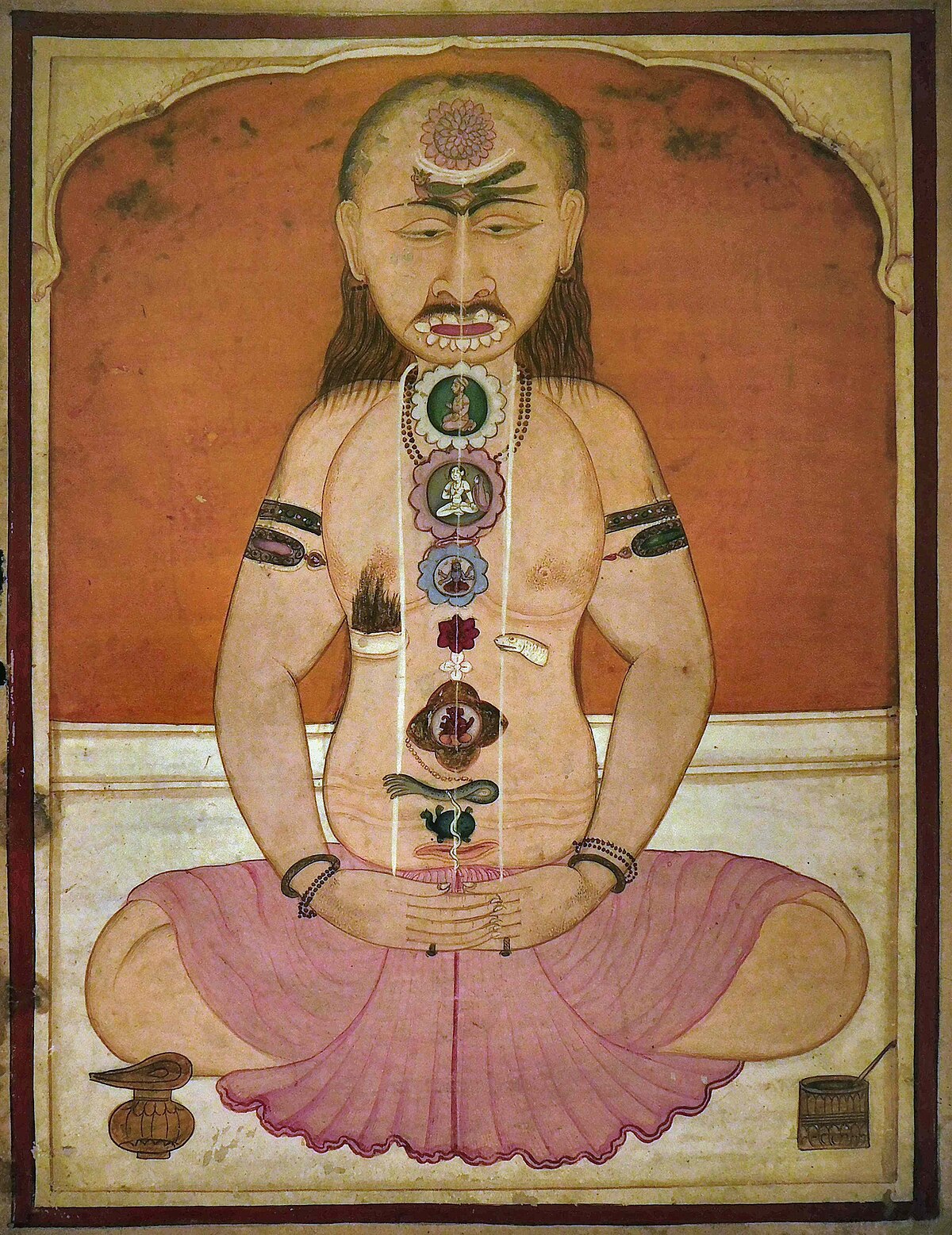
Yoga
Definition
Yoga (Sanskrit root yuj, "to yoke," "to join," "to unite") designates both the goal (union between jivatman and Paramatman, individual and universal consciousness, in some formulations; the simple stilling of consciousness in Patanjali's more cautious account) and the path of practices through which that union is approached. The term covers an enormous range of practices across the Hindu tradition — from the physical postures (asanas) of Hatha Yoga through the devotional practices of Bhakti Yoga to the philosophical inquiry of Jnana Yoga to the ritual and mantra work of Tantra. When the project refers to yoga as a concept, the primary reference is to the classical systematization of Patanjali (approximately 2nd century BCE to 2nd century CE, the dating remains uncertain), which remains the most precise and transmittable account of what yoga does and how.
Patanjali's Yoga Sutras open with the definition that has governed all subsequent discussion: yogash chitta-vritti-nirodhah — "yoga is the cessation of the fluctuations of the mind-field (citta)." This is emphatically not a mystical claim about union with God; it is a precise functional description of what the practice aims to produce. Citta is the totality of the mental apparatus — conscious mind, subconscious storage of past impressions (samskaras), and the discriminative faculty. Its vrittis (fluctuations, modifications, thought-waves) are constantly produced in ordinary consciousness through perception, inference, testimony, error, imagination, and memory. When these cease, what remains is either pure awareness (purusha, the witness) in Patanjali's Samkhya-inflected metaphysics, or, in Vedantic readings, the identity of individual consciousness with Brahman.
The eight limbs (ashtanga) of classical yoga constitute a progressive initiatic curriculum: yama (ethical restraints: non-harming, truthfulness, non-stealing, continence, non-possessiveness); niyama (ethical observances: purity, contentment, self-discipline, self-study, surrender to the divine); asana (stable, comfortable posture — a single sutra in Patanjali, expanded to an entire discipline in Hatha Yoga); pranayama (regulation of breath and vital energy); pratyahara (withdrawal of the senses from their objects); dharana (concentration — directing attention to a single point); dhyana (meditation — sustained flow of attention to that point); and samadhi (integration, absorption — the deepest states of meditation in which the object is known directly, without mediation of the ego's interpretive operations). The final three (dharana, dhyana, samadhi) together constitute samyama, the complete meditative act.
Historical Development
The history of yoga extends far beyond Patanjali. Archaeological finds from the Indus Valley civilization (3rd-2nd millennium BCE) include figures in postures that some scholars interpret as early yogic practice — though the interpretation is contested. The Vedic tradition's emphasis on breath control (pranayama) in ritual and the tapas (heat, austerity) practices of the shramana renunciants provide the earliest textual evidence for practices that would later be systematized as yoga. The Upanishads, particularly the Katha, Shvetashvatara, and Maitri Upanishads, contain early systematic accounts of yoga as a path of consciousness transformation.
The Bhagavad Gita (approximately 2nd century BCE to 2nd century CE), presented as a dialogue between Arjuna and Krishna on a battlefield, is the most widely read yoga text in the Hindu tradition. Krishna systematizes yoga into three primary paths appropriate to different human temperaments: Jnana Yoga (the path of knowledge, analysis of consciousness leading to the recognition of Atman-Brahman); Bhakti Yoga (the path of devotion, the transformation of desire into love of the divine); and Karma Yoga (the path of action, the performance of one's duty without attachment to the fruits of action). This tripartite scheme, knowledge, love, action, is one of the most elegant typologies of contemplative paths in any tradition.
Patanjali's Yoga Sutras, despite their brevity (196 aphorisms), established the classical framework that subsequent traditions have either followed, adapted, or defined themselves against. The text operates within a Samkhya metaphysical framework that posits a strict dualism between purusha (pure consciousness, the unchanging witness) and prakriti (matter, including the mind). Liberation consists in the purusha's recognition of its own nature, distinct from all modifications of prakriti — including thought, emotion, and self-concept. This Samkhya metaphysics is in tension with Advaita Vedanta's non-dualism and with Tantra's affirmation of the body, generating ongoing debates about what yoga ultimately achieves.
Hatha Yoga, developed in the medieval period (Hatha Yoga Pradipika, 15th century CE; Goraksha Sataka, 11th-12th century CE), systematized the bodily practices — posture, breath, bandha (locks), mudra — as a complete path in their own right, based on the premise that the physical body contains the subtle body and that transformation of the gross level affects the subtle. This is the tradition that became the dominant form of yoga exported to the West in the 20th century, almost entirely detached from its metaphysical and initiatic context.
Key Distinctions
Yoga vs. Physical Exercise: The confusion of yoga with fitness practice is the most consequential simplification in the Western reception. Asana (posture) constitutes two of Patanjali's 196 sutras; it is the third of eight limbs and is described as the preparation that allows the practitioner to sit still for meditation. Hatha Yoga expanded asana into a complete practice, but always in the context of pranayama, pratyahara, and samadhi as the actual goals. The physical practice divorced from the consciousness-transformation framework is a different activity with a different purpose.
Yoga vs. Meditation: Meditation (dhyana) is the seventh limb of yoga — not the whole. The preparatory limbs (ethical foundation, posture, breath work, sense withdrawal, concentration) are structurally necessary in the traditional account: without them, dhyana lacks the foundation to deepen into samadhi. Many contemporary "meditation practices" begin with the seventh limb and wonder why the transformative results claimed in the traditional texts don't materialize.
Samadhi: nirvitarka vs. nirvichara vs. asamprajnata: Patanjali distinguishes multiple levels of samadhi, culminating in asamprajnata samadhi (formless absorption) in which all cognitive operations cease and only the pure witness remains. These distinctions are not merely classificatory; they describe qualitatively different states of consciousness that require years of practice to differentiate. The project should be precise about which level of samadhi is being discussed when making comparisons with henosis, epopteia, or other peak states in the KB.
Project Role
Yoga provides its most complete Eastern initiatic curriculum — one that can be placed alongside the Western initiatic grades (Masonic, Golden Dawn, Neoplatonic) as a developed parallel. The eight limbs are initiatic stages: they require preparation, they build on each other, and they are not completed on schedule but when the consciousness is ready. The comparison illuminates what initiatic systems share across cultures (the staged approach, the requirement of ethical foundation, the movement from outer to inner) and where they differ (the specific understanding of what the inner is that one is approaching).
Primary Sources
- Patanjali, Yoga Sutras (c. 2nd century BCE - 2nd century CE): The definitive classical text. Vyasa's commentary (Yoga Bhashya) is the classical authoritative gloss. Georg Feuerstein's translation and commentary (The Yoga Sutra of Patanjali, 1979) provides the most scholarly accessible modern treatment.
- The Bhagavad Gita: The most widely read account of the multiple paths of yoga. Franklin Edgerton's translation and Barbara Stoler Miller's translation each offer different scholarly emphases.
- The Hatha Yoga Pradipika (15th century CE): The foundational Hatha Yoga manual, covering asana, pranayama, mudra, and samadhi.
- Sri Aurobindo, The Synthesis of Yoga (1914-21): A major 20th century systematic treatment that attempts to integrate the yogic paths within a consciousness-evolution framework — useful for the project's comparative work.
Agent Research Notes
[AGENT: perplexity | DATE: 2026-03-22] The dating and authorship of the Yoga Sutras remain scholarly questions; David White's The Yoga Sutra of Patanjali: A Biography (2014) provides an accessible account of the text's complex history and reception. The project should distinguish between the classical Patanjali system, the Tantric yoga traditions, and the modern postural yoga that developed in late 19th and early 20th century India (influenced in part by European physical culture) — these are distinct phenomena that the popular term "yoga" unhelpfully collapses.