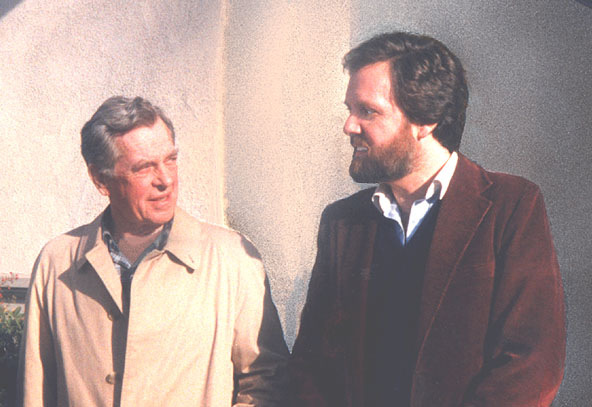
Joseph Campbell
Dates: 1904–1987 Domain: Comparative Mythology, Religious Studies, Jungian Psychology
Biography
Joseph Campbell was born in New York City in 1904 into an Irish Catholic family. He studied English literature at Columbia University, where he fell in love with Arthurian legend, then pursued graduate study in medieval literature at the University of Paris and the University of Munich. He did not complete a doctorate — he found the academic questions too narrow — and spent two years reading intensively in Jungian psychology, Schopenhauer, Spengler, and the global mythological literature. He joined the faculty of Sarah Lawrence College in 1934 and remained there for thirty-eight years, teaching courses in mythology and the history of religions that became legendary for their breadth and vitality. He died in Honolulu in 1987, having become, in the last decade of his life through his six-part conversation with Bill Moyers (The Power of Myth, broadcast 1988), perhaps the most widely watched scholar in American television history.
The Hero with a Thousand Faces (1949) is Campbell's central work and the source of his monomyth thesis. Drawing on van Gennep's rites of passage, Frazer's comparative mythology, and Jung's archetypal psychology, Campbell argued that all hero myths across all cultures share a single fundamental structure: the hero departs from the ordinary world (Separation), undergoes trials and transformation in a world of supernatural wonder (Initiation), and returns with the power to bestow boons on the ordinary world (Return). This is Eliade's death-and-rebirth morphology translated into narrative structure and applied to the world's hero stories. Campbell's examples range from Gilgamesh to Odysseus to Buddha to Moses to Christ, and the argument is that these are not parallel stories from independent traditions but expressions of the same deep structure of the human psyche (following Jung) or the same universal structure of the ritual process (following van Gennep).
The four-volume Masks of God (1959–1968) is Campbell's larger scholarly project: a comparative history of mythology from the Paleolithic to the present, organized into Primitive, Oriental, Occidental, and Creative Mythology. The scope is immense, the learning genuine, and the argument consistent: myth is not mistake or lie but the form in which the deepest human experiences of the sacred are expressed. The final volume, Creative Mythology, argues that the task of the modern person — living after the death of the available mythological frameworks — is to create their own mythology from the materials of their own experience: to follow their own bliss.
The phrase "follow your bliss" — taken from Campbell's discussions of the Sanskrit term ananda (bliss) as one of the names of ultimate reality — has had a long and problematic afterlife. In context, Campbell meant something specific: the bliss he was pointing to is the deep joy of a life aligned with its genuine vocation, its true direction, regardless of external reward or punishment. This is close to Gurdjieff's True Will, or to Nietzsche's Dionysian affirmation. In popular use, it became a warrant for doing whatever one feels like — the therapeutic-consumerist reduction of a genuine philosophical claim to a permission slip for preference-satisfaction. Campbell himself recognized this problem in some of his later interviews, noting that he had not meant "follow your bliss and it will all work out."
Key Works (in library)
| Work | Year | Relevance |
|---|---|---|
| The Hero with a Thousand Faces | 1949 | The monomyth thesis; the hero's journey as the universal structure of initiation in narrative form |
| The Masks of God, Vol. 1: Primitive Mythology | 1959 | The deep roots — Paleolithic and Neolithic mythology as the substrate of all subsequent religious forms |
| The Masks of God, Vol. 4: Creative Mythology | 1968 | The modern situation; "follow your bliss" as the instruction for post-traditional spiritual life |
| The Inner Reaches of Outer Space | 1986 | The late synthesis; myth and the modern cosmological picture |
Role in the Project
Campbell occupies a peculiar position in the project's argument — he is both a forerunner and a warning. His popularization of comparative mythology made the project's subject matter accessible to audiences that academic scholarship would never reach, and the monomyth thesis captures a genuine structural pattern. But the domestication of the hero's journey — its conversion from an account of genuine initiatory transformation (which requires genuine death, genuine suffering, and genuine surrender) into a template for personal success narratives — is exactly what the project is arguing against. Hollywood's use of Campbell's schema (under the influence of Christopher Vogler's The Writer's Journey) to structure blockbuster narratives produces stories that have the shape of initiation without any of its content. The project asks what is lost in that translation, and the answer is: the transformation itself.
Key Ideas
- The Monomyth: The single deep structure (Separation-Initiation-Return) common to all hero myths across all cultures; the narrative expression of the universal initiatory pattern.
- The Bliss Threshold: The moment at which the hero follows their genuine vocation against social expectation; the decision-point at the threshold of the adventure.
- The Boon: What the hero returns with from the initiatory world — the gift that is to be shared with the ordinary world; the goal of the hero journey is not personal transformation alone but transmission.
- Creative Mythology: The modern person's task of constructing a personal mythological framework adequate to their experience, in the absence of a shared cultural mythology.
- Follow Your Bliss: The instruction to align one's life with the deep joy of one's genuine vocation — not permission to pursue casual preferences but the demand to discover and serve one's actual calling.
Connections
- Influenced by: FIG-0021 Jung (the archetypal psychology underlying the monomyth), FIG-0001 Eliade (morphology of initiation; parallel figures), Arnold van Gennep (rites of passage), James George Frazer, Heinrich Zimmer (direct teacher)
- Influenced: FIG-0056 Kerényi (parallel), George Lucas (Star Wars openly derived from the Hero's Journey), Christopher Vogler (The Writer's Journey), the popular mythology revival
- In tension with: FIG-0001 Eliade (Campbell flattens historical difference more aggressively), academic mythology scholars who criticized his universalism, the project itself (which reads Campbell as a valuable but limited framework)
Agent Research Notes
[AGENT: perplexity | DATE: 2026-03-22] Campbell's dates are confirmed 1904–1987. The Power of Myth was broadcast on PBS in 1988, the year after his death, and reached an estimated 2.5 million viewers per episode — extraordinary for a series on mythology and religion. The Hero with a Thousand Faces (Bollingen Series XVII) has sold over a million copies. Christopher Vogler's The Writer's Journey (1992) is the Hollywood adaptation of Campbell's schema that has shaped screenwriting pedagogy for three decades. The "follow your bliss" phrase became so misunderstood that Campbell reportedly said in a late interview that he should have said "follow your blisters."