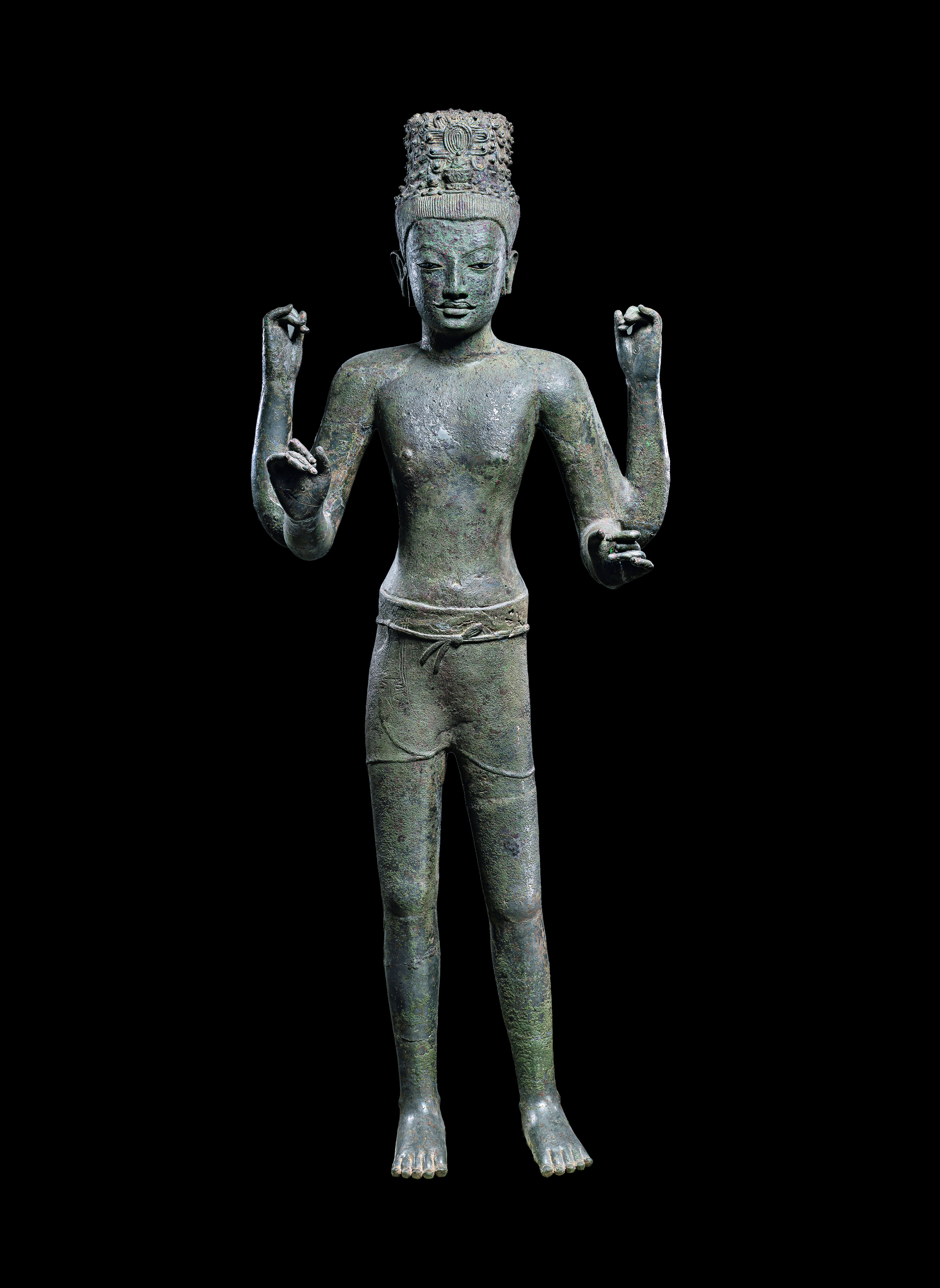
Bodhisattva
Definition
Bodhisattva (Sanskrit: bodhi "awakening" + sattva "being") — a being oriented toward awakening who has generated bodhicitta, the "mind of awakening," and undertaken the vow to attain complete buddhahood (samyaksambuddhatva) for the benefit of all sentient beings. In Mahayana Buddhism, the bodhisattva path (bodhisattva-marga) is explicitly distinguished from the path of the shravaka (hearer, who aims at individual liberation as arahant) and the pratyekabuddha (solitary realizer). The Mahayana critique of these paths as "lesser vehicles" (hinayana) — a polemical designation rejected by Theravada practitioners — centers on their orientation toward individual liberation at the expense of universal compassion.
The bodhisattva's path is structured by two complementary qualities that must develop together: prajna (wisdom, specifically the insight into emptiness/sunyata) and karuna (compassion for all suffering beings). Neither suffices alone: wisdom without compassion produces a detachment that leaves other beings unhelped; compassion without wisdom generates attachment and further entanglement in samsara. The synthesis of these two in bodhicitta is the defining quality of the bodhisattva — and the reason the bodhisattva does not immediately exit samsara but voluntarily takes rebirth to assist other beings.
The path to complete buddhahood is mapped through the bodhisattva-bhumis (ten stages or "grounds" of the bodhisattva's progress) and the paramitas (perfections or virtues to be cultivated): generosity, ethical conduct, patience, perseverance, meditation, and wisdom, with some lists adding skillful means, aspiration, power, and primordial awareness. The first stage (pramudita-bhumi, the joyful) is reached when the bodhisattva achieves a direct insight into emptiness that is irreversible — a threshold analogous in some respects to the Theravada "stream entry" (sotapatti), but the beginning of a much longer trajectory. Full buddhahood may require three "incalculable aeons" (asankheyya-kappa) of accumulated merit, wisdom, and compassionate action.
Historical Development
The term bodhisattva appears in the Pali Canon to designate the Buddha before his awakening, the being who would become the Buddha, and in the Jataka tales to designate the Buddha in his previous lives. This usage presupposes no general bodhisattva ideal; it is biographical designation. The shift to the bodhisattva as the universal Mahayana ideal — the path available to and recommended for all practitioners — is one of the defining features of the Mahayana revolution in Indian Buddhism (approximately 1st century BCE to 1st century CE).
The Prajnaparamita (Perfection of Wisdom) literature is the earliest systematic Mahayana literature and takes the bodhisattva as its central figure. The Astasahasrika Prajnaparamita (Perfection of Wisdom in 8,000 Lines) presents the bodhisattva's aspiration, the nature of bodhicitta, and the irreducible link between wisdom and compassion in a form that would be elaborated over the following centuries. Shantideva's Bodhicaryavatara (Guide to the Bodhisattva's Way of Life, 8th century CE) remains the most complete and poetically powerful treatment of the bodhisattva ideal in the entire Buddhist literary canon — a systematic account of how bodhicitta is generated, maintained, and purified across all aspects of life.
In East Asian Buddhism, the bodhisattva ideal took distinctive forms. The figure of Guanyin (Kannon in Japan, Avalokiteshvara in Sanskrit — the bodhisattva of compassion) became the most widely venerated figure in East Asian religious culture, reflecting a particular crystallization of the compassion-aspect of the bodhisattva. In Zen/Chan, the bodhisattva ideal was integrated with the emphasis on sudden awakening and expressed in the "great doubt" (daigi) and "great death" (daishi) that precede genuine awakening — a transformation that the practitioner undergoes for all beings, not merely for themselves.
Tibetan Buddhism integrated the bodhisattva ideal into the Vajrayana framework. The lojong (mind training) texts — particularly Atisha's Lamp for the Path to Enlightenment (11th century CE) and the commentarial tradition it generated — systematized bodhicitta cultivation through specific meditative practices, including tonglen (taking and sending), in which the practitioner breathes in the suffering of others and breathes out relief. This practice is structurally significant: it is an intentional inversion of ordinary self-protective impulse, a willingness to take in rather than expel what causes suffering.
Key Distinctions
Bodhisattva vs. Psychopomp: The psychopomp (Hermes, Virgil, the Hierophant) guides the individual initiate through a specific descent. The bodhisattva's orientation is universal and eschatological: not the guide for this initiate in this descent but the vow to remain present in the cycle until all beings are liberated. The scope and the temporal register differ: the psychopomp operates at the level of specific initiatic events; the bodhisattva operates at the level of cosmic time. Both represent figures who traverse the threshold and return, but the bodhisattva's return is not to a place of safety but to samsara itself.
Bodhisattva vs. the Arahant: The Theravada ideal of the arahant: the individual who has achieved liberation from the cycle — is not condemned in Mahayana polemics because it fails; it is critiqued because it succeeds individually while the compassion of full buddhahood remains incomplete. The Mahayana argument is structural: a liberation that is not yet the liberation of all beings is, from the standpoint of bodhicitta, not yet the fullest expression of what liberation is. Theravada responds that this critique caricatures the arahant as indifferent to others — the arahant who has realized nirvana acts for others' benefit; the path simply does not require making universal liberation one's vow.
Bodhicitta: relative and absolute: Mahayana distinguishes relative bodhicitta (the aspiration to awaken for all beings, which can be generated before any direct insight into emptiness) from absolute bodhicitta (the direct realization of emptiness, which is the ground from which the bodhisattva's compassion is inexhaustible). Relative bodhicitta can be cultivated; absolute bodhicitta is realized. The relationship between them is the heart of the bodhisattva path.
Project Role
The bodhisattva ideal serves the project as Mahayana Buddhism's specific answer to the question: what happens to the one who has gone through the transformative threshold? The descent-and-return pattern (katabasis, the hero's journey, the nigredo-to-albedo arc) typically presupposes a self that descends, transforms, and returns bearing knowledge or power for the community. The bodhisattva account complicates this in two ways: first, by grounding the return in the recognition of no-self (there is no substantial self that went anywhere); second, by refusing to treat individual liberation as a stable stopping point. The comparison with the katabasis and the psychopomp illuminates what the Mahayana distinctive claim actually is — and why it cannot be reduced to "the hero returns to help others."
Primary Sources
- Shantideva, Bodhicaryavatara (8th century CE): The definitive literary treatment of the bodhisattva ideal, including the celebrated Chapter 6 on patience and Chapter 8 on the meditation of equality of self and others. Available in Kate Crosby and Andrew Skilton's translation (Oxford, 1995) and Paul Williams's scholarly commentary.
- The Vimalakirti Sutra: A Mahayana text that dramatizes the bodhisattva ideal through the figure of Vimalakirti, a layman whose realization exceeds that of the Buddha's monastic disciples — a deliberately provocative formal claim about where awakening is found.
- Atisha, Lamp for the Path to Enlightenment (Bodhipathapradipa) (11th century CE): The foundational Tibetan text for the gradual path (lamrim) tradition, integrating the bodhisattva ideal into a systematic path accessible to practitioners at different levels.
- The Astasahasrika Prajnaparamita: The earliest systematic Mahayana literature on the bodhisattva path and the unity of wisdom and compassion.
Agent Research Notes
[AGENT: perplexity | DATE: 2026-03-22] The Mahayana critique of the "Hinayana" ideal has generated significant scholarly debate about whether early Buddhism actually taught individual liberation as the goal or whether the Mahayana constructed a polemical target. Gregory Schopen's archaeological work on early Buddhist monasteries and Paul Harrison's scholarship on the early Prajnaparamita literature are relevant. The project should be clear that "Hinayana" is a Mahayana polemical designation and that contemporary Theravada practitioners reject both the label and the characterization of their path as inferior.