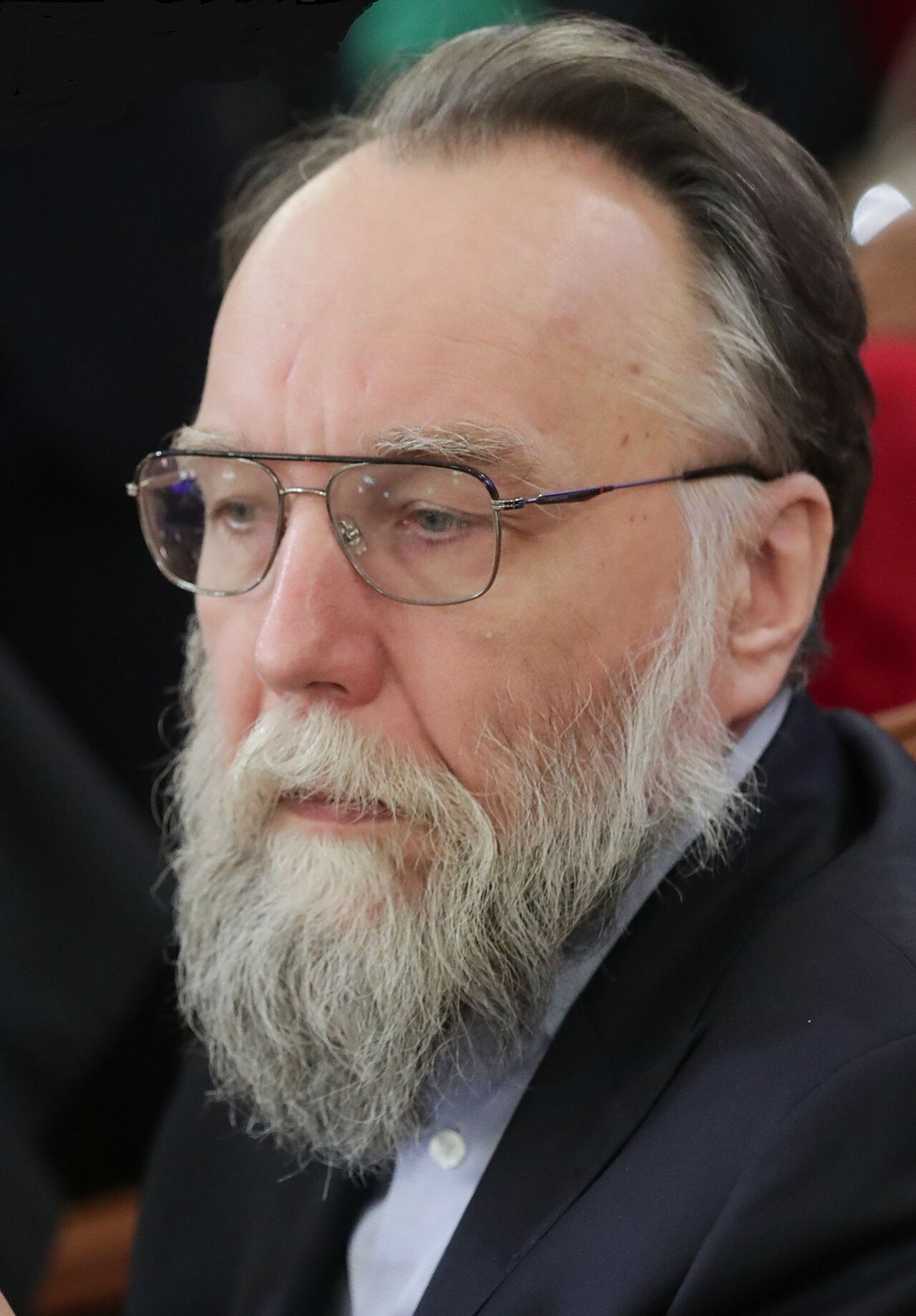
Alexander Gelievich Dugin
Dates: b. 1962 Domain: Philosophy, Civilizational Theory, Political Philosophy
Biography
Alexander Dugin was born in Moscow in 1962 and has been, since the 1980s, one of the most prolific and influential, and most controversial, Russian thinkers of the post-Soviet era. His early intellectual development combined engagement with Western esotericism (he was a member of Yurii Mamleev's Yuzhinsky circle in the 1980s, which mixed mysticism, nationalism, and countercultural provocation) with serious philosophical study. He absorbed the Traditionalism of Guénon and Evola, the phenomenology of Heidegger, and the French New Right's engagement with political philosophy, and synthesized them in a Russian context that made him both a public intellectual and a political operator.
His Foundations of Geopolitics (1997) became a textbook at the Russian General Staff Academy and was influential in Russian strategic thinking; it proposed a Eurasian strategy centered on the dissolution of American hegemony through the cultivation of European, Middle Eastern, and Asian alliances. His Fourth Political Theory (2009) proposed a political philosophy that went beyond the three failed ideologies of modernity (liberalism, communism, fascism) to recover an older concept of the subject — not the individual (liberalism), the class (communism), or the nation or race (fascism), but Heidegger's Dasein: the people-in-their-being, the historical existence of a civilization in its specific mode of being-in-the-world.
The editorial position the project adopts toward Dugin is identical to its position on Evola: engage the philosophical and civilizational analysis seriously; maintain explicit critical distance from the geopolitical agenda (which has been invoked to justify Russian expansionism and military violence) and from the nationalist politics (which have included, in Dugin's public statements, positions that are racist, misogynist, and genocidal in their rhetoric). These political positions are not incidental to his thought, they are its political expression, and they require direct acknowledgment.
What is intellectually productive is the Noomakhia: a twenty-four-volume civilizational philosophy published from 2014 onward. Each volume examines a specific civilization (Greek, Iranian, Chinese, Indian, African, Latin American, and others) through the lens of three fundamental logotypes — the Logos of Apollo (light, sky, rational order), the Logos of Cybele (earth, darkness, chthonic forces), and the Logos of Dionysus (eros, ecstasy, the mediating principle between sky and earth). These three logotypes structure each civilization's specific mode of existence, and no civilization reduces to any other; each has its own ontological configuration, its own relationship between the rational and the irrational, the sky and the earth.
This comparative ontology is genuinely useful: it provides a vocabulary for engaging the Mysteries not as a single universal phenomenon but as the specific form taken by a particular civilization's management of the encounter with the non-rational — the Dionysian, the chthonic, the ecstatic — within its own logos. The Greek Mysteries are not the same as the Egyptian mysteries or the Hindu tantra not because they occurred in different cultures,. It is because the underlying civilizational logos structures the encounter differently.
Key Works (in library)
| Work | Year | Relevance |
|---|---|---|
| Noomakhia: Wars of the Mind (24 vols.) | 2014– | The comparative civilizational philosophy; three logotypes and their different configurations across world civilizations |
| The Fourth Political Theory | 2009 | The post-liberal political philosophy built on Heideggerian Dasein |
| Philosophy of Traditionalism | 2002 | Dugin's systematic engagement with Guénon and Evola |
Role in the Project
Noomakhia's three logotypes give the project a vocabulary for comparative analysis that goes beyond both the universalism of Eliade (which tends to flatten differences) and the relativism of contemporary postcolonial theory (which tends to make comparison impossible). The claim that each civilization has its own logos — its own configuration of the rational and the irrational, the heavenly and the earthly — allows the project to ask of any specific mystery tradition: what is the specific logos within which this tradition operates, and how does that logos shape the form the initiatory encounter takes? This is a productive research question that does not require accepting Dugin's political conclusions.
Key Ideas
- Multiple Logoi: Each civilization has its own logos — its own configuration of rationality, existence, and relationship to the non-rational — not reducible to the Western European model.
- Three Logotypes: Apollo (sky, rational order, light), Cybele (earth, chthonic forces, darkness), Dionysus (eros, ecstasy, mediation) as the three fundamental principles whose varying configurations shape civilizational difference.
- Fourth Political Theory: Beyond liberalism, communism, and fascism — a political philosophy grounded in Heideggerian Dasein and civilizational particularity rather than individual, class, or race.
- Noomakhia: The war of minds — the struggle between different logotypes within and between civilizations; history as the play of these fundamental ontological forces.
- Eurasianism: The geopolitical expression of civilizational difference — the claim that Russia is not a failed Western state but the center of a distinct civilizational logos.
Connections
- Influenced by: FIG-0007 Guénon (Traditionalism), FIG-0013 Heidegger (the concept of Dasein and the question of Being), FIG-0001 Eliade (civilizational analysis), the French New Right (Alain de Benoist)
- Influenced: Russian nationalist intellectual discourse, the Russian New Right, European New Right movements
- In tension with: Liberal political philosophy, Western universalism, the political left, FIG-0007 Guénon (whose Traditionalism was more contemplative than political)
Agent Research Notes
[AGENT: perplexity | DATE: 2026-03-22] Dugin was born January 7, 1962. He was dismissed from his position at Moscow State University in 2014 following public statements about Ukraine. The Noomakhia series is being published by Academic Project (Moscow); translations into English are partial and in progress. The Fourth Political Theory is translated by Mark Sleboda and Michael Millerman (Arktos Media, 2012). The project's engagement with Dugin must carefully separate the philosophical content from the geopolitical deployment, as the same texts that provide useful civilizational analysis have been used to justify specific Russian foreign policy positions.