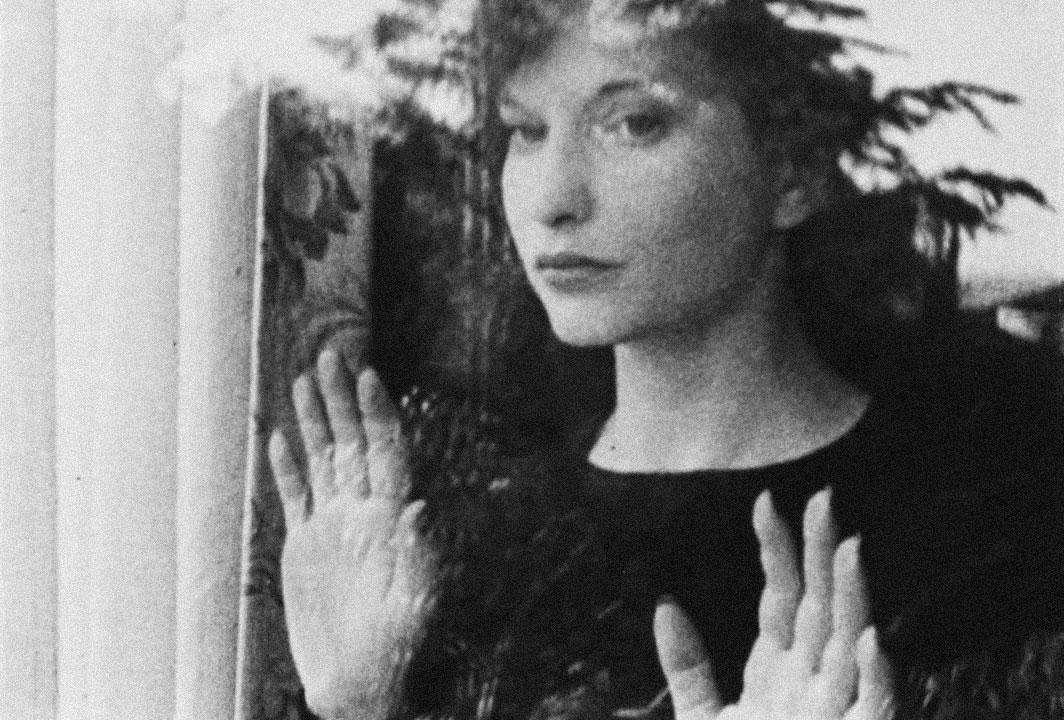
Maya Deren
Dates: 1917–1961 Domain: Experimental Film, Ethnographic Documentation, Vodou Scholarship
Biography
Eleanora Derenkowsky was born in Kiev in 1917 and emigrated to the United States with her family in 1922. She studied at Syracuse University and New York University, married the experimental filmmaker Alexander Hammid in 1942, and with him made Meshes of the Afternoon (1943) — a thirteen-minute 16mm film that is conventionally described as the founding work of American experimental cinema. The film has a dreamlike structure: a woman (Deren) returns to her house, encounters a figure in a mirrored mask who may be Death, watches a key become a knife, watches herself multiply, watches herself die. It was shot in their shared Hollywood house over two weekends. It became canonical within a decade.
Her subsequent films — At Land (1944), A Study in Choreography for Camera (1945), Ritual in Transfigured Time (1946) — developed a consistent concern with the ritual dimension of cinema: the way filmic time can be made to operate differently from narrative time, the way the body in motion reveals something about the relationship between the human and the cosmic that ordinary dramatic film suppresses. She received a Guggenheim Fellowship in 1946, the first filmmaker to do so, and used it to travel to Haiti.
In Haiti from 1947 onward, she encountered Vodou. What began as the anthropologist's position — attending ceremonies, filming, observing — became participation. She was initiated into the tradition, received possession by Erzulie (the lwa of beauty, love, and luxury), and spent twelve years traveling between New York and Haiti, accumulating approximately 18,000 feet of 16mm footage. She died in 1961 at forty-four of a cerebral hemorrhage, reportedly related to overwork and long-term malnutrition from lack of funds. Her unfinished book on Vodou (Divine Horsemen: The Living Gods of Haiti, 1953) was completed from her notes; her footage was assembled into a film posthumously by Teiji Ito and Cherel Ito in 1985.
Key Works (in library)
| Work | Year | Relevance |
|---|---|---|
| Meshes of the Afternoon | 1943 | Founding work of American experimental cinema; ritual time and the body |
| Divine Horsemen (film) | 1985 (posthumous) | Documentation of Vodou ceremonies; the scholar-practitioner at the limit |
| Divine Horsemen: The Living Gods of Haiti (book) | 1953 | Scholarly account of Haitian Vodou from inside the tradition |
Role in the Project
Deren's position in the Living Traditions series is as the most documented modern case of Western artistic-intellectual consciousness encountering a living initiatic tradition and choosing participation over observation. The Divine Horsemen footage is the primary visual document of lwa possession: the lwa riding their human horses, the communal ceremony that produces the possession states, the radical alteration of the human instrument by what rides it.
Her films are relevant to the Ape of God series as well: Meshes of the Afternoon shows a consciousness that has structurally grasped what initiatic experience does — the self-multiplication, the encounter with death, the dissolution of the boundary between the dreaming and waking selves — before she encountered Vodou. The films document a consciousness prepared to receive what Haiti showed her.
Key Ideas
- Vertical Time: Deren's theoretical concept — film can create a vertical axis of time (depth, intensity, the moment inhabited fully) rather than the horizontal axis of narrative time (before and after). Sacred time as distinct from historical time, rendered in cinematic terms.
- The Camera as Participant: Deren's argument that the camera in ritual context is not a neutral recording instrument but a participant that affects what it documents — and that affects the filmmaker who operates it.
- Possession as Initiatory Technology: From inside the tradition, Deren describes lwa possession as a specific alteration of the human instrument by a divine force that the individual self's ego cannot produce — and that requires the dissolution of that ego as its condition.
- The Scholar Who Crosses the Line: Her value to the project is the crossing: she is documented as both observer (she wrote the scholarly book) and participant (she received possession). This double position is philosophically significant.
Connections
- Living Traditions track: FIG-0071 Black Elk (the other scholar-practitioner relationship in the series; Black Elk spoke to Neihardt, Deren filmed and participated), FIG-0102 Diop (African cultural traditions on their own terms)
- Ape of God series: FIG-0086 Tarkovsky (both interested in film as consciousness technology), FIG-0103 Kenneth Anger (Crowley-influenced cinema; different approach to the same question)
- Methodological: FIG-0001 Eliade (Deren tests the scholar-practitioner boundary Eliade maintained from outside)
Agent Research Notes
[AGENT: perplexity | DATE: 2026-03-22] Deren died October 13, 1961 in New York. The Guggenheim Fellowship was awarded in 1946. The Divine Horsemen film was assembled in 1985 by Teiji Ito (her third husband) and Cherel Ito from her unedited footage. The film is approximately 51 minutes and is used in anthropology and film studies courses. VèVè A. Clark, Millicent Hodson, and Catrina Neiman edited the collected writings: The Legend of Maya Deren: A Documentary Biography and Collected Works (Anthology Film Archives, 1984–88).