Bardo
Definition
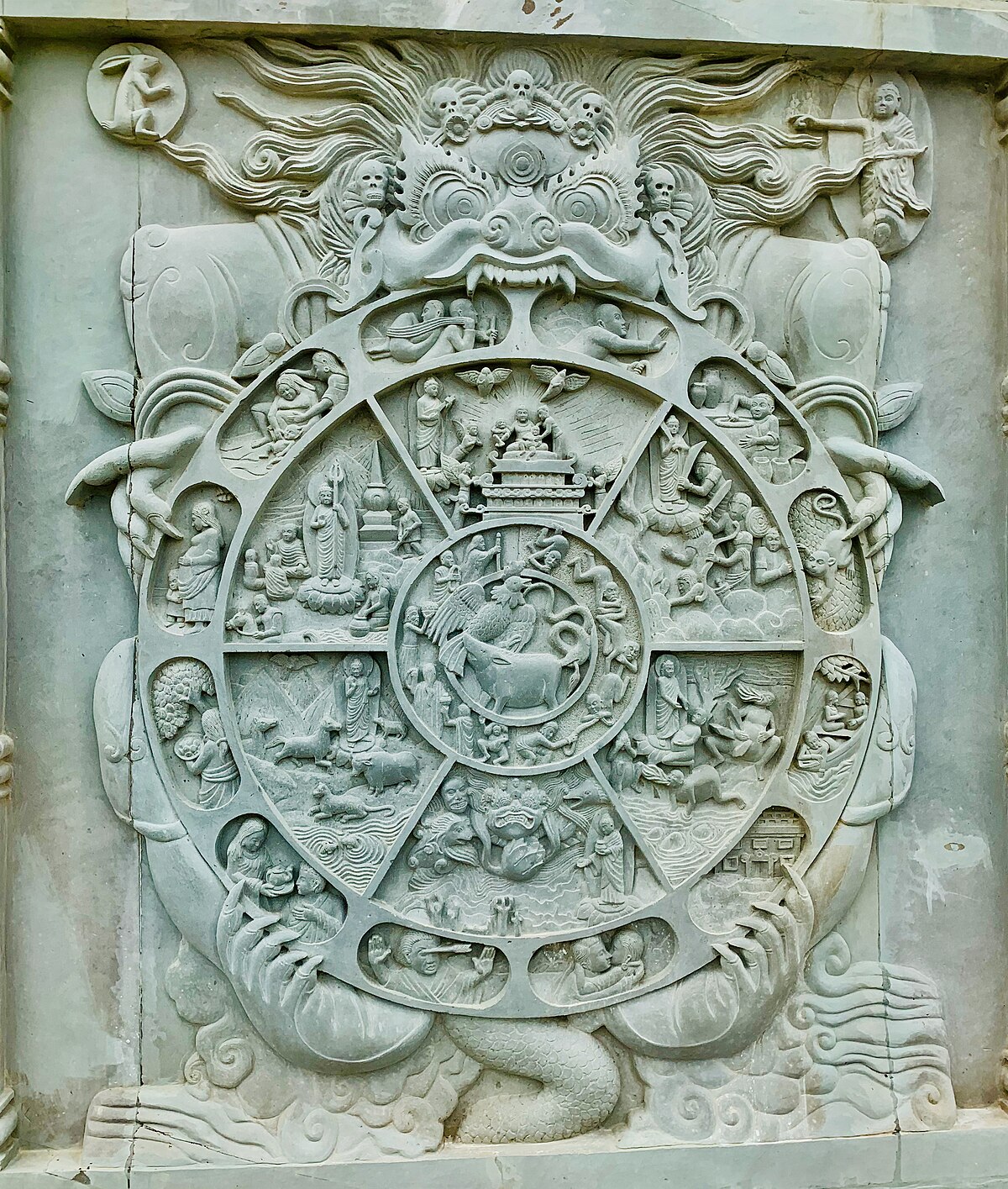
Bardo (Tibetan: bar do, literally "between two") designates any transitional state — not only the interval between death and rebirth, but any liminal gap in consciousness, including the gap between sleeping and waking, and the moment of consciousness that flickers in deep dreamless sleep. In Tibetan Buddhist cosmology, four primary bardos structure the totality of consciousness: the bardo of living, the bardo of dying, the bardo of dharmata (the luminous ground-nature of mind encountered at the moment of death), and the bardo of becoming (in which karmic propensities reassemble into a new birth). The term gained its current prominence in Western consciousness through the Bardo Thodol: the Liberation Through Hearing During the Intermediate State — attributed to Padmasambhava (8th century CE) and said to have been concealed as a terma (hidden treasure text) until its rediscovery by Karma Lingpa in the 14th century.
The Bardo Thodol is not funerary literature in the Western sense. It is a manual of recognition (ngödrö pa). The text is read aloud to the dying or the recently dead — or studied thoroughly by practitioners before death — on the premise that consciousness persists through the dissolution of the body and that the states encountered in the bardo are not arbitrary but follow a predictable sequence that can be prepared for and navigated. The key move the text demands is recognition: the luminous white light (od gsal, clear light) that blazes at the moment of death is recognized, by one who has trained, as the dharmakaya, the mind's own primordially pure nature. The same nature that practice works to uncover in life appears unmistakably at death. Liberation is recognition. Failure to recognize sends consciousness into the subsequent bardos, where it encounters first peaceful and then wrathful deity forms — which are equally projections of mind's own nature, equally opportunities for liberation, progressively more terrifying.
This structure makes the Bardo Thodol continuous with the living practice of meditation. The ability to recognize the clear light in the bardo is held to depend on the degree to which the practitioner has recognized it, even fleetingly, in meditation. The path and the post-death experience are not separate events; the bardo is the test of what the practice accomplished. This is not metaphor. The Tibetan tradition treats this as a precise causal claim about the relationship between meditative recognition and post-mortem capacity.
Historical Development
The concept of bardo predates Padmasambhava's synthesis. Early Buddhist sources (the Pali Majjhima Nikaya, the Theravada Abhidhamma tradition) acknowledged a gandhabba or antarabhava: an intermediate being between death and rebirth — though Theravada orthodoxy has debated and sometimes rejected the concept as incompatible with the no-self teaching. The Sarvastivada and later Mahayana schools generally accepted the intermediate state, and it appears in Vasubandhu's Abhidharmakosha (4th-5th century CE) with systematic treatment of its phenomenology: the intermediate being perceives as a subtle body, travels toward its next birth drawn by karma, and can in principle be redirected by the prayers of living relatives or teachers.
The distinctive Tibetan elaboration of this material emerged through the fusion of Indian Vajrayana tantra with indigenous Tibetan Bön elements in the early centuries following the introduction of Buddhism to Tibet (7th-9th centuries CE). The terma tradition — the concept of texts concealed by Padmasambhava and discovered by later tertöns (treasure revealers) — created a mechanism for the ongoing elaboration of bardo teachings keyed to the needs of successive generations. The Bardo Thodol as Karma Lingpa assembled it belongs to a larger cycle of teachings and should not be read as a single unified text; it is an anthology with distinct layers and voices.
The 20th century saw two major transmissions of the Bardo Thodol to Western audiences that shaped its reception in ways the project must hold distinct. W.Y. Evans-Wentz's 1927 translation, with its extensive Jungian-flavored commentary, translated the text into Theosophical and comparative-mystical categories that distort its Tibetan context. C.G. Jung's psychological commentary (appended to the 1953 edition) reads the bardo deities as projections of the unconscious — a reading that is illuminating for Jungians and misleading for understanding the tradition's own metaphysical commitments. Chögyam Trungpa and Francesca Fremantle's 1975 translation, prepared in close collaboration with a living lineage holder, represents a qualitatively different order of textual engagement: it renders the Tibetan technical vocabulary with precision and embeds the text in its actual practice context. These different translations as themselves data about how the West has received and transformed the teaching.
The 1960s counter-cultural reception of the Bardo Thodol as a psychedelic manual — most prominently through Timothy Leary's The Psychedelic Experience (1964), which presented the text as a guide to LSD states — created a third layer of transmission that has permanently colored Western usage. The parallel between induced psychedelic dissolution states and bardo phenomenology is real and has been seriously argued by scholars of consciousness (Stanislav Grof, Rick Strassman). The parallel does not equate the two. The bardo as the tradition understands it is not a pharmaceutical state but the mind encountering its own nature under specific conditions of dissolution. The psychedelic parallel illuminates certain phenomenological features; it does not reproduce the full context of Vajrayana cosmology, karmic causality, and guru transmission in which the teaching is embedded.
Key Distinctions
Bardo vs. Katabasis: Katabasis is a narrative of descent — the hero or initiate goes down and returns. The bardo is not a descent narrative; it is a map of what happens to consciousness after biological death, in which the question is not return but recognition and release. The parallel — threshold crossing, encounter with overwhelming powers, the requirement of preparation — is real and serves the project's comparative work. The difference is equally real: katabasis presupposes a self that descends and returns; bardo teachings are grounded in the Buddhist teaching of no-self (anatman), in which what "navigates" the bardo is not a substantial soul but a continuity of karmic tendencies. To flatten these into each other is to commit the comparative error the project explicitly avoids.
Bardo vs. Liminality: Victor Turner's liminality describes social transitions in which status structures dissolve and communal bonds emerge. The bardo is a solitary encounter between consciousness and its own projections. Turner's framework illuminates certain surface features — the dissolution of ordinary identity, the encounter with overwhelming symbolic material — but the bardo has no communitas, no social reintegration, and no social structure to dissolve. The comparison is instructive at the level of formal structure and misleading at the level of content.
Bardo vs. Near-Death Experience (NDE): The bardo phenomenology has structural overlap with NDE reports — the experience of brilliant light, encounters with deceased persons or overwhelming presences, a sense of life-review. The overlap does not establish identity. NDE reports are cross-cultural and vary significantly in their details; the bardo sequence is specific and tradition-embedded. The project holds the parallel as genuinely interesting and the epistemological question (does the bardo teaching describe an actual post-mortem state?) as genuinely open.
On no-self: The bardo doctrine sits in tension with Buddhist no-self teaching, a tension the Tibetan traditions address in different ways. If there is no self, what continues through the bardo? The tradition's answer involves the concept of rigpa (pure awareness, the ground of mind) and alaya-vijnana (storehouse consciousness) — which are not identical to a substantial self but are not nothing. This tension is philosophically alive within Tibetan Buddhism itself and should not be prematurely resolved.
Project Role
The bardo serves the project as the most detailed extant map of the consciousness territory encountered at the threshold of dissolution. No Western tradition has produced anything equivalent: a practical manual, embedded in a living lineage, that treats the moment of death as the supreme test of meditative training and that specifies in advance the sequence of experiences that consciousness will encounter. This specificity makes the bardo teaching either an extraordinary example of sophisticated introspective cartography or an elaborate metaphysical construction with no empirical referent. The project holds both possibilities.
The bardo is also relevant to the project's AI strand. If the Bardo Thodol is understood as a technology of recognition — a training system for identifying mind's own nature under conditions of maximal dissolution — then the question it raises about AI is precise: an AI system processes information about the bardo but is not positioned to face the dissolution it describes. This remains unresolved. It carries the question.
Primary Sources
- Karma Lingpa (attrib.), Bardo Thodol (14th century, rediscovered): The root text, available in Trungpa/Fremantle's translation (The Tibetan Book of the Dead, Shambhala, 1975) and in the more literal Gyurme Dorje translation edited by Graham Coleman and Thupten Jinpa (Penguin, 2005).
- Padmasambhava, Natural Liberation (Rigpa Rangdröl): Commentary on bardo teachings attributed to Padmasambhava; translated by B. Alan Wallace (Wisdom Publications, 1998).
- Vasubandhu, Abhidharmakosha: Contains the systematic Sarvastivada treatment of the intermediate state (antarabhava) that provided the doctrinal framework for Tibetan elaboration.
- C.G. Jung, Psychological Commentary (in Evans-Wentz edition, 1935/1953): Historically significant reception document; reads bardo deities as projections of the unconscious. Illuminating as an example of Jungian comparative method; not reliable as a guide to Tibetan categories.
Agent Research Notes
[AGENT: perplexity | DATE: 2026-03-22] The scholarship on the Bardo Thodol's actual textual history is complex. Bryan Cuevas's The Hidden History of the Tibetan Book of the Dead (2003) provides the best critical historical analysis, distinguishing the text's complex layering from its reception as a unified work. The project should be precise about which layer of the text is being engaged. The Nyingma and Kagyu traditions have somewhat different bardo elaborations, and the project should note where the Bardo Thodol specifically as a Nyingma terma teaching differs from broader Tibetan Buddhist bardo doctrine. The Bön tradition has its own analogous bardo teachings that predate or develop in parallel with the Buddhist versions — a further complication for simple origin narratives.