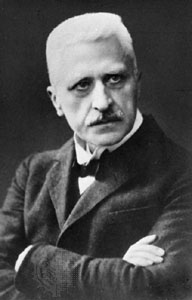
Rudolf Otto
Dates: 1869–1937 Domain: Theology, Philosophy of Religion, Comparative Religion
Biography
Rudolf Otto was born in Peine, Lower Saxony, in 1869, and spent his career at Marburg, where he was Professor of Systematic Theology. He traveled extensively in North Africa, India, and Palestine, and his comparative work grew from direct encounter with non-Christian religious life rather than from library study alone. He was by theological training a liberal Protestant in the Schleiermacher tradition — his early work built on Schleiermacher's analysis of the "feeling of absolute dependence" as the root of religious experience — but The Idea of the Holy (1917) departed from Schleiermacher in a specific and philosophically important direction.
The Idea of the Holy (Das Heilige) is the argument that the experience of the sacred is irreducible to any moral, rational, or aesthetic category — that it has a quality (das Numinose, the numinous) that is sui generis: a category unto itself that cannot be derived from anything else. Otto analyzes this quality through two poles: the mysterium tremendum (the mystery that causes trembling — awe, dread, overpowering majesty, the sense of absolute creatureliness before what is wholly other) and the fascinans (the fascination that attracts — the quality that draws the consciousness toward what also terrifies it). These are not opposites but aspects of the same experience: the sacred is both terrifying and irresistible simultaneously, and this double quality is what distinguishes genuine religious experience from ordinary aesthetic or moral experience.
He died in Marburg in 1937, having spent his final years increasingly marginalized by the dominant strands of both German theology (Barth's neo-orthodoxy) and German politics.
Key Works (in library)
| Work | Year | Relevance |
|---|---|---|
| The Idea of the Holy | 1917 | The numinous; mysterium tremendum et fascinans as the phenomenology of the sacred |
| Mysticism East and West | 1926 | Comparative analysis of Eckhart and Shankara; structural parallels between Christian and Vedantic mysticism |
Role in the Project
Otto's mysterium tremendum et fascinans is the primary phenomenological description of what initiates were experiencing in the Telesterion and what practitioners experience in the moments of genuine contemplative breakthrough the traditions describe. It provides the vocabulary for discussing the quality of the sacred encounter that remains consistent across traditions even when the doctrinal content differs radically. When the project says that the Eleusinian initiation produced a direct encounter with the sacred, Otto's analysis describes what "direct encounter with the sacred" means experientially.
Key Ideas
- The Numinous: The irreducible quality of sacred experience — sui generis, not derivable from moral, rational, or aesthetic categories. The mysterium tremendum et fascinans is its structure.
- Mysterium: The quality of the wholly other — what is encountered in the numinous experience is radically unlike anything in ordinary experience. Of a different order.
- Tremendum: The awe-inspiring, overpowering majesty that causes the consciousness to feel its absolute smallness — creatureliness before what is wholly other.
- Fascinans: The irresistible attraction that accompanies the terror — what draws the consciousness toward the tremendum rather than away from it. The sacred is compelling because it is also frightening.
Connections
- Built on by: FIG-0001 Eliade (hierophany as Eliade's development of Otto's numinous), FIG-0092 James (parallel empirical approach to religious experience)
- The numinous in specific traditions: CON-0003 Epopteia (the Eleusinian epopteia as the paradigmatic numinous encounter in the ancient world), CON-0019 Henosis (the Plotinian union as the numinous encounter in Neoplatonism)
Agent Research Notes
[AGENT: perplexity | DATE: 2026-03-22] Das Heilige published 1917; English translation by John Harvey, The Idea of the Holy (Oxford, 1923). The book went through 25 German editions by Otto's death. His trips to India, Egypt, and Palestine occurred 1911–1913. Mysticism East and West compared Eckhart and Shankara's mystical language with considerable care, anticipating later comparative mysticism scholarship.