Mithraism
Definition
The Mysteries of Mithras (Latin: Mysteria Mithrae, Greek: Mithraiká mystéria) were a mystery cult practiced in the Roman Empire from approximately the 1st century CE through the 4th, when the combination of Christian imperial legislation and the closing of pagan temples brought them to an end. The cult was organized in small underground temples (mithraea) typically built in cellars, caves, or underground rooms to simulate the rocky cave in which the central myth placed the bull-slaying. It was organized in seven grades — Corax (raven), Nymphus (bridegroom), Miles (soldier), Leo (lion), Perses (Persian), Heliodromus (sun-courier), Pater (father) — each with specific symbolic associations, ritual requirements, and liturgical roles.
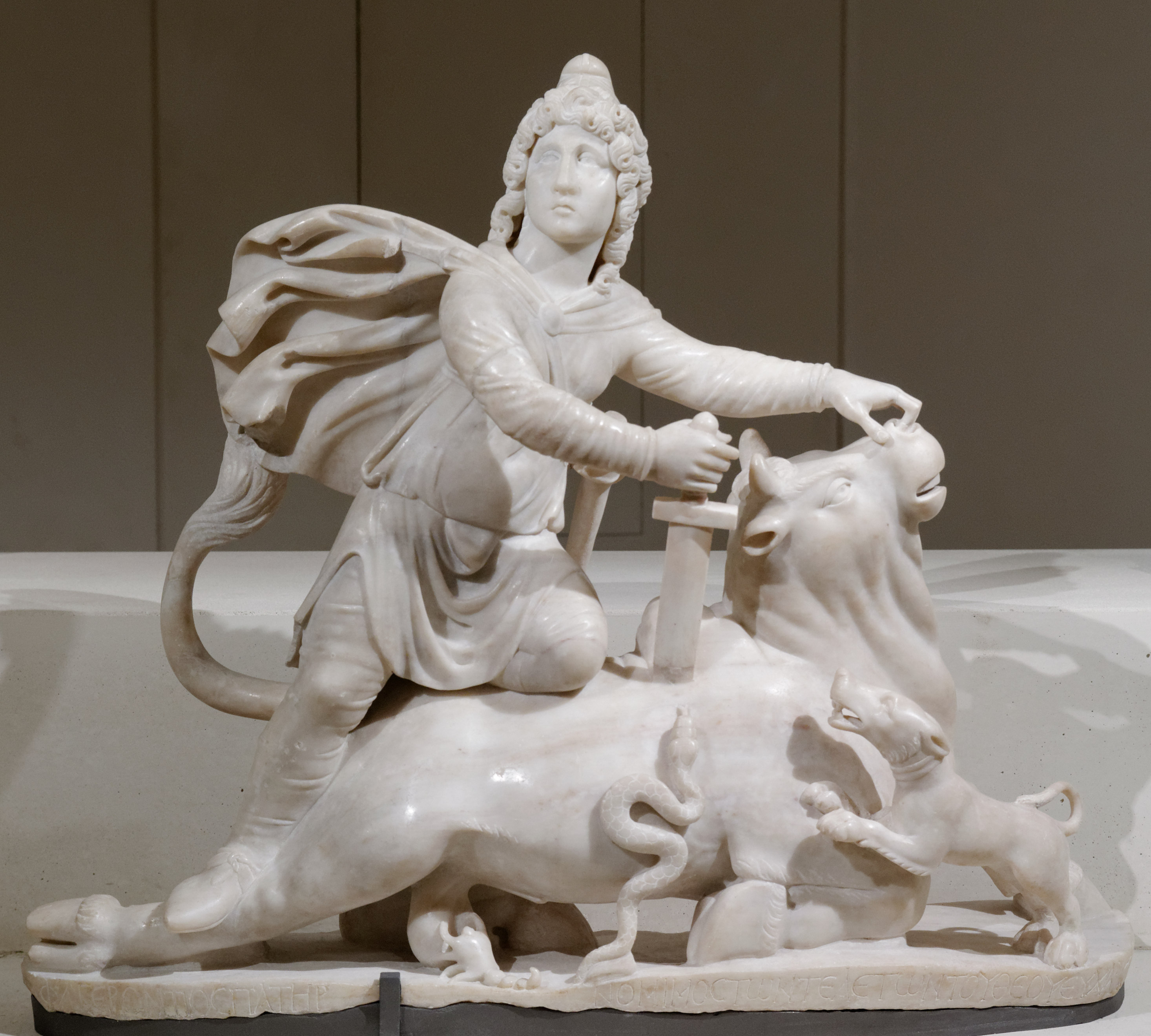
The cult's central cultic image — represented in virtually every mithraeum — is the tauroctony: Mithras astride a bull, turning his face away while plunging a dagger into the bull's neck, while a dog and serpent drink from the wound and a scorpion attacks the bull's genitals, often under the gaze of the torch-bearers Cautes and Cautopates and surrounded by zodiacal imagery. This image was the focus of the cult's ritual space but its precise meaning remains contested: what did the bull-slaying signify? Proposed interpretations range from astronomical (the bull as Taurus, Mithras killing the constellation marking the spring equinox in an earlier era) to soteriological (the sacrifice generating cosmic renewal) to psychological (the hero mastering the animal drives). No consensus has been reached because the cult left no surviving texts explaining its own symbolism.
The membership was primarily male (women were excluded), drawn heavily from soldiers, merchants, and freedmen — groups that valued the graded achievement structure and the fraternal bonds of mutual initiation. The social composition distinguishes Mithraism from the Eleusinian Mysteries: where Eleusis was a civic institution open to all Greeks (including women and slaves), Mithraism was a private fraternal organization accessible through deliberate choice and advancing through effort.
Historical Development
The historical origins of Roman Mithraism are disputed. The Greek historian Plutarch (1st century CE) mentions the Mithraic mysteries as practiced by Cilician pirates whom Pompey subdued in 67 BCE, which some scholars treat as the moment of transmission from East to West. Franz Cumont's century-long-dominant thesis — that Roman Mithraism was a direct descent from Iranian Mithra worship — has been largely challenged by modern scholarship. Roger Beck, David Ulansey, and others argue that Roman Mithraism was a largely Roman creation, using Iranian names and some Iranian symbolism but constituting a new synthesis in the Roman religious context. The Iranian Mithra (a deity of contracts, light, and the solar principle in the Avesta) provides the name and some imagery; the Roman cult built a largely new structure on this foundation.
The solar-heroic character of Mithraism is its most consistent interpretive strand. The seven grades map onto the seven planetary spheres in Neoplatonic and Hermetic cosmology: the initiatic ascent through the grades re-enacts the soul's ascent through the planetary spheres toward the sun. This cosmological framework — the soul descending through the spheres at birth, acquiring the qualities of each planet, and ascending back through them at death — is shared with Hermetic, Gnostic, and Neoplatonic traditions. The Mithraic initiation enacts the ascent through ritual and grade structure, with the Heliodromus (sun-courier) grade marking the penultimate approach to the solar source.
Evola's reading of Mithraism in Revolt Against the Modern World and in The Mystery of the Grail develops the solar-heroic interpretation: Mithraism represents the "virile," ascending, differentiating path of initiation, as opposed to the Eleusinian-Dionysian dissolution path. This polarity — solar vs. chthonic, ascending vs. descending, differentiating vs. dissolving — is one of Evola's most structurally illuminating observations even as his political valorization of the "solar" path is not the project's position.
Key Distinctions
Mithraism vs. Eleusinian Mysteries: The contrast is structurally fundamental. Eleusis was civic, open, centered on the agricultural cycle and the descent-return pattern, and included both men and women. Mithraism was private, male-only, centered on the heroic-solar ascent pattern, and organized in grades that required effort and achievement. Eleusis emphasized the dissolution of the ordinary self and encounter with the divine; Mithraism emphasized the strengthening and elevation of the masculine self through cosmic identification. Both are genuine mystery traditions; their structural contrast illuminates the range of what initiation can be.
Tauroctony vs. Sacrifice: The bull-slaying is not simply a sacrifice in the Vedic or Greek sacrificial sense. The cosmological and astrological dimensions of the image — confirmed by the surrounding zodiacal imagery — suggest that the act signifies something about the relationship between cosmic time (represented by the bull-Taurus) and the initiatic breakthrough beyond it (Mithras turning his face away, acting from a position outside the cosmic cycle). This may be read as the Mithraic equivalent of transcending samsara: the dissolution of bondage to the cosmic wheel through identification with its transcendent source.
Evidence Problem: Mithraism presents a particularly acute version of the general problem of mystery tradition evidence: the cult's entire theology and practice was secret, and the surviving material (mithraea, statuary, inscriptions, brief literary references) gives us the container without the content. Every significant claim about Mithraic theology is inference from material remains interpreted in light of other traditions.
Project Role
Mithraism gives the project the other pole of its initiatic typology: where Eleusis represents descent, dissolution, and communal renewal, Mithraism represents ascent, mastery, and individual solar identification. This polarity not to prefer one over the other but to illuminate the full range of what initiation can accomplish — and to raise the question of which pole each historical moment has emphasized and what the consequences of that emphasis have been.
Primary Sources
- Manfred Clauss, The Roman Cult of Mithras (1990; trans. 2000): The best current scholarly overview of the evidence.
- David Ulansey, The Origins of the Mithraic Mysteries (1989): The most developed astronomical interpretation of the tauroctony — speculative but illuminating.
- Roger Beck, The Religion of the Mithras Cult in the Roman Empire (2006): Full scholarly treatment emphasizing the cult's distinctiveness from Iranian religion.
- Julius Evola, Revolt Against the Modern World: Contains the philosophical interpretation of Mithraism as solar-heroic initiation — read critically, as always.
Agent Research Notes
[AGENT: perplexity | DATE: 2026-03-22] The Mithraic grade system's relationship to Neoplatonic planetary sphere cosmology has been argued by Beck and others; the strongest version of this argument would make Mithraism a ritual enactment of the same ascent through the planetary spheres that Hermetic and Neoplatonic texts describe philosophically. The evidence for a direct connection is suggestive but not conclusive. The project should treat this as a defensible interpretation rather than established fact.