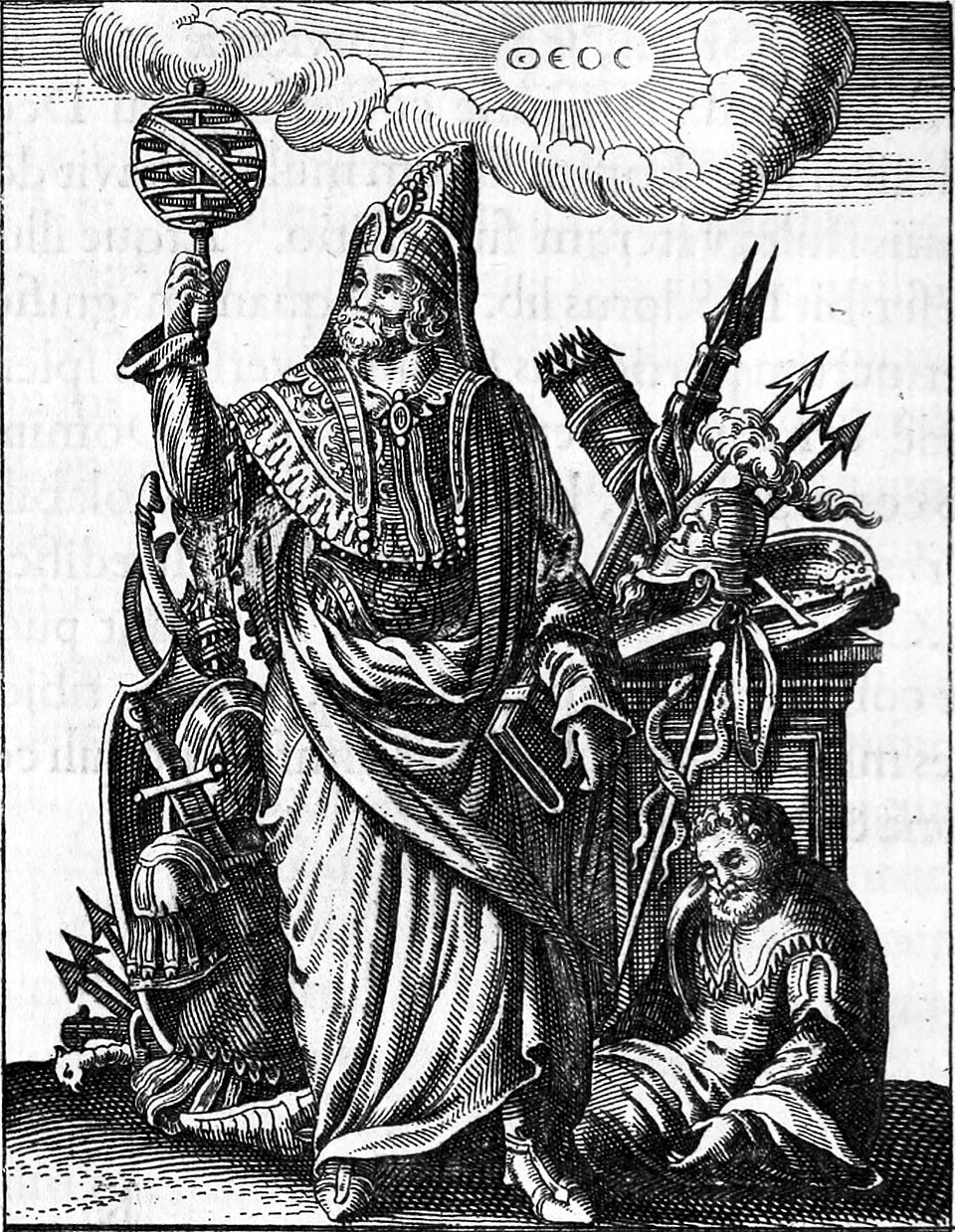
Hermes Trismegistus
Dates: Mythic/composite (texts: 2nd–3rd century CE) Domain: Hermeticism, Cosmology, Alchemy, Philosophy of Mind
Biography
Hermes Trismegistus, "Thrice-Great Hermes", is not a historical person. He is a composite figure constructed at the intersection of Greek Hermes (messenger of the gods, guide of souls to the underworld, patron of thieves and tricksters) and Egyptian Thoth (god of writing, wisdom, and cosmic order), elaborated into a legendary sage who supposedly lived in the remote Egyptian past and received and transmitted the foundational wisdom of civilization. The Corpus Hermeticum: a collection of seventeen Greek philosophical-religious tractates — and the Asclepius (surviving in Latin) were composed in Roman Egypt sometime between the first and third centuries CE, in the same cultural milieu that produced Neoplatonism and Gnosticism. Their texts show evidence of Greek philosophical influence (especially Platonic and Stoic) alongside Egyptian religious imagery. They are extraordinary documents regardless of their historical provenance: dense, poetic, intellectually ambitious attempts to describe the nature of the divine, the structure of the cosmos, and the path of the human soul's return to its source.
The Poimandres, the first tractate of the Corpus Hermeticum, is a cosmogonical vision: Hermes (or the narrator) is addressed by Nous (Mind), the supreme principle, who shows him the creation of the world and the descent of the human being into matter. The human being, gazing down from the divine light into the material creation, falls in love with its own reflection in the waters of nature and descends into embodiment, becoming entangled in the material world but retaining a spark of the divine light that constitutes its deepest nature. The path of return is gnosis — self-knowledge that is simultaneously knowledge of the divine. This is the Hermetic soteriology: salvation through knowing, specifically through knowing one's own divine origin.
The Emerald Tablet (Tabula Smaragdina) is a separate and possibly older document, preserved in Arabic alchemical texts from the eighth century CE and attributed to Hermes. Its most famous phrase — rendered in various translations as "As above, so below; as below, so above" — encodes the principle of correspondence: the macrocosm and the microcosm mirror each other, the celestial and the terrestrial are structured by the same laws, and therefore knowledge of one yields knowledge of the other. This principle became the operative axiom of alchemical, astrological, and magical practice in the Western tradition: the physician can read the signs of disease in the planets because body and cosmos are correspondingly structured; the alchemist can effect changes in the human soul by working with physical matter because the same principles govern both; the magician can act on events by acting on their symbolic correlates because the symbol and the thing are connected through the network of cosmic correspondences.
The critical historical intervention came in 1614 when Isaac Casaubon — arguably the greatest classical scholar of his age — demonstrated through philological analysis of the Corpus Hermeticum that the texts could not have been written in the remote Egyptian past. Their Greek vocabulary and philosophical concepts, Casaubon showed, were demonstrably post-Platonic; they were composed in the common era, not in the time of Moses or earlier. This discovery should have been devastating to the Hermetic tradition, but its impact was surprisingly limited. The tradition continued — partly because the institutional Hermeticists simply stopped claiming historical priority, partly because the philosophical content of the texts was sufficiently interesting to survive the deflation of their historical pretensions.
Key Works (in library)
| Work | Year | Relevance |
|---|---|---|
| Corpus Hermeticum | 2nd–3rd century CE | The foundational text of the Western Hermetic tradition |
| Asclepius | 2nd–3rd century CE | The companion text; contains the famous lament over the loss of Egyptian religion |
| Emerald Tablet (Tabula Smaragdina) | unknown; first in Arabic, 8th–9th century CE | The operative axiom of alchemical and magical practice |
Role in the Project
Hermes Trismegistus functions in the project as the figure of the tradition itself — the legendary ancestor around whose name a living tradition of intellectual and spiritual practice organized itself for fifteen centuries. That he is not historical does not diminish his significance; it transforms it. The question the project raises is: what is a tradition organizing itself around a legend doing? The answer is: constructing a mandate. By claiming descent from a figure who predates all available revelation, the Hermetic tradition claimed priority over Christianity, Judaism, and Islam — the right to evaluate them from a more ancient standpoint rather than being evaluated by them. This is the political logic of prisca theologia. When Ficino translated the Corpus Hermeticum, he was not merely making ancient texts available; he was constructing a lever by which the living tradition could move the institutionalized religions.
Key Ideas
- As Above, So Below: The principle of correspondence — macrocosm and microcosm mirror each other through the network of cosmic sympathies; operative axiom of magic, alchemy, and astrology.
- Gnosis as Soteriology: Salvation through self-knowledge that is simultaneously knowledge of the divine; the Hermetic path is epistemological rather than devotional or ascetic.
- The Divine Spark: The human being contains a portion of the divine Nous, temporarily imprisoned in matter but capable of recovering its origin through disciplined philosophical and spiritual practice.
- The Lament for Egypt: In the Asclepius, Hermes prophesies the death of Egyptian religion — a lament that anticipates the closure of the ancient world and has haunted Western esotericism as a founding trauma.
- The Legendary Sage as Mandate: The construction of a founding ancestor who is beyond all historical challenge — the figure of absolute antiquity whose authority cannot be questioned because it predates all existing authorities.
Connections
- Influenced by: Platonic philosophy (demonstrably), Stoic cosmology, Egyptian religious traditions (imagery), Orphic and Pythagorean themes
- Influenced: FIG-0024 Ficino (the translation and the prisca theologia), FIG-0025 Pico (the Hermetic synthesis), FIG-0026 Bruno (the fullest Hermetic philosopher), the entire Western alchemical tradition
- In tension with: Historical-critical scholarship (Casaubon's dating), the historical religions that claimed earlier authority
Agent Research Notes
[AGENT: perplexity | DATE: 2026-03-22] The standard modern scholarly edition of the Corpus Hermeticum is by A. D. Nock and A. J. Festugière (4 vols, 1945–1954). Brian Copenhaver's Hermetica (1992) is the best English translation with scholarly apparatus. Frances Yates's Giordano Bruno and the Hermetic Tradition (1964) established the historiographical framework for the project. Garth Fowden's The Egyptian Hermes (1986) is the best account of the social and intellectual context of the Hermetic texts. Casaubon's dating is in De rebus sacris et ecclesiasticis exercitationes XVI (1614); it did not immediately end the Hermetic tradition but shifted its self-understanding.