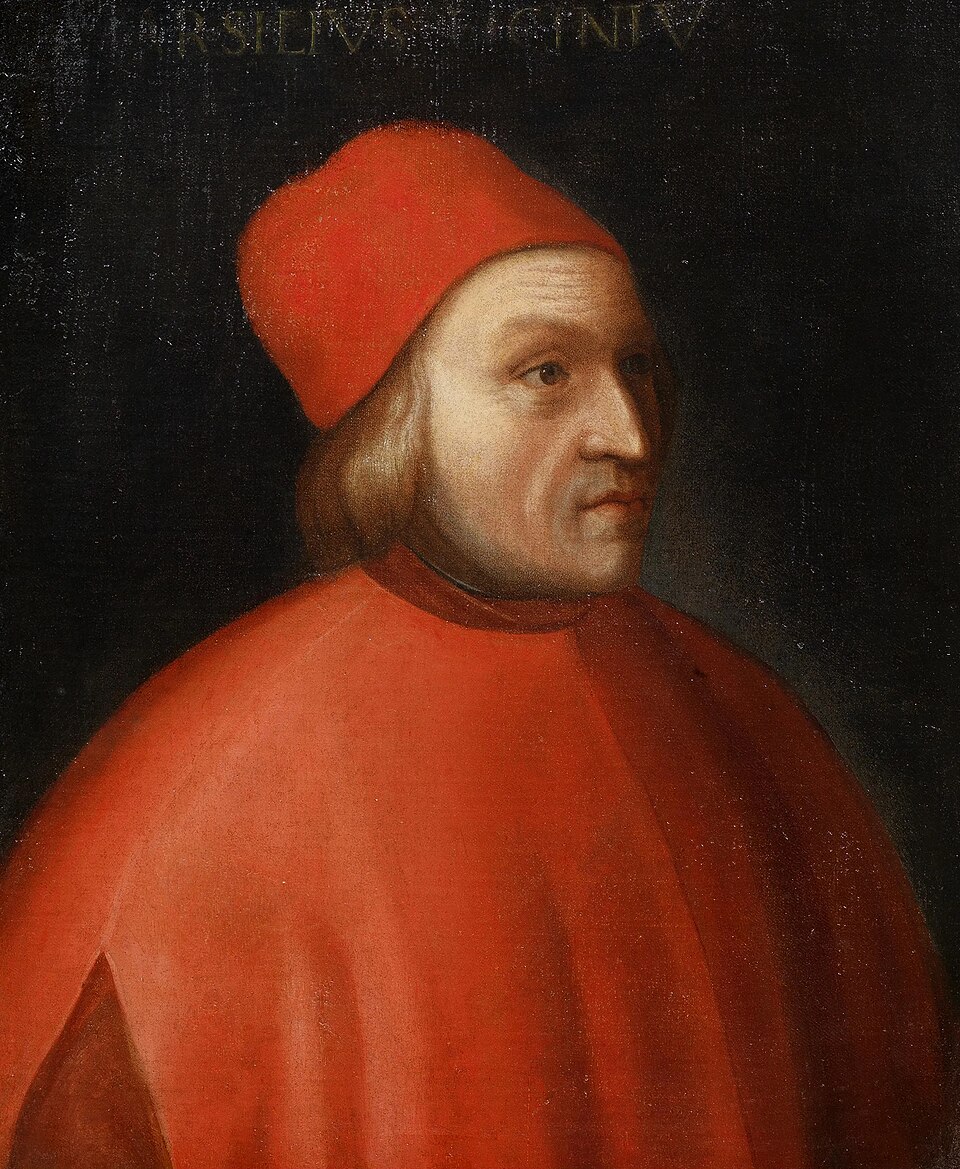
Marsilio Ficino
Dates: 1433–1499 Domain: Philosophy, Translation, Theology, Hermeticism
Biography
Marsilio Ficino was born in 1433 in Figline Valdarno, near Florence. His father was physician to Cosimo de' Medici, who became Ficino's patron and, in an important sense, his co-creator: it was Cosimo who commissioned the translation projects that defined Ficino's career and, through him, transformed the intellectual life of Europe. Ficino received an education in Latin, philosophy, and medicine before Cosimo directed him toward Greek studies so that he could translate the Platonic corpus. He was ordained a Catholic priest in 1473, combining his philosophical work with his religious vocation in a synthesis that he considered not contradictory but necessary. He led the informal philosophical circle known as the Platonic Academy at Careggi and maintained an extensive correspondence across Europe, making him a philosophical impresario.
The critical biographical moment occurred in 1463. Cosimo, near death, instructed Ficino to set aside his ongoing translation of Plato and instead translate a newly acquired Greek manuscript called the Corpus Hermeticum: a collection of philosophical-religious texts attributed to Hermes Trismegistus, the legendary sage who had supposedly taught both Moses and Plato. Ficino completed the translation within weeks, in time for Cosimo to read it before dying. The speed of the request reveals what Cosimo (and presumably Ficino) believed: that this text was more urgently important than Plato, because it was older and therefore closer to the original divine revelation. This was historically wrong — the Corpus Hermeticum was composed in the second and third centuries CE, not in ancient Egypt — but the error was not fully corrected until Isaac Casaubon's philological analysis in 1614. For the century and a half between Ficino's translation and Casaubon's refutation, the Western world operated on the assumption that it had recovered a wisdom tradition predating Moses. The consequences of that assumption are the Renaissance esoteric tradition.
Ficino's own philosophical synthesis, most fully expressed in the Theologia Platonica (written 1469–1474, published 1482), attempted to demonstrate the essential compatibility of Platonic philosophy and Christian theology — that the immortality of the soul, the ascent through the levels of being, and the final contemplation of the divine were truths recognized by Plato, encoded in Hermes, and confirmed by Christ. His concept of prisca theologia (ancient theology) held that a single perennial wisdom had been successively revealed through a chain of ancient sages — Hermes, Zoroaster, Orpheus, Pythagoras, Plato — and that this wisdom found its fullest expression in Christianity. This is not merely an academic thesis; it is the founding premise of the Western esoteric tradition as a self-conscious project. The claim that diverse traditions share a common esoteric core — repeated in different forms by Pico, Bruno, Dee, Blavatsky, Guénon, and Huxley — originates here.
His De Vita Libri Tres (Three Books on Life, 1489) is the most practically oriented of his major works: a medical-astrological manual that draws on Neoplatonic and Hermetic sources to prescribe how a scholar can maintain and cultivate his spiritus (a subtle bodily-spiritual medium between soul and body) against the effects of Saturn. It is, among other things, a manual for what we might call the hygiene of contemplative life — the care of the body and environment to support the sustained attention required for philosophical work. Frances Yates and D. P. Walker have argued that it also encodes a theory of natural (not demonic) magic: the manipulation of astral influences through image, music, and the deliberate channeling of planetary spiritus.
Key Works (in library)
| Work | Year | Relevance |
|---|---|---|
| Corpus Hermeticum (translation) | 1463 | The founding document of Renaissance Hermeticism; made the Hermetic tradition available to the Latin West |
| Theologia Platonica | 1482 | The philosophical synthesis of Platonism, Hermeticism, and Christianity |
| De Vita Libri Tres | 1489 | Practical philosophy of spiritus and natural magic for the contemplative |
| Platonis Opera Omnia (translation) | 1484 | The complete Platonic corpus in Latin — the Renaissance's primary access to Plato |
Role in the Project
The project needs Ficino for two reasons. First, as the architect of the Renaissance synthesis: it was Ficino who created the conceptual space in which all subsequent Western esoteric work took place — the space defined by the thesis that Plato, Hermes, and Christ are witnesses to the same truth. Every figure from Pico to Bruno to Dee to the Rosicrucians was operating within the framework Ficino established. Second, as an example of the transmissive function itself: Ficino did not claim to originate new ideas but to transmit ancient ones. The translator-as-initiate is a pattern the project tracks — the idea that the act of bringing an ancient text into a new language and cultural context is itself a form of initiatory practice, not merely a scholarly exercise.
Key Ideas
- Prisca Theologia: The doctrine that a single ancient wisdom was revealed to a chain of sages (Hermes, Zoroaster, Orpheus, Pythagoras, Plato) and finds its fulfillment in Christianity; the founding concept of Western perennialism.
- Spiritus: The subtle intermediary medium between soul and body, subject to astral influence and the vehicle of magical effects; Ficino's concept bridges Neoplatonic pneumatology and medical practice.
- Natural Magic: The manipulation of astral and elemental correspondences through material means (images, music, plants, stones) — not demonic but a deployment of natural affinities built into the cosmos.
- The Academy: Not merely a school but a revival of an ancient institution — the premise that a circle of philosophical friends constitutes a functional alternative to institutional religion as a vehicle of wisdom.
- The Contemplative Ascent: The Platonic-Hermetic path of the soul's return through the planetary spheres to the One — adapted by Ficino as both a philosophical argument and a spiritual practice.
Connections
- Influenced by: FIG-0005 Plotinus (primary philosophical source), Porphyry, Iamblichus (FIG-0004), Hermes Trismegistus (FIG-0036), Cosimo de' Medici (patron)
- Influenced: FIG-0025 Pico della Mirandola (student and collaborator), FIG-0026 Bruno (absorbed the full Hermetic synthesis), FIG-0027 Dee (direct inheritance), the entire Western esoteric tradition
- In tension with: Scholastic Aristotelianism (which he replaced as Florence's dominant philosophy), the reforming Christianity that would eventually suppress the Hermetic project
Agent Research Notes
[AGENT: perplexity | DATE: 2026-03-22] Ficino's dates are confirmed 1433–1499. The Corpus Hermeticum translation of 1463 is the pivotal moment; Cosimo died in August 1464. Casaubon's dating of the Hermetic texts is in his De rebus sacris et ecclesiasticis exercitationes XVI (1614). Frances Yates's Giordano Bruno and the Hermetic Tradition (1964) and D. P. Walker's Spiritual and Demonic Magic (1958) are the foundational secondary sources for the project. The Platonic Academy was not a formal institution but a circle around Ficino's villa at Careggi; its informal nature is part of its esoteric character.