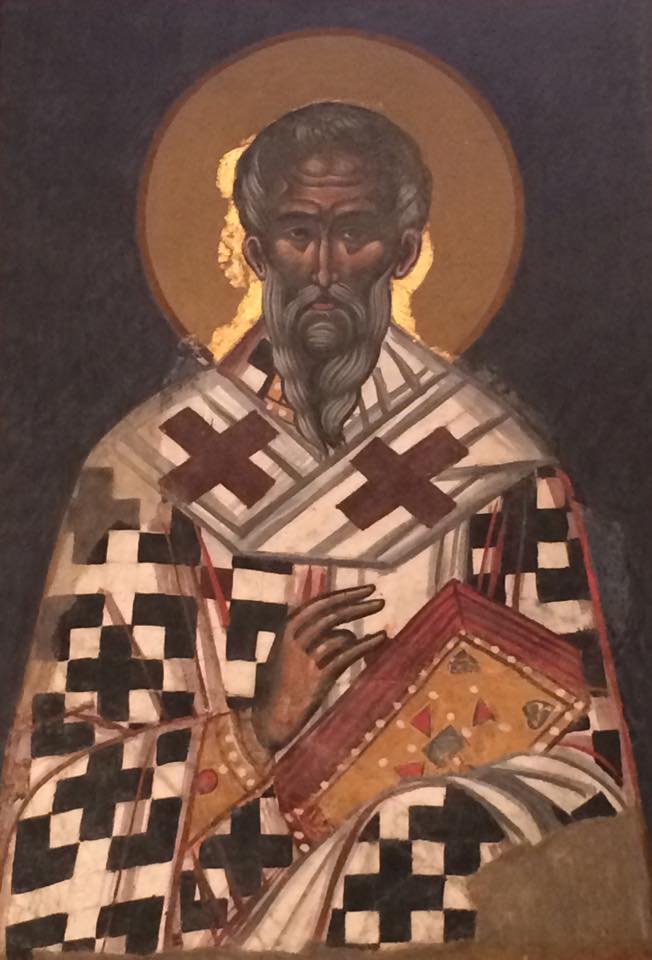
Pseudo-Dionysius the Areopagite
Dates: c. Late 5th–early 6th century CE (probably c. 480–520 CE) Domain: Christian Mystical Theology, Neoplatonist Philosophy, Apophatic Tradition
Biography
The author known as "Pseudo-Dionysius the Areopagite" was a Christian writer who, sometime around the late fifth or early sixth century CE, composed a body of theological works under the name of Dionysius the Areopagite, the Athenian convert whom Paul baptized on the Areopagus in Athens (Acts 17:34). This pseudonymous attribution was accepted without serious question until the Renaissance, when Lorenzo Valla and subsequently others began to identify anachronisms that made the apostolic authorship impossible. The name "Pseudo-Dionysius" (or "Denys" in some traditions) has been standard in scholarship since the late nineteenth century.
The historical identity of the author remains unknown. Internal evidence places the texts after 485 CE (because they quote Proclus's Elements of Theology) and before their first certain citation in 532 CE at the Council of Constantinople. The author was almost certainly a Syrian Christian monk trained in Neoplatonist philosophy, probably in the tradition descending from Iamblichus and Proclus, and his pseudonymous assumption of an apostolic name was not (by the conventions of late antiquity) simply fraudulent — it was a rhetorical strategy for claiming authoritative status for a synthesis he believed to be genuinely Christian.
The Dionysian corpus consists of four treatises and ten letters. The four treatises are: The Divine Names (De Divinis Nominibus), the longest work, which examines the names Scripture applies to God and systematically argues that each affirms and then transcends itself; The Mystical Theology (De Mystica Theologia), the shortest and most concentrated work, which is the first text in the history of Christianity to use the word "mystical" in its distinctive modern sense; The Celestial Hierarchy, which maps the orders of angels and their mediating role between God and humanity; and The Ecclesiastical Hierarchy, which maps the sacramental and liturgical life of the Church as the earthly reflection of the celestial hierarchy.
The Dionysian synthesis is the most thoroughgoing integration of Neoplatonism and Christianity in late antiquity. Pseudo-Dionysius takes the structure of Proclus's Neoplatonist emanationism, the procession of all things from the One and their return, and maps it onto Christian theology, with God as the super-essential One, the angelic hierarchies as the mediating levels of Nous and Soul, and the sacramental life of the Church as the ritual means of ascent. In The Mystical Theology, he codifies the tradition of apophatic (or negative) theology: the insistence that no positive statement can adequately name God, that all names must ultimately be denied (God is not being, not goodness, not even the One), until the soul arrives in the "brilliant darkness" beyond all speech and thought, what later Christian mystics would call the via negativa or cloud of unknowing.
The Dionysian corpus shaped Western Christianity at every level. It was translated into Latin by John Scottus Eriugena in the ninth century and became the authoritative framework for medieval Christian mysticism. Hildegard of Bingen, Bonaventure, Albert the Great, Thomas Aquinas (who wrote a commentary on The Divine Names), Meister Eckhart, and the anonymous author of The Cloud of Unknowing all worked within or against the Dionysian framework.
Key Works (in library)
| Work | Year | Relevance |
|---|---|---|
| Pseudo-Dionysius: The Complete Works | 1987 | The four treatises and ten letters in Colm Luibheid's translation, with Paul Rorem's introduction and notes; the standard scholarly English edition (LIB-0340) |
Note: The corpus is now in the library as LIB-0340, the Paulist Press Classics of Western Spirituality volume: Colm Luibheid's translation with Paul Rorem's introduction and notes. It collects all four treatises and the ten letters in a single volume.
Role in the Project
Pseudo-Dionysius represents one of the decisive historical moments the project is tracing: the absorption of mystery-school metaphysics into institutionalized Christianity, and the crystallization of the apophatic tradition as the "safe harbor" within which initiatory and mystical experience could persist inside orthodoxy. His angelic hierarchies are essentially a Christianized version of the Neoplatonic chain of being through which theurgical ascent was understood to operate (cf. Iamblichus, FIG-0004). His Mystical Theology provides the framework within which the Christian contemplative tradition (Meister Eckhart, John of the Cross, The Cloud of Unknowing) claims that the deepest encounter with God is an encounter in darkness and unknowing, not in the possession of knowledge but in its transcendence. This apophatic insight connects directly to the project's themes of initiation as transformation that exceeds any particular doctrinal content.
Key Ideas
- Apophatic (negative) theology: All statements about God, even the most exalted, must ultimately be negated, because God transcends all categories, including being and goodness. The soul approaches God by progressively stripping away all concepts.
- Brilliant darkness: The paradoxical formulation for the mystical encounter: God is like a darkness that is more luminous than any light, an unknowing that exceeds all knowledge.
- Divine names: Each name (Good, Being, Life, Wisdom, etc.) reveals something real about God's activity in the world (prohodos, procession) while the divine essence transcends all names.
- Celestial hierarchy: The nine orders of angels (Seraphim, Cherubim, Thrones; Dominions, Virtues, Powers; Principalities, Archangels, Angels) as the Christianized version of the Neoplatonic mediating principles, through which divine light descends and the soul ascends.
- Ecclesiastical hierarchy: The sacramental life of the Church as the material, earthly image and medium of the celestial hierarchy; liturgy as theurgy.
- Henadic theology: God as the source of all henads (unities) in Proclus's system, translated into Christian terms as the Trinity as the source of all divine names and energies.
The Ten Letters
The corpus collected in LIB-0340 is not only the four treatises. It closes with ten letters, and they are not occasional correspondence appended for completeness. They compress the teaching of the treatises into its sharpest form. The first, to the monk Gaius, states the central paradox in a single stroke: the divine darkness is unknown not because there is too little light in it but because there is too much. If anyone, having seen God, understood what he saw, then what he saw was not God but something lesser that belongs to God. To know that one has not comprehended is, here, the success of the ascent rather than its failure.
The fifth letter, to Dorotheus, names that same darkness "the unapproachable light in which God is said to dwell," and holds the two descriptions together as one. The light is unapproachable; what is unapproachable is, to the one who approaches it, dark. The letters as a group range from this kind of compressed metaphysics to practical questions of conduct and rank within the Church, but the apophatic insistence runs through all of them.
For the project the letters matter because they show the apophatic working at conversational scale. The treatises can read as architecture, vast and impersonal. The letters are Pseudo-Dionysius advising particular readers on how to hold an idea that resists being held, and they confirm that the "brilliant darkness" was never a literary flourish. It was a practical instruction about the limit of every concept, addressed to people expected to act on it (LIB-0340).
Connections
- Influenced by: FIG-0005 (Plotinus: structural framework of emanation and return), Proclus (Elements of Theology directly quoted), Iamblichus (theurgical structure, though adapted to Christian sacraments), Damascius
- Influenced: John Scottus Eriugena, Albert the Great, Thomas Aquinas, Bonaventure, Meister Eckhart, Nicholas of Cusa, John of the Cross, the anonymous author of The Cloud of Unknowing, FIG-0009 (Corbin: Corbin's ta'wil and apophatic impulse parallel the Dionysian)
- In tension with: FIG-0007 (Guénon: Guénon acknowledged the esoteric content of the Dionysian corpus but regarded Latin Christianity as having lost its initiatic transmission)
Agent Research Notes
[AGENT: perplexity | DATE: 2026-03-20] LIBRARY FLAG: No Pseudo-Dionysius texts are currently in the library (LIB-0001–0329). The definitive scholarly edition and translation for the project would be the Paulist Press Classics of Western Spirituality volume, translated by Colm Luibheid with extensive introductory essays by Paul Rorem (1987). The Stanford Encyclopedia of Philosophy entry on Pseudo-Dionysius (cited in research) provides an excellent scholarly overview. The pseudonymous authorship issue should be addressed frankly in podcast episodes that feature this figure. It is historically significant because the enormous influence of the Dionysian corpus in medieval Christianity was in large part premised on its (false) apostolic authority. The discovery of the pseudonymity in the sixteenth century was, paradoxically, philosophically liberating, since it allowed the ideas to be evaluated on their merits rather than on claimed authority.
[AGENT: claude-code | DATE: 2026-04-03] Deepened with material from LIB-0340 (Pseudo-Dionysius: The Complete Works), now in the library — the volume the perplexity note above recommended acquiring. Added "The Ten Letters," drawing on Letters 1 (to Gaius) and 5 (to Dorotheus) for the darkness-as-excess-of-light paradox, and updated the Key Works table and note, which had stated no Pseudo-Dionysius texts were in the library. Existing content was not rewritten.