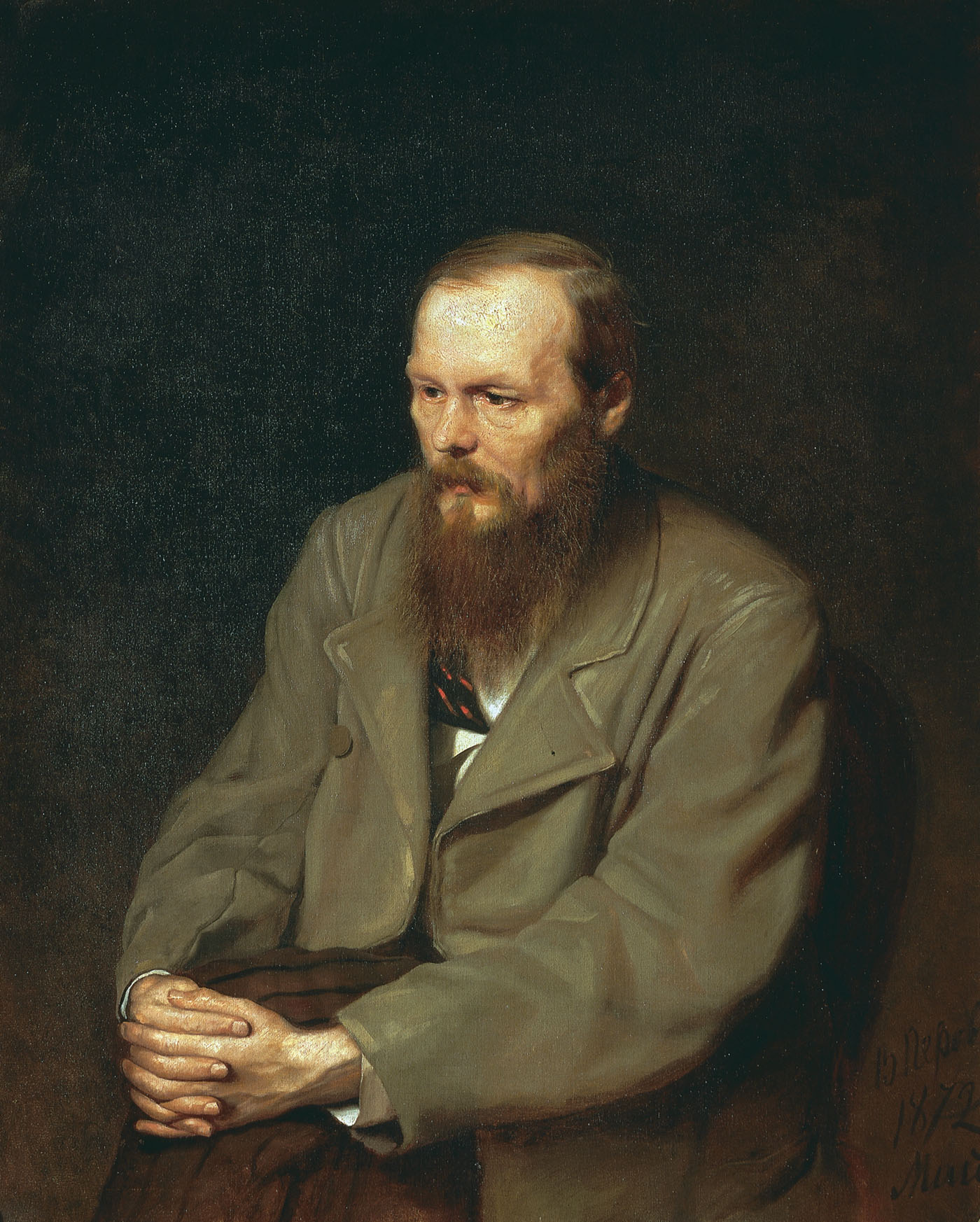
Fyodor Dostoevsky
Dates: 1821–1881 Domain: Fiction, Literature, Psychology, Theology
Biography
Fyodor Dostoevsky was born in Moscow in 1821, the son of a hospital doctor who was murdered by his serfs in 1839 — an event Freud later analyzed, almost certainly incorrectly but revealingly, in Dostoevsky and Parricide. He published Poor Folk in 1846 to immediate acclaim, was arrested in 1849 for participation in the Petrashevsky Circle (a literary discussion group with socialist sympathies), endured a mock execution before the reprieve was announced at the last moment, and spent four years in a Siberian prison camp followed by five years of military service in Semipalatinsk. The prison experience produced The House of the Dead (1862) and permanently altered his understanding of what human beings are capable of — both the extremes of debasement and the persistence of dignity beneath them.
Notes from Underground (1864) is his first fully mature work and the founding document of existentialist psychology. The Underground Man — a retired civil servant who has retreated from social life into a life of vindictive isolation and compulsive self-analysis — is not a character to be sympathized with or judged but a psychological phenomenon to be understood: the consciousness that has seen through every consoling rationalization, that refuses the Crystal Palace of rational social progress because it would reduce human being to an input in a calculation, that insists on the freedom to act against its own interests as the last proof that it is not a piano key. This is the dark side of what Schopenhauer called the will: not the metaphysical blind striving but its psychological avatar in a consciousness too intelligent to deceive itself and not wise enough to transcend its own pain.
Crime and Punishment (1866), The Idiot (1868), The Possessed (1872), and The Brothers Karamazov (1880) form the great quartet. The Brothers Karamazov is the primary Dostoevsky text: it is, among other things, a sustained dialogue between Ivan (intellect, radical doubt, the rejection of God's world on moral grounds) and Alyosha (faith, love, active engagement with suffering), with the Elder Zosima as the representative of the tradition from which Alyosha draws. The Grand Inquisitor chapter — in which Ivan imagines Christ's return and a Spanish cardinal's explanation of why Christ must be imprisoned again — is the twentieth century's most important theological argument, and it is made by the side the novel argues against: Ivan's case against God's world is presented with complete intellectual honesty.
Key Works (in library)
| Work | Year | Relevance |
|---|---|---|
| The Brothers Karamazov | 1880 | The novel as theological initiation; Ivan's rebellion and Alyosha's response |
| Notes from Underground | 1864 | The underground man as the psychological limit of unaided reason |
| Crime and Punishment | 1866 | The Napoleonic fantasy and its consequences; the initiatory power of guilt |
| The Dream of a Ridiculous Man | 1877 | Short story; direct vision narrative, katabasis structure in miniature |
Role in the Project
The Western Canon track uses Dostoevsky to show that the initiatic question — whether there is a transformation of consciousness that can redeem what consciousness encounters at the bottom of its descent — is also the central question of the nineteenth-century novel in its most serious form. Ivan Karamazov's rebellion against God is not atheism; it is theodicy at maximum intensity. He does not deny that God exists; he returns the ticket. His refusal to accept a world in which children suffer as the price of cosmic harmony is morally serious, not merely rebellious.
Alyosha's response, which is not an argument but a life, is the project's model for the initiatory answer: not the intellectual resolution of Ivan's challenge but the embodied demonstration that a different mode of being is possible. Elder Zosima's teaching — the active loving of each thing in its specificity, the bow to the earth, the recognition of universal responsibility — is the closest Russian Orthodox Christianity comes to the initiatic teaching the project traces through the Western tradition.
Key Ideas
- The Underground Man: The consciousness that sees through every consolation and refuses every system that would subordinate human freedom to rational calculation. Not heroic but diagnostically accurate about what consciousness becomes when stripped of every meaningful framework.
- Ivan's Rebellion: The most intellectually honest rejection of theodicy in Western literature. Not the easy atheism of one who hasn't thought about it, but the refusal of a man who has thought about it completely and cannot accept the premise.
- Active Love: Elder Zosima's teaching as the novel's answer to Ivan: not theological argument but the practice of attending to what is actually here, loving it specifically rather than loving humanity in the abstract.
- The Grand Inquisitor: Christ returns and is arrested by the Church that preserved his memory. The Inquisitor tells him that humanity does not want freedom — it wants bread, miracle, and authority. Christ says nothing. He kisses the old man. The Inquisitor releases him. The kiss is the novel's answer.
Connections
- Russian philosophical context: FIG-0049 Solovyov (Russian religious philosophy; Solovyov was present at Dostoevsky's reading of the Pushkin speech in 1880), FIG-0050 Fedorov (Fedorov's Common Task influenced Dostoevsky in his final years)
- Psychological depth: FIG-0021 Jung (the underground man as shadow-dominated consciousness), FIG-0015 Weil (Weil on affliction and Dostoevsky's portraits of it)
- The theodicy question: CON-0009 Gnosis (the Gnostic tradition's answer to Ivan's challenge — evil is real and the creator is not good)
Agent Research Notes
[AGENT: perplexity | DATE: 2026-03-22] Dostoevsky's mock execution took place December 22, 1849 at the Semyonov Parade Ground in St. Petersburg. The reprieve was read as the prisoners stood blindfolded before the firing squad. The Brothers Karamazov was serialized in The Russian Messenger 1879–1880; completed months before Dostoevsky's death on February 9, 1881. Joseph Frank's five-volume biography (Princeton) is definitive. The Freud essay is "Dostoevsky and Parricide" (1928).