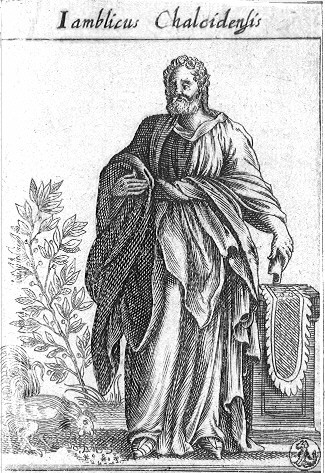
Iamblichus of Apamea
Dates: c. 245–c. 325 CE Domain: Neoplatonist Philosophy, Theurgy, Late Antique Religion
Biography
Iamblichus was born around 245 CE in Chalcis ad Belum (now Qinnasrin, Syria), a city in the Roman province of Syria, sometimes called Apamea for the surrounding region. He came from a wealthy Syrian family and studied under Anatolius and then Porphyry of Tyre, the disciple and editor of Plotinus, before eventually establishing his own influential school in Syria. His students included many of the major figures of later Neoplatonism, and his influence extended forward through Proclus and Julian the Apostate (who attempted a Neoplatonist revival of paganism) to the Florentine Platonists of the Renaissance. He died around 325 CE, just as the Christianization of the Roman Empire was beginning to decisively shift the philosophical landscape.
Iamblichus represents a decisive break within the Neoplatonic tradition. His immediate predecessor Plotinus had established the central Neoplatonic practice as epistrophē: the inward turning of the intellect toward its source in the One. For Plotinus, salvation (or more precisely, henosis, union with the One) was achievable through pure philosophical contemplation, and the material world was at best an occasion for such turning, at worst a distraction. Porphyry, Plotinus's disciple, had written a letter (Letter to Anebo) raising pointed philosophical questions about traditional religious rites and theurgy, doubting their efficacy and wondering whether such practices could truly elevate the soul.
Iamblichus's De Mysteriis (On the Mysteries) is his massive response to Porphyry, written, interestingly, under the fictional persona of "Abamon," an Egyptian priest. The strategic choice of persona is significant: Iamblichus was asserting the priority of Egyptian priestly wisdom over Greek philosophy as a framework for understanding the ritual dimension of religion. Against Porphyry's rationalistic skepticism, Iamblichus argued that the soul has fully descended into matter, a crucial correction to the Plotinian doctrine of the "undescended soul" (the idea that part of the soul always remains in contact with the divine). For Iamblichus, the soul is thoroughly embodied, and therefore purely intellectual ascent is insufficient. The body, and specifically embodied ritual action, is the very medium through which divine power enters human life.
Theurgy, literally "divine working," is, for Iamblichus, not magic in any vulgar sense but a form of ritual participation in the divine order. The theurgical rites (which included material objects, specific gestures, incantations, and initiatory procedures) do not manipulate the gods or compel divine power; rather, they are themselves the activity of the gods operating through human vessels. The theurgist does not ascend to the gods by his own power; the gods descend through the ritual form. This inversion of the Plotinian paradigm, from contemplative ascent to receptive ritual descent, is philosophically momentous and directly relevant to any account of why mystery initiations require embodied practice rather than private meditation.
Key Works (in library)
| Work | Year | Relevance |
|---|---|---|
| On the Mysteries of the Egyptians, Chaldeans, and Assyrians | c. 300 CE | Central document: the philosophical defense of theurgy and the argument against Porphyry's rationalism (LIB-0299) |
Role in the Project
Iamblichus is central to the project's argument about why mystery schools exist at all — why initiation requires a community, a teacher, a ritual setting, and embodied practice rather than solitary contemplation. His debate with Porphyry and the implicit contrast with Plotinus dramatizes the core question: can the intellect alone achieve what initiation promises, or does transformation require something more? The project's answer, following Iamblichus, is that the fully descended soul requires a fully embodied path. This has implications not only for the ancient mystery schools but for the project's account of what esoteric practice in the present should look like. Iamblichus also connects the project to the broader question of the relationship between Greek philosophy and Egyptian and Near Eastern initiatory traditions, which Iamblichus was consciously attempting to synthesize.
Key Ideas
- Fully descended soul: Against Plotinus's "undescended soul," Iamblichus argues that the human soul has entirely entered matter. Purely intellectual ascent cannot accomplish what theurgy alone can.
- Theurgy vs. philosophy: Philosophy (dialectic, contemplation) is necessary but insufficient; theurgy — ritual action in participation with divine powers — is the completing act.
- Divine activity through ritual: Theurgical rites are not human performances that compel the gods but divine activities that work through human material; the theurgist is the medium, not the agent.
- Hierarchy of beings: Iamblichus greatly expanded the Neoplatonic hierarchy (gods, daimons, heroes, souls) and specified the ritual means by which each level could be engaged.
- Egyptian wisdom: By writing as "Abamon," Iamblichus was asserting that Greek philosophical analysis must answer to an older, deeper wisdom preserved in priestly and initiatory traditions.
The Orders of the Divine
The central thesis of On the Mysteries (LIB-0299) is the defense of theurgy, but a large part of the actual text is taken up with something more concrete: a detailed map of the beings a theurgist might encounter. Iamblichus expands the Neoplatonic hierarchy into a graded series of orders, gods, archangels, angels, daimons, heroes, archons, and souls, and then does something his predecessors had not. He describes how to tell them apart.
Each order, Iamblichus argues, manifests with its own signature. The manifestations differ in their beauty, their stability, the quality and intensity of their light, the speed of their motion, and above all in their effect on the one who receives them: a true god leaves the soul with order, calm, and a kind of enlargement, while lower or disordered powers leave agitation, confusion, or inflation. The theurgist is therefore not only a celebrant but a discriminating observer. Ritual without discernment is dangerous, because not every presence that answers an invocation is what it appears to be.
This is why Iamblichus matters to the project beyond the theurgy debate. He insists that the invisible world is neither uniform nor automatically benign, and that initiatory practice requires the trained capacity to tell one order of being from another. The phenomenology of manifestation that occupies the second book of On the Mysteries is the ancient world's most systematic attempt to give that discernment a method (LIB-0299).
Connections
- Influenced by: FIG-0005 (Plotinus, against whom he is defining himself), Porphyry, Pythagoras, Egyptian priestly tradition
- Influenced: Proclus, Julian the Apostate, Damascius, and through them the entire late Neoplatonic tradition; indirectly, the Florentine Platonists (Ficino, Pico) who revived theurgy in the Renaissance
- In tension with: FIG-0005 (Plotinus; the fundamental tension between contemplative and theurgical approaches to the divine)
Agent Research Notes
[AGENT: perplexity | DATE: 2026-03-20] LIB-0299 is present in the library as the full text of De Mysteriis. The Stanford Encyclopedia of Philosophy article on Iamblichus is excellent and was consulted for this entry. His dates are given variously as c. 242–325 or c. 245–325 CE; the c. 245 figure reflects the most recent scholarly consensus. The debate structure between Iamblichus and Porphyry is unusually well preserved and makes for strong podcast material: it is a genuine philosophical disagreement about the nature of the soul and the efficacy of ritual, not merely a doctrinal squabble. The project should note that Iamblichus's De Mysteriis was enormously influential on the Cambridge Platonists and, through them, on the Western esoteric tradition broadly; see CON-0008 (Theurgy).
[AGENT: claude-code | DATE: 2026-04-03] Deepened with material from LIB-0299 (Iamblichus, On the Mysteries). Added "The Orders of the Divine," on Book II's phenomenology of the classes of divine beings and the discernment theurgic practice requires. Existing content was not rewritten.