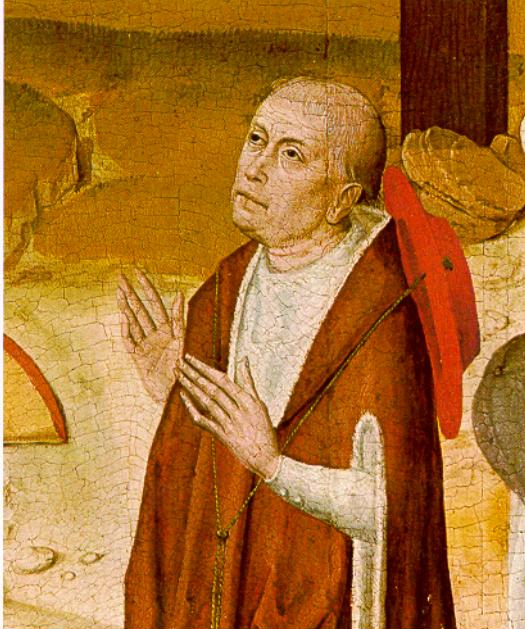
Nicholas of Cusa
Dates: 1401–1464 Domain: Philosophy, Theology, Mysticism, Mathematics
Biography
Nicholas of Cusa was born in 1401 in Kues (Cusa), on the Moselle River in the Trier diocese of Germany, the son of a prosperous wine merchant, and died on August 11, 1464, in Todi, in the Papal States. He received an education that reflected the transitional intellectual world of his time: he studied at Deventer with the Brethren of the Common Life (the devotional movement associated with The Imitation of Christ), studied canon law at Padua (where he received his doctorate in 1423), and theology at Cologne. The range of his formation, mystical devotion, humanist scholarship, mathematical reasoning, and canon law, produced the distinctive combination that defines his thought.
His public career was devoted to the reform and governance of the Catholic Church: he was a prominent participant in the Council of Basel in the early 1430s, where he initially supported conciliarism (the view that church councils take precedence over the pope) before shifting his allegiance to the papacy and eventually becoming a cardinal. He served as papal legate to Germany and later as Bishop of Brixen in the Tyrol, where he engaged in protracted and sometimes violent conflicts with the local nobility. He died in the service of Pope Pius II's crusading project, ending his life far from the intellectual world he had created.
What makes Nicholas philosophically extraordinary is the way he used mathematics, specifically the study of infinity and its relationship to the finite, as a vehicle for mystical theology and epistemology. He arrived at his central concept of docta ignorantia (learned ignorance) during a sea voyage from Constantinople to Venice in 1437–1438, describing the experience as an illumination received "from above." The resulting treatise, De Docta Ignorantia (finished February 12, 1440), is one of the great monuments of medieval-Renaissance thought: a work that applies the mathematics of the infinite to the question of God's relationship to creation, and arrives at conclusions that are simultaneously Neoplatonic, apophatic (negative theological), and mathematically rigorous.
The texts he drew on were formative: Pseudo-Dionysius the Areopagite (his primary mystical source), Meister Eckhart (whose radical apophatic theology he synthesized with greater philosophical precision), the Hermetic tradition, and Boethian mathematics. He influenced Marsilio Ficino and Pico della Mirandola directly and thus stands at the foundation of the Florentine Neoplatonic renaissance that Yates would later analyze. His De Pace Fidei (1453), written in the wake of the Turkish conquest of Constantinople, proposed a reconciliation of all religions in a universal peace grounded in the recognition of their convergence on a single divine reality, one of the earliest serious documents of interreligious philosophy.
Key Works (in library)
Note: Nicholas of Cusa's works do not appear in the current library index (LIB-0001–0337) and should be flagged as significant acquisitions.
| Work | Year | Relevance |
|---|---|---|
| De Docta Ignorantia (On Learned Ignorance) | 1440 | The central philosophical-theological work; learned ignorance, the absolute maximum, and coincidentia oppositorum |
| De Coniecturis (On Conjectures) | 1442–43 | Extension of the epistemological framework: all human knowledge as conjecture oriented toward an infinite truth |
| De Visione Dei (The Vision of God) | 1453 | Mystical treatise on divine seeing and being seen; uses the image of an omnivoyant icon to meditate on the relationship between finite and infinite awareness |
| De Pace Fidei (On the Peace of Faith) | 1453 | Interreligious dialogue; the convergence of all religions on the one God |
Role in the Project
Nicholas of Cusa occupies a structurally essential position in the project: he is the philosopher who makes the transition from the medieval mystical tradition (Pseudo-Dionysius, Eckhart) to the Renaissance humanism (Ficino, Pico) that Yates documents. Without Cusa, the thread of apophatic mysticism runs the risk of remaining locked within a specifically theological register. With Cusa, it becomes available to the philosophically secular and mathematically sophisticated Renaissance mind, and thus to the chain of influence that eventually reaches Giordano Bruno and the Hermetic tradition.
His central concept, coincidentia oppositorum (the coincidence of opposites), provides its most philosophically precise expression of what all initiatory traditions gesture toward with their symbolism of paradox, reversal, and the union of seemingly incompatible states. The mystic's claim that in the divine, life and death are one, that the maximum and minimum coincide, that the finite and infinite are enfolded in each other: this is not mere rhetoric but, for Cusa, a logical consequence of rigorous mathematical reasoning about the nature of infinity. The infinite, he argues, cannot be exceeded; therefore anything whatsoever that it "contains" (and it contains all things, since nothing can be outside it) coincides within it, its extremes touching. The mathematical image of the circle whose circumference, when expanded to infinite radius, becomes a straight line, and whose center and circumference thus coincide, is one of his most elegant demonstrations.
The concept of docta ignorantia (learned ignorance) connects Cusa directly to the project's apophatic register (see FIG-0010, Pseudo-Dionysius) and to the epistemological problematic that runs through all the project's thinkers. Learned ignorance is not the ignorance of the uninformed but the recognition, achieved through rigorous inquiry, that the ultimate truth exceeds all conceptual grasp. This is not skepticism (we cannot know anything) but a positive epistemological position: the highest form of knowledge is the knowledge that the highest truth cannot be known in the ordinary sense, and this knowledge, properly attained, is itself a form of transformed cognitive relationship with the divine. It corresponds precisely to what Barfield calls the overcoming of onlooker consciousness: the recognition that the cognitive subject cannot stand outside the living whole and grasp it from a neutral position.
His concept of complicatio/explicatio (enfolding and unfolding) provides an elegant vocabulary for the relationship between divine unity and created multiplicity. God complicates (enfolds) all things in the divine unity; creation explicates (unfolds) the divine into the multiplicity of finite existence. This is not pantheism (Cusa was careful to maintain the distinction) but a dynamic understanding of transcendence and immanence that gives philosophical precision to the Neoplatonic framework the project inherits from Plotinus and Iamblichus.
Key Ideas
- Docta ignorantia (learned ignorance): The epistemological insight that the highest truth, infinite, absolute Being, exceeds all finite conceptual grasp. The learned person is one who has genuinely recognized this limit, not from intellectual failure but from insight: the recognition of the limit is itself a transformed cognitive relationship with the unlimited.
- Coincidentia oppositorum (coincidence of opposites): In the Absolute Maximum, all distinctions and opposites, large and small, one and many, finite and infinite, rest and motion, coincide. What appear as irreconcilable opposites in finite existence are enfolded in unity in the divine. This is not irrational paradox but a consequence of rigorous thinking about the nature of infinity.
- Complicatio / explicatio (enfolding / unfolding): God enfolds (complicat) all things within the divine unity; creation is the unfolding (explicatio) of the divine into the diversity of finite beings. Every creature is thus a contraction of the divine, a finite expression of the infinite. The mystical path is the return through explicatio toward complicatio: the ascent from multiplicity toward the enfolding unity.
- The Absolute Maximum: Cusa's term for God: that which can be exceeded by nothing, that which is equal to the Minimum (since beyond the maximum no distinction of greater and lesser obtains), and in relation to which all finite beings are infinitely below. The mathematical reasoning about the infinite drives this concept.
- Conjectural knowledge: In De Coniecturis, Cusa argues that all human knowledge is conjecture, not in the sense of mere guessing, but in the sense that finite mind always participates in, without ever fully grasping, the infinite truth. This is a sophisticated epistemological claim that avoids both skepticism and naive dogmatism.
- De Pace Fidei: Nicholas's vision of an interreligious dialogue in which representatives of all the world's religions discover that they all worship the same God under different names and through different rites. A fifteenth-century precursor of perennialist thinking that is more philosophically careful than Huxley because it insists on the diversity of rites while affirming the unity of the divine that is worshipped.
Cusa and the Modern Synthesis
The Secret Doctrine (LIB-0015), H. P. Blavatsky's vast 1888 attempt to recover a single wisdom-tradition behind all religion, science, and philosophy, enlists Nicholas of Cusa among its forerunners. Blavatsky reads Cusa as one of the Western minds who approached the hidden doctrine: a cardinal of the Church who nonetheless grasped the infinity of the cosmos and the unity beneath the world's many faiths, and who therefore belongs, in her account, to the lineage running forward to Bruno.
The enlistment is half apt and half distortion, and the distinction is worth holding. It is apt because Cusa genuinely did seek the one behind the many. De Pace Fidei imagines the world's religions discovering that they worship a single God, and De Docta Ignorantia drives toward an Absolute in which all opposites coincide. A synthetic, perennially inclined impulse is really there in him.
But Blavatsky's synthesis and Cusa's are not the same kind of thing, and reading him only as her precursor loses what makes him valuable. Cusa held a discipline that The Secret Doctrine repeatedly drops. De Pace Fidei affirms one divine reality while insisting on the genuine diversity of the rites through which it is approached; docta ignorantia keeps the apophatic limit, the knowledge that the highest truth exceeds every formulation, including the synthesizer's own. Cusa's synthesis is bounded by what it confesses it cannot know. Blavatsky's is not.
This is part of why the project sets the two side by side. Cusa is a measure against which the modern Theosophical synthesis can be assessed: the forerunner who shows that the search for unity need not flatten the distinctions, and need not manufacture the certainty, that The Secret Doctrine flattens and manufactures.
Connections
- Influenced by: Pseudo-Dionysius the Areopagite (primary mystical source; see FIG-0010), Meister Eckhart (apophatic theology and the mystical intellectual tradition), Boethius (mathematical thinking), Proclus (Neoplatonic metaphysics), Raymond Llull
- Influenced: Marsilio Ficino (directly; Cusa met Ficino in Florence), Pico della Mirandola, Giordano Bruno (the infinite universe; the coincidence of opposites), and through these figures the Renaissance Hermetic tradition that Yates documents
- In convergence with: FIG-0010 (Pseudo-Dionysius: Cusa is the systematic medieval philosophical heir of the Dionysian apophatic tradition), FIG-0005 (Plotinus: Cusa synthesizes Neoplatonic henology with Christian theology and mathematical reasoning), FIG-0017 (Yates: Cusa stands at the foundation of the Florentine Renaissance Neoplatonism Yates analyzes)
Agent Research Notes
[AGENT: cursor | DATE: 2026-03-21] Assigned thematic image IMG-0002 as imagery.primary. No portrait available in corpus. Portrait acquisition needed.
[AGENT: perplexity | DATE: 2026-03-20] None of Cusa's works appear in the current library index. The most important acquisition is De Docta Ignorantia: the best English scholarly edition is Jasper Hopkins's translation (Nicholas of Cusa on Learned Ignorance, Arthur J. Banning Press, 1981/1985), though the German original edition (Meiner Verlag) is the scholarly standard. His dates are definitively 1401–1464 (born in 1401 in Kues; died August 11, 1464 in Todi). The De Visione Dei (1453) is particularly recommended as an accessible entry to his mystical thought; it is organized around meditation on a painting of an omnivoyant face and is shorter and more directly experiential than the metaphysical treatises. The connection to Pseudo-Dionysius (FIG-0010) should be foregrounded: Cusa is the primary scholastic-into-Renaissance transmitter of the Dionysian apophatic tradition, and the project's FIG-0010 entry should cross-reference him explicitly.
[AGENT: claude-code | DATE: 2026-04-03] Deepened with material from LIB-0015 (The Secret Doctrine). Added "Cusa and the Modern Synthesis," on Blavatsky's enlistment of Cusa among the forerunners of the hidden wisdom-tradition, and on the contrast between Cusa's disciplined synthesis (the diversity of rites preserved in De Pace Fidei, the apophatic limit kept in docta ignorantia) and the modern Theosophical synthesis. Existing content was not rewritten.