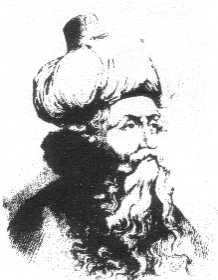
Muhyiddin Ibn Arabi
Dates: 1165–1240 Domain: Islamic Metaphysics, Sufi Mysticism, Cosmology
Biography
Muhyiddin Ibn Arabi was born in Murcia, in Muslim Spain (al-Andalus), in 1165. The intellectual and cultural world of his formation was one of the most sophisticated in the medieval world: Andalusian Islam had produced Averroes (Ibn Rushd) and Maimonides within a generation, and the confluence of Arabic, Hebrew, Berber, and Spanish intellectual traditions created a density of philosophical and spiritual resource that was unmatched in Europe. Ibn Arabi began encountering Sufi masters in his youth; he claimed to have met Averroes as a child, a meeting he described as the moment when the philosopher who knew by syllogism recognized, in the child, the one who knew by direct disclosure. He traveled extensively — to Tunis, to Cairo, repeatedly to Mecca, finally settling in Damascus in 1223, where he lived and wrote until his death in 1240.
His output was staggering: over 350 works, of which the most important are the al-Futuhat al-Makkiyya (The Meccan Openings) — begun at Mecca in 1203 and revised continuously for thirty years, running to 37 volumes in the modern edition — and the Fusus al-Hikam (Bezels of Wisdom, 1229), a work he claimed was dictated to him by the Prophet Muhammad in a vision, in which each chapter is organized around a prophetic figure (Adam, Noah, Abraham, Moses, Jesus, Muhammad) and extracts from their story the specific divine wisdom (hikma) they embody. The Fusus is one of the most dense and difficult texts in Islamic philosophical literature, and it generated centuries of commentary.
The concept most associated with Ibn Arabi in Western scholarship — wahdat al-wujud (Unity of Being, or Oneness of Existence) — was actually a formulation by his followers, not a phrase he used in this form. But the idea it captures is genuinely central: all existence is a single self-disclosure of the Real (al-Haqq, one of the names of God). There are not two things, God and world, related by creation; there is one Reality that appears under different modalities and degrees of intensity. This is not pantheism in the simple sense (God is not identified with the world as it appears); it is closer to panentheism, or to what Plotinus would call the emanation of the One. The world is the self-disclosure of the divine names and attributes — the mirror in which the divine knows itself.
The concept that is most directly relevant to the project is the Barzakh: the isthmus or intermediate world that stands between the purely spiritual and the purely material. Ibn Arabi uses this term (borrowed from the Quran) to name the ontological level where imagination operates — a level that is neither purely subjective nor purely objective but has its own genuine reality. This is exactly Corbin's "imaginal world" (mundus imaginalis): Corbin developed his entire phenomenology of the imaginal by working with Ibn Arabi's ontological framework, and the argument that the imaginal is genuinely real (the critique of Jung) has its foundation here. This means that what the Mysteries were accessing — the encounter with divine figures, the journey through non-physical spaces, the communication with intelligences — was neither hallucination nor material fact but something in between: ontologically real, but of a different ontological order than the material world.
Ibn Arabi's prophetology — his account of the perfect human being (al-Insan al-Kamil) who mirrors the totality of the divine attributes — is the Islamic parallel to the Hermetic concept of the anthropos: the primordial human being whose full restoration constitutes the telos of spiritual life. His account of the imagination as the faculty that operates in the Barzakh, that is responsible for the genuine symbolic perception of divine realities, is the most sophisticated medieval Islamic account of what the Mysteries were claiming the initiated consciousness could do.
Key Works (in library)
| Work | Year | Relevance |
|---|---|---|
| Fusus al-Hikam (Bezels of Wisdom) | 1229 | The most concentrated expression of Ibn Arabi's metaphysics; each prophet as a facet of divine wisdom |
| al-Futuhat al-Makkiyya (The Meccan Openings) | 1203–1240 | The encyclopedic account of the Sufi path; cosmology, metaphysics, spiritual psychology |
| Tarjuman al-Ashwaq (Interpreter of Desires) | c. 1215 | Love poems with extensive mystical commentary; the erotic as vehicle for the ontological |
Role in the Project
Ibn Arabi is, through Corbin's mediation, one of the most important metaphysical anchors of the project. His ontology of the Barzakh solves, or at least coherently addresses, what is otherwise the most difficult philosophical problem the project faces: how to maintain that the experiences attested by the initiatory traditions are genuinely real (not merely subjective psychological events) without claiming they are material facts. The imaginal world — Ibn Arabi's Barzakh, Corbin's mundus imaginalis — provides an ontological category adequate to the kind of reality the Mysteries claim to access. This is why the project maintains the Corbinian critique of Jung: without the imaginal as an ontological category, the Mysteries become "merely" psychology, and the claim to genuine transformation is evacuated of its content.
Key Ideas
- Wahdat al-Wujud (Unity of Being): All existence is the self-disclosure of the single Real; the world is not separate from God but is the mirror in which the divine attributes appear.
- Barzakh (Isthmus): The intermediate ontological level between spirit and matter, where imagination operates and where divine realities become perceptible to the trained consciousness.
- The Perfect Human (al-Insan al-Kamil): The human being who mirrors the totality of the divine names — the telos of spiritual development, the point at which the divine knows itself through a human instrument.
- Self-Disclosure of the Divine: Creation as continuous theophany — the divine is constantly showing itself in new and different forms, because its nature is self-expression; the Sufi is the one who can read these disclosures.
- The Imagination as Ontological Faculty: Not a subjective capacity that produces fictions but the faculty that perceives the Barzakh — the level at which spiritual realities become visible without fully materializing.
Connections
- Influenced by: The Quran and Hadith (primary sources), Neoplatonism (indirect, via Islamic translations), earlier Sufi tradition (al-Hallaj, al-Ghazali)
- Influenced: FIG-0009 Corbin (who organized his entire philosophical project around Ibn Arabi), FIG-0041 Rumi (parallel contemporary, though direct influence is disputed), the entire subsequent tradition of Islamic metaphysics
- In tension with: Literalist and legalist Islam (which has found wahdat al-wujud problematic or heretical), Averroist rationalism
Agent Research Notes
[AGENT: perplexity | DATE: 2026-03-22] Ibn Arabi's dates are confirmed 1165–1240. He died in Damascus on November 16, 1240. The standard Western scholarly introduction is William Chittick's The Sufi Path of Knowledge (1989) and The Self-Disclosure of God (1998) — both essential for the project. Corbin's engagement with Ibn Arabi is most fully developed in Creative Imagination in the Sufism of Ibn Arabi (1958, trans. 1969). The concept of wahdat al-wujud has been a source of controversy within Islam for centuries; Salafi and Wahhabi movements have consistently condemned it. The Ottoman Empire produced extensive commentaries on Ibn Arabi, treating him as the supreme Sufi authority.