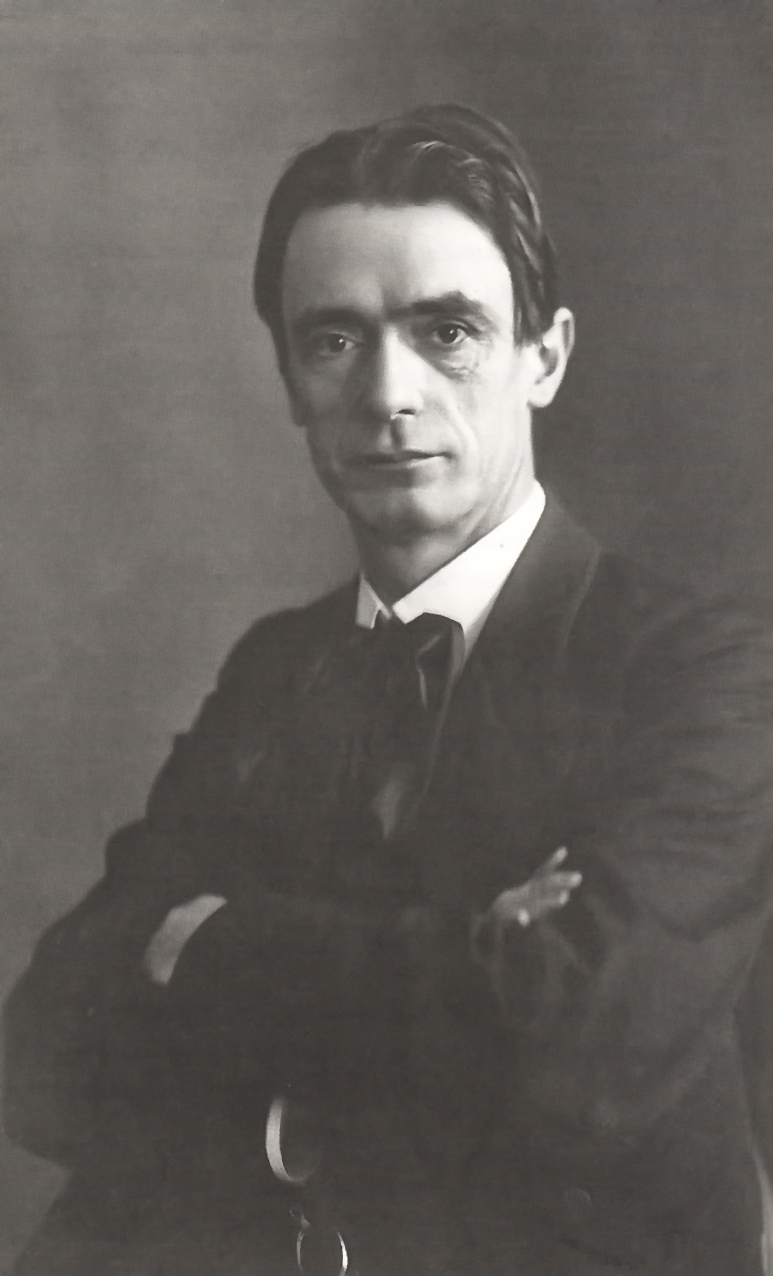
Rudolf Steiner
Dates: 1861–1925 Domain: Philosophy, Epistemology, Esotericism, Spiritual Science
Biography
Rudolf Steiner was born on February 27, 1861, in Kraljevec, then part of the Austrian Empire (now Croatia), and died on March 30, 1925, in Dornach, Switzerland, having shaped one of the most ambitious syntheses of spiritual knowledge and epistemological rigor in modern Western esotericism. He grew up in a modest Austrian railway family, showing early gifts in mathematics and natural science, and was appointed by Joseph Kürschner to edit Goethe's natural-scientific writings for a major German edition, a task that began in 1883 and would define the intellectual trajectory of his life. That encounter was not incidental: Goethe gave Steiner the model for a science that does not retreat from quality, organism, and living process, but makes them the object of a disciplined, expanded cognition.
His early philosophical work, including Goethean Science (1883–1897) and The Philosophy of Freedom (1894, later republished as Intuitive Thinking as a Spiritual Path), established the foundation for everything that followed. In The Philosophy of Freedom, Steiner argued that genuine freedom is only possible when a human being acts from pure thinking: thinking that has freed itself from both external compulsion and unconscious instinct, and derives its impulse from the self-evident content of ideas apprehended with full consciousness. This is not libertarianism but a precise epistemological claim: that thinking, when made sufficiently pure and inward, discloses the structure of reality itself. It is the spiritual faculty waiting to be recognized as such.
Steiner was associated with the Theosophical Society from 1902 to 1912, serving as head of its German Section, but departed over irreconcilable differences, chiefly his insistence on the centrality of Christ as a unique spiritual event in cosmic history, in contrast to Theosophy's more syncretic framings. He founded the Anthroposophical Society in 1913 and built its headquarters, the Goetheanum, in Dornach, Switzerland, a building of extraordinary organic architecture that embodied his Goethean principles. The Goetheanum burned down in 1922 (a suspected arson), and Steiner's health declined thereafter; he died three years later, having given over 6,000 lectures on topics ranging from education, medicine, and agriculture to cosmology, Christology, and the evolution of consciousness.
His clairvoyant method, which he called spiritual science, claimed to apply the rigor of scientific method to the investigation of supersensible realities. He produced elaborate accounts of the spiritual history of humanity (Cosmic Memory, An Outline of Esoteric Science), the nature of the human being as a fourfold entity (physical, etheric, astral, ego), and the beings that influence human development across cosmic time-cycles. Waldorf education, biodynamic agriculture, anthroposophical medicine, and eurythmy all emerged as practical applications of his vision.
Key Works (in library)
| Work | Year | Relevance |
|---|---|---|
| An Outline of Esoteric Science (CW 13) | 1910 | The most systematic account of Anthroposophy's cosmological and spiritual framework (LIB-0078) |
| Cosmic Memory: Atlantis, Lemuria, and the Division of the Sexes | 1904–1908 | Clairvoyant reports on the evolution of humanity through earlier stages (LIB-0079) |
| Goethe's Theory of Knowledge (CW 2) | 1886 | Foundational epistemological statement; Goethean method as participatory cognition (LIB-0080) |
| How to Know Higher Worlds | 1904–1905 | The path of esoteric training and cognitive development (LIB-0081) |
| Intuitive Thinking as a Spiritual Path (The Philosophy of Freedom) | 1894 | Core epistemological argument for thinking as spiritual experience (LIB-0082) |
| Theosophy: An Introduction to the Spiritual Processes in Human Life and in the Cosmos | 1904 | Accessible introduction to Steiner's worldview (LIB-0083) |
Role in the Project
Steiner operates in the project on two distinct but related levels, and the project must be explicit about maintaining this distinction. At the epistemological level, Steiner's Philosophy of Freedom is treated as a substantive philosophical contribution of the first order. His argument that pure, living thinking, freed from the body and from the merely mechanical, is itself the gateway to spiritual perception is not a wild claim but a disciplined epistemological proposal. It converges with Barfield's account of final participation (both point toward a freely achieved re-engagement with reality through consciousness rather than regression to undifferentiated states) and with Hadot's insistence that philosophy is a practice of self-transformation. Steiner's Goethean method, taking qualitative phenomena seriously and training perception to meet them with corresponding depth, anticipates contemporary critiques of reductionist science without abandoning the aspiration to rigor.
At the diagnostic level, Steiner's Ahrimanic/Luciferic polarity provides an unusually precise framework for what the project is navigating. Ahriman is the force of hardening, abstraction, and materialization: the reduction of reality to measurable, manipulable quantity, the death of thought in dead reflection, the denial of spirit in matter. Lucifer is its complement and collaborator: the force of inflation, fantasy, and false spirituality, the escape from incarnate reality into ungrounded mystical elevation. Both poles distort consciousness and both are active in modernity: Ahrimanic forces dominate the techno-scientific worldview, while Luciferic forces animate its spiritual counter-movements in degraded forms. The healthy development of consciousness requires holding the tension between them, as the figure in Steiner's sculpture The Representative of Humanity stands between and overcomes both. This polarity maps directly onto Heidegger's Gestell (Ahrimanic) and the dangers of ungrounded New Age spirituality (Luciferic).
At the clairvoyant report level, the project adopts a deliberate methodological agnosticism. Steiner's accounts of Atlantis, the Akashic Record, planetary evolution, and the spiritual hierarchies are treated as a tradition's own perceptions: the kind of claims that a spiritual movement makes about the structure of spiritual reality as it experiences it. They are neither accepted as factual accounts verifiable by other means nor dismissed as fabrications. The project holds them in the same way one might hold the cosmological claims of the Neoplatonists or the Hermetic tradition: seriously, contextually, without requiring epistemological capitulation.
Key Ideas
- Living thinking: Steiner's central epistemological claim: that thinking, when pursued beyond its ordinary mechanical form, becomes an organ of spiritual perception. Living thinking is active, not merely reflective; creative, not merely reproductive.
- Ahrimanic forces: Spiritual influences that harden and densify, promoting materialism, abstraction, and the quantification of all reality. In the present age, the dominant Ahrimanic influence is expressed in technological enframing, mechanistic science, and the reduction of the human being to a measurable object.
- Luciferic forces: Complementary spiritual influences that dissolve and inflate, promoting premature spiritualism, evasion of earthly responsibility, and false illumination that bypasses incarnate development.
- Representative of Humanity: The image of the spiritually developed human being who stands between and consciously integrates both polarities rather than being captured by either. This is the key image for the project's vision of mature initiation.
- Goethean science: A method of natural inquiry that engages qualities rather than reducing them to quantities, trains perception to meet phenomena in their living wholeness, and treats the scientist's inner transformation as inseparable from knowledge of the world.
- Mystery of Golgotha: Steiner's interpretation of the Christ event as a unique spiritual occurrence in cosmic evolution: the moment at which the Sun-Spirit descended into matter and redeemed the hardening of earthly existence. This gives the project a specifically Christian Anthroposophical framing of cosmic initiation that it must engage carefully.
The Operative Path: How to Know Higher Worlds
Steiner's role in the project is usually described in three registers: the epistemologist of The Philosophy of Freedom, the diagnostician of the Ahrimanic and Luciferic, and the clairvoyant reporter of An Outline of Esoteric Science. How to Know Higher Worlds (LIB-0081) adds a fourth, and it is the one that shows Steiner most plainly as a figure: the practical teacher of a path.
The book is a training manual. Serialized in 1904 and 1905 and then published openly, it sets out a graded discipline of inner work, exercises in the control of thought, in reverence, in inner tranquility, leading through stages Steiner names Imagination, Inspiration, and Intuition. What it reveals about Steiner is a characteristic refusal of shortcuts. He insists that for every step taken toward higher knowledge the student take three steps in the perfecting of character, and he means the proportion as a safeguard: a cognitive faculty developed without matching moral development is, on his account, dangerous rather than merely useless. The path is to be freely chosen, self-monitored, and abandonable at any point; no hierophant conducts it. At its threshold stands the Guardian, the student's own accumulated and unacknowledged self, met as a confronting form.
This operative dimension is continuous with the epistemological one. The claim of The Philosophy of Freedom, that thinking made sufficiently awake is itself a spiritual perception, is what How to Know Higher Worlds turns into a course of practice. Steiner is, across his work, relentlessly practical: Waldorf education, biodynamic agriculture, and anthroposophical medicine are all applications of his vision. How to Know Higher Worlds is that practicality turned on the reader's own initiation.
Connections
- Influenced by: Johann Wolfgang von Goethe (science and epistemology), German Idealism (especially Fichte and Schelling), Theosophy (early formative period, then rejected)
- Influenced: FIG-0002 (Barfield: committed Anthroposophist, formed by Steiner), FIG-0018 (Scaligero: post-Steinerian thinker who extends the method of living thinking), Owen Barfield, biodynamic agriculture, Waldorf education
- In tension with: FIG-0007 (Guénon: both claim esoteric knowledge; Guénon dismissed Steiner as a "pseudo-initiatic" individual without legitimate traditional connection), FIG-0019 (Huxley: perennialism versus Anthroposophy's developmental Christocentric cosmos)
Agent Research Notes
[AGENT: cursor | DATE: 2026-03-21] Assigned thematic image IMG-0178 as imagery.primary. No portrait available in corpus. Portrait acquisition needed.
[AGENT: perplexity | DATE: 2026-03-20] Steiner is well-represented in the library with six entries (LIB-0078 through LIB-0083). The Philosophy of Freedom (LIB-0082) is the most directly relevant to the project's epistemological claims. The Ahrimanic/Luciferic polarity is developed across dozens of lecture cycles; the most accessible treatment is the 1919 lecture cycle The Influences of Lucifer and Ahriman (GA 191). The Wikipedia article on Steiner notes the association with Evola-adjacent figures among some Anthroposophists; the project should be aware of the contested political reception of his work, though Steiner himself was consistently anti-nationalist and anti-racist. His dates are definitively 1861–1925. Note the important biographical link to Scaligero (FIG-0018), who was the primary Italian transmitter of Steiner's thought in the 20th century and who explicitly continues the project of living thinking.
[AGENT: claude-code | DATE: 2026-04-03] Deepened with material from LIB-0081 (How to Know Higher Worlds: A Modern Path of Initiation). Added "The Operative Path," which sets out the fourth register in which Steiner figures for the project: the practical teacher of a self-directed modern initiation, with the moral safeguard ("three steps in character for every step in knowledge") and the Guardian of the Threshold as its signature features. Existing content was not rewritten.