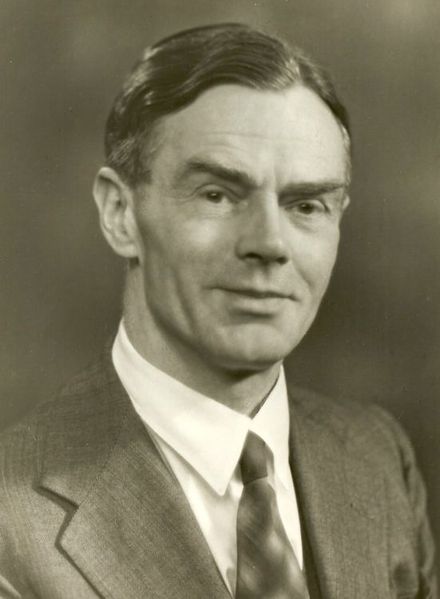
Owen Barfield
Dates: 1898–1997 Domain: Philosophy, Philosophy of Language, Theory of Consciousness
Biography
Owen Barfield was born in London in 1898 and died in 1997 at the age of ninety-nine, a longevity that allowed him to witness the growing recognition of his ideas in the final decades of the twentieth century. He was educated at Wadham College, Oxford, where he formed the friendships that would define his intellectual world: he was among the founding members of the Inklings, the celebrated Oxford literary group that also included C. S. Lewis, J. R. R. Tolkien, and Charles Williams. Lewis famously called Barfield "the wisest and best of my unofficial teachers," and acknowledged that it was Barfield's arguments that destroyed his early materialism and set him on the path toward theism. Tolkien, for his part, drew on Barfield's theory of language and myth in his own sub-creation mythos.
Barfield spent most of his working life as a solicitor (lawyer), writing philosophy on the side, which helps explain why his work was slower to receive academic recognition than that of his more institutionally embedded contemporaries. His intellectual development was shaped above all by two forces: the study of language and its history, and his encounter with the work of Rudolf Steiner. Barfield became a committed Anthroposophist in the 1920s and remained so throughout his life, a commitment that both deepened and limited his reception in mainstream philosophy.
His master insight, first worked out in Poetic Diction (1928) and History in English Words (1926), was that language itself preserves a fossil record of an earlier state of consciousness. Words that today seem metaphorically related, spirit/breath, matter/mother, lunatic/moon, were once experienced as literal descriptions of a unified reality: the inner and outer worlds had not yet separated. This pointed to a mode of awareness he called original participation: an undivided consciousness in which the self was embedded in the world, and the world was felt to be alive, ensouled, and meaningful in its very substance. The history of Western consciousness is, on Barfield's account, the progressive withdrawal from original participation, a necessary but painful process of individuation that reaches its nadir in the modern scientific worldview, where consciousness has been exiled from nature altogether.
The critical and creative move is Barfield's concept of final participation: a deliberate, freely achieved re-engagement with the living world that does not regress to the undifferentiated state of original participation but integrates the hard-won self-awareness of modernity. This is not a return to animism but a forward movement: the task of becoming consciously what archaic humanity was unconsciously. Saving the Appearances (1957) is his most systematic philosophical treatment of this arc, developing a sophisticated epistemological argument that perception itself is always a participatory act, that the "appearances" of the world are co-created by consciousness, and that the scientific revolution's reduction of nature to mathematical quantity was a necessary but ultimately insufficient moment in a longer evolutionary story.
Key Works (in library)
| Work | Year | Relevance |
|---|---|---|
| Poetic Diction: A Study in Meaning | 1928 | Foundational argument that living language preserves record of unified participation (LIB-0139) |
| Saving the Appearances: A Study in Idolatry | 1957 | Core epistemological framework; original participation, idolatry of the literal, final participation (LIB-0240) |
| History in English Words | 1926 | Shows evolution of consciousness encoded in etymology; accessible entry point (LIB-0279) |
Role in the Project
Barfield is arguably the single most important theoretical framework-provider for the project. The project's central thesis, that the mystery traditions represent not mere historical curiosities but milestones in a genuine evolution of consciousness, is unintelligible without Barfield's developmental model. The concept of original participation explains why archaic initiation was both more total and less freely chosen than modern spiritual practice: the initiate was being inducted into a world that was still alive in a way that demanded ritual navigation. The concept of final participation explains what the mystery schools are for in the present: not a nostalgic recovery of the past but a conscious achievement of new relationship with the world. The project uses Barfield's framework as the philosophical spine on which historical material from Eliade, Burkert, and others is organized.
Key Ideas
- Original participation: The undivided state of archaic consciousness in which self and world, inner and outer, spirit and matter were not yet experienced as separate. The world was alive, animated, and meaningful in its literal substance.
- Final participation: The goal of conscious evolution: a freely achieved re-engagement with the living world that preserves and integrates the individual self forged in the modern period.
- Withdrawal of participation / onlooker consciousness: The progressive alienation of the self from the world through the history of Western thought, culminating in the scientific worldview. Necessary, but not the end of the story.
- Living language: Etymology as evidence: the fossil record of prior states of consciousness preserved in word meanings. Words point back toward original unity.
- Polarity and imagination: Barfield's epistemology insists that imaginative knowing, not merely rational analysis, is required to re-enter participatory awareness.
Connections
- Influenced by: Rudolf Steiner (Anthroposophy), Samuel Taylor Coleridge (imagination theory), Johann Wolfgang von Goethe
- Influenced: C. S. Lewis (by his own acknowledged admission), J. R. R. Tolkien (myth and sub-creation), FIG-0006 (Tarnas: participatory epistemology is a direct descendant)
- In tension with: FIG-0001 (Eliade: Eliade's morphology maps forms but not the developmental arc Barfield tracks), FIG-0003 (Gebser: parallel but distinct developmental schema; Gebser's "structures" and Barfield's "participation stages" complement rather than map perfectly)
Saving the Appearances: The Central Text
Saving the Appearances: A Study in Idolatry (1957) is Barfield's most important work for the project, the text in which his philosophy of participation achieves its fullest expression. The book's argument proceeds in three movements: first, an analysis of how collective representations constitute the perceived world (drawing on physics, perception theory, and the history of science); second, a historical account of how these representations have changed, tracing the withdrawal of participation from archaic consciousness through the Greek Axial period to the modern scientific worldview; and third, a philosophical argument for the possibility of "final participation," a conscious recovery of the participatory bond at a higher level. The book's title is its thesis: modern consciousness treats its own representations as independently existing realities (idols), and this idolatry is the deepest obstacle to recovering the participatory consciousness that the mystery traditions cultivated. C.S. Lewis, Barfield's lifelong friend, called Saving the Appearances one of the most important books of the twentieth century. The project agrees.
Agent Research Notes
[AGENT: perplexity | DATE: 2026-03-20] Barfield's three works in the library (LIB-0139, LIB-0240, LIB-0279) cover the main bases. Notable absences include Romanticism Comes of Age (1944) and Speaker's Meaning (1967), which develop his ideas on imagination and anthroposophy respectively. Barfield's close relationship with Steiner's Anthroposophy should be flagged for the project: while Anthroposophy is not the same as the mystery school tradition proper, it represents a modern esoteric system that explicitly claims continuity with those traditions, a claim the project will need to position itself in relation to. Barfield's dates (1898–1997) make him one of the most long-lived philosophers of the twentieth century; he was still giving lectures in his 80s and 90s and saw a significant revival of interest in his work toward the end of his life.