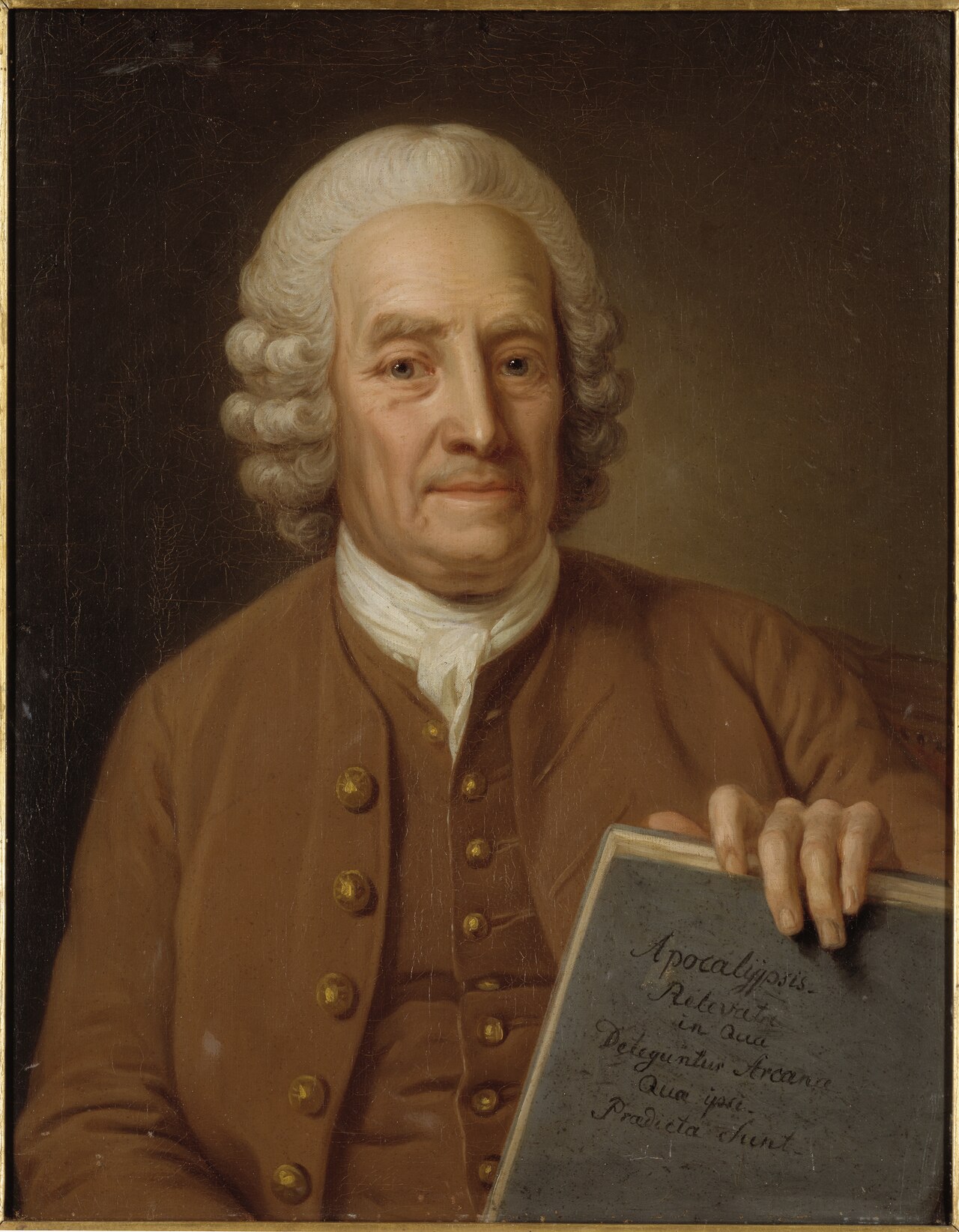
Emanuel Swedenborg
Dates: 1688–1772 Domain: Visionary Theology, Natural Philosophy, Anatomy
Biography
Emanuel Swedenborg was born in Stockholm in 1688, the son of a Lutheran bishop. He received a thorough classical education and emerged as one of the most accomplished natural scientists of his era — before the visionary experiences that would define his second career. His pre-crisis works include important contributions to metallurgy, mineralogy, and anatomy; his Prodromus Principiorum Rerum Naturalium (1721) anticipated Kant's nebular hypothesis, and his anatomical work on the brain and nervous system, done without a microscope, identified the cerebrospinal fluid's role and described the neuron's function with surprising accuracy. He also designed, among other engineering projects, a scheme for transporting a fleet of galleys overland — executed successfully during the 1718 siege of Fredriksten.
The transformation came in 1744–1745, recorded in a private Journal of Dreams that Swedenborg himself never published: a series of violent, terrifying, and ultimately overwhelming experiences in which he believed himself in direct contact with angelic beings. The experiences did not feel like ordinary dreams, and he did not treat them as symbolic material to be interpreted. He believed he had been opened, by divine permission, to direct perception of the spiritual world — that the same world was always present alongside the physical one but that most human beings could not perceive it. From 1745 until his death in 1772, he produced thirty volumes of theological writing based on these perceptions, working in a state that he described as oscillating freely between the two worlds.
Heaven and Hell (1758) is the most systematic presentation of what he observed in the spiritual states: a world organized not by external geography but by inner states, where inhabitants inhabit environments that perfectly reflect their character, where proximity and distance are functions of spiritual affinity rather than physical space, and where the transformation of character that was possible but avoided in earthly life continues through post-mortem states. His doctrine of correspondences — that every natural object corresponds to a spiritual reality — runs through all his theological works and is his most direct legacy to the Romantic tradition. Blake's fourfold vision, Baudelaire's Correspondances, and Emerson's idealism all draw from this well, directly or indirectly.
The Spiritual Diary (written 1746–1765, not intended for publication) is perhaps more revealing than the formal theological works: it contains his moment-to-moment observations during the visionary period, including accounts of conversations with the spirits of historical figures, descriptions of hellish states that are psychologically precise, and occasional expressions of doubt about whether his perceptions are accurate. These moments of uncertainty in the Diary are important: they show a man who regarded his own experiences with the critical attention of a scientist even while he accepted them as real.
Key Works (in library)
| Work | Year | Relevance |
|---|---|---|
| Heaven and Hell | 1758 | Systematic cartography of post-mortem states; correspondence doctrine |
| The Spiritual Diary | 1746–1765 (posthumous) | Private record of visionary experiences; the scientist observing his own visions |
| Arcana Caelestia | 1749–1756 | Eight-volume spiritual interpretation of Genesis and Exodus |
| Divine Love and Wisdom | 1763 | Metaphysical system; love as the substance of spiritual reality |
Role in the Project
Swedenborg occupies a position in the Romantic Initiates series that no other figure fills: the scientist-visionary who served as the primary data source for the Romantic period's recovery of a non-materialist world. His influence on Blake was direct (Blake copied passages from Swedenborg's works and then reacted against him violently); his influence on Balzac, Strindberg, and Yeats was documented and acknowledged. He demonstrated, for the generation that inherited him, that the spiritual world was not a matter of theological doctrine but of direct perception — perceivable by a trained observer if the conditions of perception were properly established.
For the project's broader argument about consciousness, Swedenborg is a test case of what happens when visionary opening occurs without an initiatic tradition to interpret and channel it. He had no guru, no community of practitioners, no existing framework sophisticated enough to receive what he was experiencing. He built the framework himself, using the tools of eighteenth-century empiricism, and the result is simultaneously impressive (its systematic clarity) and limited (its domestication of the visionary into a spiritual bureaucracy). The imaginal world he describes is populated and organized, but it is organized according to Lutheran moral categories that have been spiritualized rather than transcended. Corbin's mundus imaginalis is a more philosophically refined version of the territory Swedenborg explored.
Key Ideas
- Correspondence: Every natural object corresponds to a spiritual reality — not symbolically but ontologically. The natural world is a theater of spiritual meanings, and reading those correspondences is the central cognitive act of Swedenborgian perception.
- The Spiritual World as Inner State: In Swedenborg's heaven and hell, location is determined by character — inhabitants are in environments that reflect what they are. This is not reward and punishment but rather a precise mapping of the principle that the world one inhabits is the world one's perceptions create.
- Continuous Waking Vision: Swedenborg's claim to perceive the spiritual world while fully awake and engaged in ordinary activity — not in trance or sleep but as a parallel stream of perception running alongside the physical. This claim is phenomenologically interesting regardless of its theological status.
- The Scientist's Procedure: Swedenborg brought to his visionary reports the same procedural care he brought to his anatomical observations — describing what he observed, noting anomalies, acknowledging uncertainty. This gives his reports a different texture from most visionary literature.
Connections
- Direct influence on: FIG-0023 Blake (who annotated Swedenborg before reacting against him), FIG-0047 Novalis (Romantic magical idealism draws from the correspondence tradition)
- Related imaginal cartography: FIG-0009 Corbin (Corbin's mundus imaginalis is the philosophically rigorous version of what Swedenborg intuitively perceived), FIG-0052 Andreev (another visionary who built systematic cosmology from direct perception)
- Methodological comparison: FIG-0011 Steiner (another scientist-turned-visionary who claimed systematic perceptual access to spiritual worlds)
Agent Research Notes
[AGENT: perplexity | DATE: 2026-03-22] Swedenborg's Journal of Dreams was not published until 1859, long after his death; it was found among his papers. The New Jerusalem Church — the denomination founded posthumously on his writings — was established in London in 1787. Blake owned and annotated Swedenborg's Heaven and Hell and Divine Love and Wisdom before writing The Marriage of Heaven and Hell (1790) partly as a critique of Swedenborg's binary moral categories. Lars Bergquist's Swedenborg's Secret (2005; English translation 2005) is a solid modern biography. The anatomical claim about cerebrospinal fluid is documented by neurological historian Emanuel Swedenborg, M.D., in papers collected by John Chadwick.