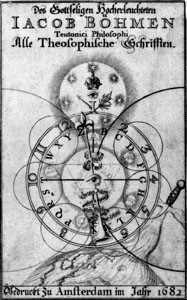
Jakob Boehme
Dates: 1575–1624 Domain: Theosophical Mysticism, Christian Mysticism, Alchemical Philosophy
Biography
Jakob Boehme was born in Alt Seidenberg, near Görlitz, in Lusatia (now eastern Germany), in 1575. He was apprenticed as a cobbler, traveled as a journeyman, settled in Görlitz as a master cobbler, and in 1600 had the illumination that would determine the rest of his life: watching sunlight reflected in a polished pewter dish, he experienced what he described as a penetration into the innermost ground of nature — a vision of the whole of creation's inner principle that he spent the next twenty-five years attempting to articulate. He wrote in German rather than Latin — a choice that both limited his immediate audience and eventually gave him a wider one — and produced a body of visionary theosophical writing that shaped German Romanticism, Schelling's Naturphilosophie, and the English Romantic tradition (through William Law's translations).
Aurora (1612), his first major work, was confiscated by the local Lutheran pastor and Boehme was forbidden to write. He obeyed for six years. Then he began again. The subsequent works — The Three Principles of the Divine Being, De Signatura Rerum (Signature of All Things), Mysterium Magnum — develop his vision with increasing sophistication. The central philosophical innovation is the Ungrund: the groundless abyss that is prior to God himself — not nothing, but the void from which even the divine nature unfolds. This is the most audacious move in the Christian mystical tradition outside of Porete: a theology in which God does not stand at the beginning as the complete and self-sufficient creator but as the first distinction within an abyss that precedes him.
The Signature of All Things (1622) is his most practically influential work: the doctrine that every created thing bears the signature of its inner nature in its outer form — that a healer who has learned to read the book of nature can see, in the shape, color, smell, and texture of a plant, what spiritual and physical condition it addresses. This is the doctrine of correspondences in its most active and practical form, and it fed the Romantic Nature Philosophy's conviction that nature is a living text readable by the properly prepared consciousness.
Key Works (in library)
| Work | Year | Relevance |
|---|---|---|
| Aurora | 1612 | First major work; the theosophical vision of the divine as living self-unfolding |
| The Signature of All Things | 1622 | The doctrine of natural signatures; nature as divine text |
| Mysterium Magnum | 1623 | Commentary on Genesis; cosmic emanation in Protestant mystical key |
| The Way to Christ | 1622 | The practical-devotional dimension; access for non-specialists |
Role in the Project
The Underground Stream track uses Boehme as the figure who kept the theosophical-mystical dimension alive within Protestant Christianity through the seventeenth century, passing it on to the Romantic philosophical and poetic movements of the late eighteenth and early nineteenth centuries. Without Boehme, the transmission from Eckhart through to Blake and Schelling is significantly thinned.
His concept of the Ungrund is philosophically important in a specific way: it shows that a Christian mystic working from within the Protestant tradition arrived at a concept structurally parallel to Eckhart's Godhead, to Nagarjuna's sunyata, and to the pre-divine abyss in Lurianic Kabbalah (Ein Sof before the tzimtzum) — which suggests that this concept is not merely theologically determined but is what the contemplative tradition arrives at when it pushes to the limit of what any framework can describe.
Key Ideas
- The Ungrund: The groundless abyss prior to God — not nothing, not God himself, but the originary void from which even the divine nature unfolds. Boehme's most radical philosophical contribution.
- The Signature of All Things: Every created thing bears the signature of its inner nature in its outer form. Nature is a divine text; the initiated eye can read it.
- The Divine Contrariety: God's nature includes contrariety — light and darkness, love and wrath, fire and gentleness — and it is the tension of these contraries that generates the divine self-expression. This is the Western theosophical version of coincidentia oppositorum.
- Sophia: Boehme's Sophia (divine Wisdom) is not the same as Plotinus's Soul or the Lurianic Shekinah, but she occupies a structurally parallel position: the divine feminine principle that mediates between the infinite and the finite.
Connections
- Underground Stream: FIG-0040 Eckhart (the Ungrund as Boehme's development of the Eckhartian Godhead), FIG-0043 Luria (parallel abyss-before-God in Lurianic Kabbalah — independent convergence)
- Romantic inheritance: FIG-0023 Blake (Boehme's influence on Blake's prophetic books is documented), FIG-0048 Schelling (Weltalter philosophy draws directly on Boehme's theogony)
- CON-0017 Coincidentia Oppositorum (divine contrariety as the theosophical version)
Agent Research Notes
[AGENT: perplexity | DATE: 2026-03-22] Boehme died November 17, 1624 in Görlitz. The Aurora confiscation occurred in 1612 by Pastor Gregor Richter; Boehme obeyed the prohibition until approximately 1618. William Law translated much of Boehme into English in the 1760s; Law's translations were read by Blake and directly influenced the Romantic reception. Andrew Weeks' Boehme: An Intellectual Biography (1991) is the standard scholarly English-language treatment. Franz von Baader's elaborations of Boehme in the early nineteenth century were the conduit into German Idealism.