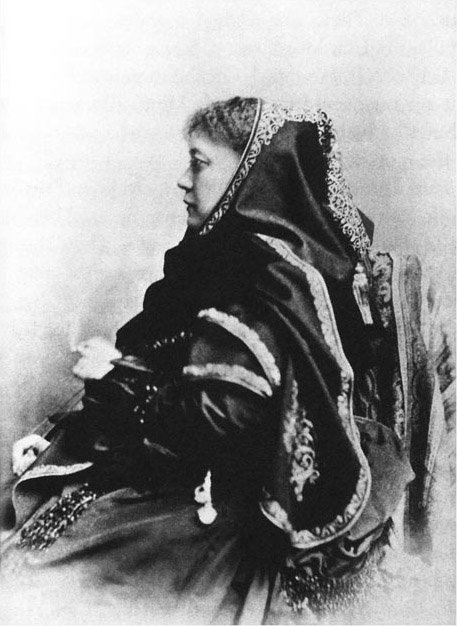
Helena Petrovna Blavatsky
Dates: 1831–1891 Domain: Esotericism, Comparative Religion, Occultism
Biography
Helena Petrovna von Hahn was born in 1831 in Ekaterinoslav (now Dnipro, Ukraine) into a Russian noble family. Her mother was a novelist; her father a military officer. She married Nikifor Blavatsky, a military governor of Yerevan, at seventeen but left him almost immediately and spent the next two decades traveling — Egypt, Tibet (allegedly), India, Europe, and the United States. The years of travel are poorly documented and heavily contested: Blavatsky's own accounts of her movements are inconsistent, and her claim to have studied in Tibet under Mahatmas (Masters of the Ancient Wisdom) was never verifiable and was actively disputed by her critics, especially the Society for Psychical Research's 1885 report by Richard Hodgson, which concluded she had fabricated the Mahatma letters. The Hodgson report has itself been contested; a 1986 re-examination by the SPR suggested methodological problems in Hodgson's analysis. The truth about Blavatsky's biography likely lies somewhere between hagiography and debunking, and the project does not need to resolve it — the work matters independently of the biography.
In 1875, Blavatsky co-founded the Theosophical Society in New York with Henry Steel Olcott and William Quan Judge, with three stated objects: universal brotherhood regardless of race, religion, or sex; the comparative study of religion, philosophy, and science; and the investigation of unexplained laws of nature and the latent powers of the human being. Isis Unveiled (1877), her first major work, was an enormous, chaotic, erudite attack on both materialistic science and dogmatic Christianity, drawing on a vast range of Hermetic, Neoplatonic, and Kabbalistic sources to argue that a secret tradition of occult knowledge had always existed beneath the surface of exoteric religions. The Secret Doctrine (1888), her magnum opus, went further: it claimed to offer the foundational cosmogenesis and anthropogenesis of that hidden tradition, drawing on a mysterious ancient text called the Book of Dzyan (no independent copy of which has ever been identified) and elaborating it with commentary drawing on contemporary science, Hindu and Buddhist philosophy, Kabbalah, and Western occultism.
The intellectual content of The Secret Doctrine is substantial regardless of its provenance. Its cosmological scheme — cyclic manvantaras and pralayas (periods of manifestation and dissolution), the evolution of matter and consciousness through seven rounds and seven root-races, the principle of hierarchical emanation from an Absolute — is a genuine synthesis, however imperfect, of Hindu cosmology, Neoplatonic emanationism, and evolutionary thought. Its central philosophical claim — that consciousness is primary and matter is derived from it, the reverse of Victorian scientific materialism — anticipates the hard problem of consciousness by a century. Its comparative method, drawing parallels between seemingly unrelated traditions to argue for a common origin, is the direct ancestor of the perennialist project in both its academic (comparative religion) and esoteric (Traditionalism) forms.
The problems with Blavatsky's synthesis are also real. The concept of root-races — sequential epochs of humanity, including the Lemurian and Atlantean — was taken up by later occultists including Steiner and, disastrously, by proto-Nazi racial theorists who inverted its hierarchical scheme into a justification for racial ideology. Blavatsky herself was not a racial theorist in the modern sense, but her writing on root-races is often loose enough to support misreadings that led to consequences she would have found repugnant. Steiner, who learned from Blavatsky before breaking with Theosophy, spent decades trying to disentangle the genuine philosophical content from what he considered its excesses.
Key Works (in library)
| Work | Year | Relevance |
|---|---|---|
| Isis Unveiled | 1877 | The original synthesis: Western occultism vs. scientific materialism and dogmatic theology |
| The Secret Doctrine | 1888 | The full cosmogenesis and anthropogenesis of the Theosophical worldview |
| The Key to Theosophy | 1889 | Accessible introduction to Theosophical doctrine in dialogue form |
| The Voice of the Silence | 1889 | Translation and commentary on Tibetan Buddhist ethical teachings; Blavatsky at her most serene |
Role in the Project
Blavatsky occupies a peculiar position in the project: she is both a primary subject and a cautionary example. The Theosophical Society's three objects — universal brotherhood, comparative study, investigation of hidden powers — are almost exactly the project's own program, and this is not coincidental: Theosophy created the conceptual space in which the twentieth century's serious engagement with the esoteric traditions became possible. Without Blavatsky, there is no Steiner, no Guénon (who defined himself partly against her), no Evola, no Western reception of Hindu and Buddhist philosophy on the terms that shaped the twentieth century. At the same time, the template she created — the claim to a single hidden tradition behind all traditions, accessible through a synthesis that the claimant happens to have mastered — is also the template for the pseudo-initiatic movements the project distinguishes from genuine traditions. The project holds this in tension: Blavatsky opened doors that mattered, and she also opened doors through which less scrupulous figures walked.
Key Ideas
- The Secret Doctrine: The claim that a single esoteric wisdom tradition underlies all exoteric religions, encoded in ancient texts and transmitted through initiatic lineages.
- Root-Races: Cyclic epochs of human evolution, each associated with a geographical continent and a specific form of consciousness; the source of both Theosophical cosmology and its most dangerous misappropriations.
- Masters/Mahatmas: Adepts who have completed the normal cycle of human evolution and now guide humanity from retreat — the Theosophical version of the initiatic hierarchy.
- Primacy of Consciousness: Against Victorian materialism, the claim that consciousness is the primary reality and matter is its product; the foundation of the Theosophical anti-materialist position.
- Comparative Religion as Esotericism: The method of finding structural parallels across traditions as evidence for a common origin — the method that academic comparative religion and esoteric perennialism both inherited.
Connections
- Influenced by: Western Hermetic and Neoplatonic tradition (Ficino lineage), Hindu and Buddhist philosophy (via direct study), Kabbalah, Swedenborg
- Influenced: FIG-0011 Steiner (who absorbed and then rejected Theosophy), FIG-0007 Guénon (who defined Traditional philosophy partly against her errors), FIG-0029 Gurdjieff (parallel stream), FIG-0030 Ouspensky (Theosophical context)
- In tension with: FIG-0007 Guénon (fundamental methodological critique), Victorian scientific materialism, orthodox Christianity and Hinduism
Agent Research Notes
[AGENT: perplexity | DATE: 2026-03-22] Blavatsky's dates are confirmed 1831–1891. The Hodgson Report was published in Proceedings of the Society for Psychical Research (1885); the 1986 re-examination was by Vernon Harrison. The Book of Dzyan has never been identified in any independent manuscript; scholars including David Reigle have studied its possible sources. K. Paul Johnson's The Masters Revealed (1994) proposes historical candidates for the Mahatmas. The influence of Blavatsky on proto-Nazi racial thought runs through Guido von List and Jörg Lanz von Liebenfels, not through Blavatsky directly — the connection requires careful historical tracing. The Theosophical Society remains active globally.