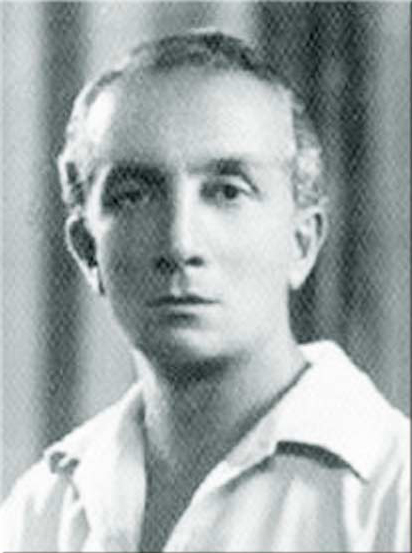
Massimo Scaligero
Dates: 1906–1980 Domain: Philosophy, Spiritual Practice, Post-Steinerian Anthroposophy
Biography
Massimo Scaligero was born Antonio Sgabelloni on September 17, 1906, in Veroli, in the Frosinone area south of Rome, and died on January 26, 1980, in Rome, having dedicated his entire adult life to the cultivation and transmission of what he called living thinking, a form of philosophical practice he understood as the most urgent spiritual task of the present age. His formal education was broad and humanistic: logic, mathematics, philosophy, and literature. As a young man he experienced intense, spontaneous spiritual states whose nature and significance he did not understand and spent decades attempting to clarify. This search eventually brought him, just after World War II, to the works of Rudolf Steiner, specifically to Occult Science (An Outline of Esoteric Science), where he found described in precise terms what he had experienced from within.
His path into Steiner's thought was not direct academic adoption but recognition: "this is what I experienced, now I understand it." He came under the guidance of Giovanni Colazza, who had been a direct personal student of Steiner, and through this living transmission received what he regarded as the essential spiritual impulse of anthroposophy. In the years following Colazza's death, Scaligero became the most prolific and dedicated Italian disseminator of Steinerian thought in the twentieth century, writing more than thirty books and giving two lectures a week in Rome for decades, a relentless output of teaching, meeting, and guidance that continued until he died.
His relationship with Julius Evola is a complicating biographical detail that the project must acknowledge. In his youth, Scaligero was associated with the UR Group, the Italian esoteric organization led by Evola, and contributed to its journals. This association brought him into contact with a world that combined esotericism with fascist-adjacent politics, and Wikipedia's article on Scaligero notes antisemitic writings from this period. By the time of his mature Anthroposophical work, he had departed substantially from Evola's framework; his later thought is humanistic, inward, and focused on the individual's encounter with the Logos. But this earlier association is part of his biography and relevant to the project's critical engagement with the Italian esoteric tradition more broadly.
Scaligero's engagement with Eastern traditions was genuine and prolonged: he practiced Zen and yoga and brought both into creative dialogue with Western philosophical meditation. The subtitle of his central work, A Path beyond Western Philosophy, beyond Yoga, beyond Zen, reflects his aspiration to a meditative path that could not be subsumed under any existing category.
Key Works (in library)
| Work | Year | Relevance |
|---|---|---|
| A Practical Manual of Meditation | n.d. | Practical guidance in the meditative techniques that Scaligero teaches (LIB-0071) |
| A Treatise on Living Thinking: A Path beyond Western Philosophy, beyond Yoga, beyond Zen | 1961 (Ital.) | The central philosophical work; pure thinking as the ground of spiritual experience (LIB-0072) |
| The Light (La Luce): An Introduction to Creative Imagination | n.d. | Extension of the living thinking method to creative imagination as a spiritual faculty (LIB-0073) |
| The Secrets of Space and Time | n.d. | Esoteric treatment of cosmic dimensions (LIB-0074) |
Role in the Project
Scaligero represents the sharpest edge of the engagement with a specific question that the project's contemporary context makes urgent: if thinking itself, active, living, sense-free thinking, is the fundamental form of spiritual experience available to the human being in the present age, then what does it mean to delegate thinking to machines?
This is not a rhetorical question. Scaligero, following Steiner, argued that the present epoch in human spiritual evolution is the epoch in which the individual's capacity to think, to generate genuinely self-originated, living thought rather than merely passive reflection, is what is at stake. The Ahrimanic (Gestell, left-hemisphere dominance, enframing) works precisely by converting thought from active to passive: from something the human being does as a living participation in the Logos to something the human being merely receives as pre-formed information. The external machine is an image of what happens inwardly when thought becomes merely mechanical.
Scaligero's Treatise on Living Thinking presents the philosophical argument with unusual precision. The Treatise is not to be read as a text but experienced as a practice: following its sequence of thought is itself described as beginning the experience it proposes. The central insight is that there are two kinds of thought: thought-thought (reflected, already-dead thought, what we normally call cognition) and thinking thought (the living act of thought before it has crystallized into content). Western philosophy, Scaligero argues, has always operated at the level of thought-thought, analyzing the products of thinking without ever grasping the living process from which they emerge. Even Idealism's most ambitious moves, Fichte's self-positing I and Hegel's self-thinking Thought, remain at the level of reflection about thinking rather than participation in thinking as it lives.
The path Scaligero proposes is a concentrated, sustained effort to catch thinking in the act, to retrace the living movement before it falls into reflection and fixity. This is meditation in the precise Steinerian sense: not visualization or affirmation, but the disciplined activation of the thinking activity itself in its pure, sense-free form. When this succeeds, even for a moment, the practitioner encounters what Scaligero calls the Logos, not as a belief or a concept but as the living ground of reality that thinking, when truly alive, directly touches.
For the project's specific contemporary concern, the relationship between initiation and artificial intelligence, Scaligero's position is unusually precise. If living thinking is the spiritual practice, then a cultural regime that systematically encourages human beings to outsource their thinking to external systems (algorithms, AI) is not technologically interesting. It is spiritually consequential. It is the Ahrimanic hardening at the level of cognition itself.
Key Ideas
- Living thinking (pensiero vivente): The central concept: thought as a living activity rather than a dead product. Living thinking is sense-free (not driven by sensory stimulus), self-originating (not merely reactive), and participatory (it directly participates in the Logos rather than merely representing it). It is distinguished from reflected or abstract thinking, which is thought-thought: the already-formed, crystallized product of thinking that ordinary consciousness takes for thinking itself.
- Thought-thought vs. thinking thought: The fundamental distinction: pensiero pensato (dead, reflected, already-formed thought) versus pensiero pensante (the living act of thinking in its pre-reflective origination). Western philosophy has universally operated at the level of thought-thought; the Scaligerian path reaches behind it to the living activity.
- The Logos as ground of thinking: When thinking becomes truly living and sense-free, it does not encounter its own subjectivity but the objective Logos, the living rational ground of reality in which individual thinking participates when it is genuinely free and alive.
- Concentration as practice: The specific meditative technique Scaligero transmits: sustained, willed, sense-free attention directed not at a mental image but at the living activity of thinking itself, retracing the process by which a thought comes into being rather than merely analyzing the product.
- The primacy of experience: The central methodological commitment: philosophy is not speculative discourse but the direct experience of the thinking act. The Treatise cannot be "understood" from outside; it must be "climbed" from within.
Connections
- Influenced by: Rudolf Steiner (foundational; Scaligero regarded himself as continuing Steiner's mission in Italy), Giovanni Colazza (direct transmission), Julius Evola (early influence, later departed from), Zen and Yoga (serious engagement in their own terms, then transcended)
- Influenced: Post-Steinerian anthroposophical practitioners in Italy; the specific lineage of sense-free thinking practice he transmitted in Rome
- In convergence with: FIG-0011 (Steiner: Scaligero explicitly extends Steiner's project from the same basis; The Philosophy of Freedom is the shared foundation), FIG-0002 (Barfield: both are Anthroposophists whose work develops from Steiner, but Scaligero's focus is more concentrated on thinking itself while Barfield focuses on language and participation)
Agent Research Notes
[AGENT: cursor | DATE: 2026-03-21] Assigned thematic image IMG-0180 as imagery.primary. No portrait available in corpus. Portrait acquisition needed.
[AGENT: perplexity | DATE: 2026-03-20] Scaligero is well-represented in the library with four entries (LIB-0071 through LIB-0074). His dates are confirmed as September 17, 1906 – January 26, 1980. The Wikipedia article on Scaligero notes the antisemitic writings from his UR Group period; the massimoscaligero.net website (the primary fansite/devotional resource for his work) does not address this. The project should note the Evola association and the antisemitic material in his earlier period, distinguish it clearly from his mature Anthroposophical output, and explain why the mature work is nonetheless engaged. The English translation of the Treatise on Living Thinking (LIB-0072) was published by Lindisfarne Books; the translation quality has been discussed among practitioners. The project should use the library entries to ground the textual analysis.