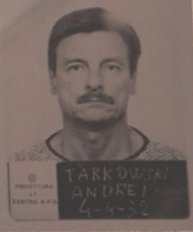
Andrei Tarkovsky
Dates: 1932–1986 Domain: Cinema, Aesthetic Philosophy, Visual Theology
Biography
Andrei Tarkovsky was born in 1932 in Zavrazhye, a village on the Volga, the son of the poet Arseny Tarkovsky. He trained at VGIK (the Soviet film school) under Mikhail Romm and made seven feature films before dying of lung cancer in Paris in 1986, aged 54. His Soviet career was conducted under continuous pressure: Andrei Rublev (1966) was completed in 1966 but withheld from domestic distribution until 1971; The Mirror (1975) was controversially received within the Soviet system. His final two films, Nostalghia (1983) and The Sacrifice (1986), were made in exile in Italy and Sweden after he was denied permission to return to the Soviet Union.
Andrei Rublev (1966/1971) takes the fifteenth-century icon painter as its subject but is not biographical in the conventional sense. It is structured as a series of episodes — the buffoon, the pagan festival, the Tatar raid, the casting of a bell — that constitute a meditation on the conditions under which sacred art is possible. Rublev does not speak for much of the film; he witnesses suffering, withdraws from painting, and eventually returns to it. The film's final minutes are the only color sequence: the camera moves slowly across Rublev's icons. Tarkovsky is making an argument that the suffering witnessed during the film's black-and-white episodes is the ground from which the icons emerged.
Stalker (1979) is the central Tarkovsky text. Based on the Strugatsky brothers' science fiction novel Roadside Picnic, it follows a guide (the Stalker) who leads a Writer and a Professor through the Zone — a mysterious territory of unknown origin surrounded by military checkpoints, with shifting geography and unknown dangers, at whose center is a room said to grant the deepest wishes of those who enter it. The journey through the Zone is conducted in almost real time, with long silences and minimal dialogue. The Zone is never explained; the film does not tell us what it is or where it came from. The Writer and Professor, when they finally reach the threshold of the room, cannot enter — not from physical obstruction but from the recognition that they do not know what their deepest wish actually is, and they are afraid to find out.
Sculpting in Time (1986), his theoretical book written in exile, articulates the aesthetic philosophy his films embody: cinema is the only art form that can preserve actual time. Not represent it — preserve it. The footage is a block of time in which specific lived moments are captured and can be revisited. This is what distinguishes cinema from all other arts, and it is the source of cinema's peculiar power: the audience literally inhabits a preserved past.
Key Works (in library)
| Work | Year | Relevance |
|---|---|---|
| Stalker | 1979 | The Zone as liminal territory; the room that reveals what you actually want |
| Andrei Rublev | 1966/1971 | Sacred art from suffered witness; icons as consciousness documents |
| The Mirror | 1975 | Memory, time, and the visual field as spiritual autobiography |
| Sculpting in Time | 1986 | Theoretical statement; cinema as preserved time, not represented narrative |
Role in the Project
The Ape of God series investigates art forms that have claimed or demonstrated initiatory function in the absence of initiatic institutions. Tarkovsky's films belong here because his explicit theoretical position — that cinema is a form that preserves time and that this preservation has spiritual consequences — is the most rigorous modern argument for an art form as sacred rather than merely aesthetic.
The Zone in Stalker operates as a perfect initiatory structure: it is a liminal territory with a threshold (the checkpoint), a guide (the Stalker), an ordeal (the constantly shifting geography, the rules that cannot be explained only followed), and a potential transformation at the center (the room). The film's refusal to resolve what the room does — the Writer and Professor don't enter; the Stalker's faith in the Zone is shown as both genuine and possibly self-deceived — is the primary example of a work that maintains the initiatory structure while refusing to guarantee its outcome.
Key Ideas
- Sculpting in Time: Tarkovsky's central concept — cinema preserves actual time, not representations of events. The long takes, the slow pans across water and fire, are not stylistic choices but the medium performing its essential function.
- The Zone: A liminal territory whose rules cannot be understood in advance, only followed; whose geography shifts; whose center promises fulfillment while demanding complete honesty about what fulfillment means. The Zone as the liminal phase made terrain.
- Sacred Art from Witness: Andrei Rublev's argument that sacred art, the icons, is not the product of piety but of witness: Rublev could paint the Trinity because he had seen what human beings do to each other.
- Extended Duration as Epistemology: The long takes are not self-indulgent. They are the argument that genuine perception requires duration — that the habitual glance replaces the thing with a category, and that only sustained attention reaches what is actually there.
Connections
- Russian spiritual context: FIG-0052 Andreev (Russian visionary tradition that Tarkovsky inhabits differently), FIG-0011 Steiner (the theory of art as consciousness technology parallel to Tarkovsky's practice)
- Ape of God series: FIG-0064 Bataille (both attending to what exceeds normal consciousness), FIG-0103 Kenneth Anger (the other filmmaker in the series — very different approach)
- Liminal territory: CON-0001 Initiation (the Zone as the liminal phase rendered as film environment)
Agent Research Notes
[AGENT: perplexity | DATE: 2026-03-22] Tarkovsky died December 29, 1986 in Paris; he had been diagnosed with lung cancer in 1985. Andrei Rublev was completed in 1966 but not shown publicly in the USSR until 1971; it was screened at Cannes in 1969 without official Soviet permission. Stalker was filmed twice after the original footage was ruined in processing; Tarkovsky essentially made the film twice during 1977–1979. Sculpting in Time was written in exile and published posthumously in German and Russian. Vida T. Johnson and Graham Petrie's The Films of Andrei Tarkovsky: A Visual Fugue (1994) is a reliable scholarly source.