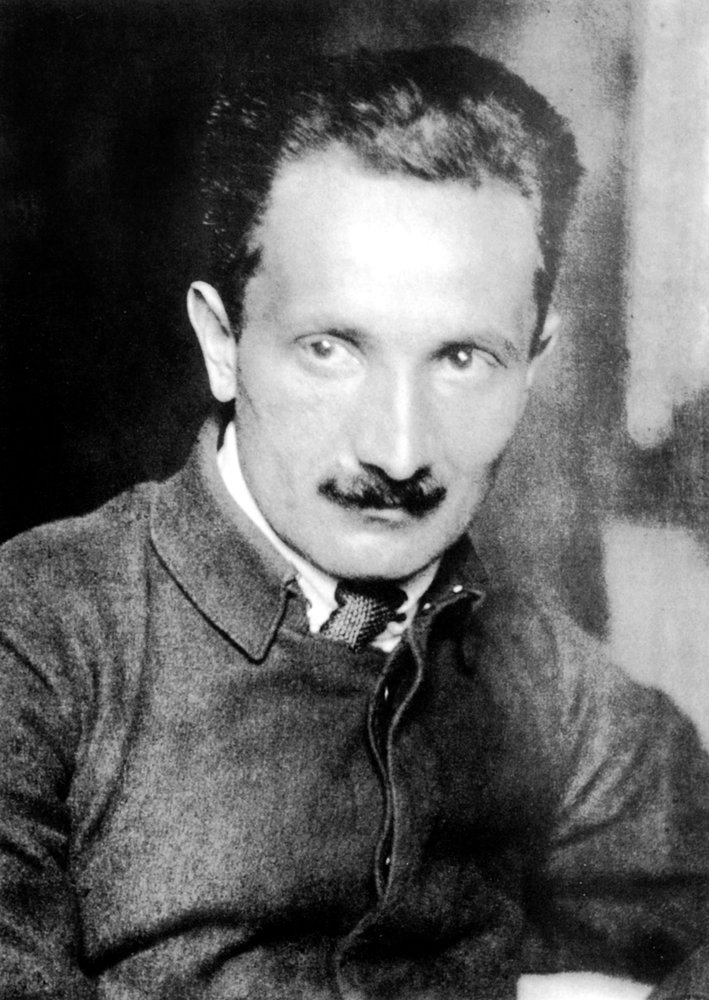
Martin Heidegger
Dates: 1889–1976 Domain: Philosophy, Phenomenology, Ontology, Philosophy of Technology
Biography
Martin Heidegger was born on September 26, 1889, in Meßkirch, a small town in the Black Forest of southwestern Germany, and died on May 26, 1976, in Freiburg im Breisgau. He studied theology before turning to philosophy, completing his habilitation under Heinrich Rickert at Freiburg in 1915 and beginning his teaching career there and later at Marburg. His appointment as professor at Freiburg in 1928 followed the publication of Being and Time (1927), which established him overnight as one of the most significant German philosophers since Kant. In 1933, following the Nazi seizure of power, Heidegger was appointed rector of the University of Freiburg and joined the Nazi Party, an entanglement that casts a long shadow over his legacy and that the project must acknowledge without allowing it to simply foreclose engagement with his thought. He was banned from teaching by a denazification committee after the war (1946–1949) and never offered a public account of his conduct that satisfied his critics.
Being and Time is a work of phenomenological ontology: Heidegger's announced project was to renew the question of the meaning of Being, the most fundamental question of philosophy, which he argued Western thought since Plato had progressively obscured by focusing on entities (the beings that exist) rather than Being itself (the sheer fact and structure of existence as such). His analysis of Dasein, the particular mode of being that belongs to human beings, defined by the fact that existence is always an issue for it, uncovered the deep structures of human existence: being-in-the-world as the primary mode (against Cartesian subject-object bifurcation), thrownness (the unchosen factical situation from which we always begin), projection (the orientation toward possibilities that structures understanding), and authenticity as the achievement of genuinely owning one's existence in the face of death rather than being lost in the anonymous das Man (the "they," the average everydayness of social conformism).
A key concept is Heidegger's recovery of aletheia, the ancient Greek word for truth, as unconcealment. Truth is not the correspondence of a proposition to a fact but the disclosure of Being itself: the coming-forth of things from concealment into the open clearing of human awareness. This shifts truth from a property of statements to an event of disclosure that requires a certain quality of human attention and openness. The modern age, Heidegger argues, has systematically narrowed this clearing: under the sway of technological rationality, beings are allowed to appear only in the mode of manipulable, measurable, quantifiable entities.
After Being and Time, Heidegger's thought underwent what he called die Kehre (the turn), shifting from the analysis of Dasein to the history of Being itself and its self-concealment across Western metaphysics. The most important result of this period is his account of technology. In lectures of the 1940s and 1950s, especially The Question Concerning Technology (1954), Heidegger argued that the essence of modern technology is not the machines and procedures it employs but a way of revealing the world: specifically, the revealing of everything as Bestand (standing-reserve), material awaiting transformation and use. Nature becomes a resource, the river a power supply, the forest a timber reserve. This totalizing reduction of the world to manipulable standing-reserve he named Gestell (enframing): the gathering claim that orders everything as standing-reserve, which at its limit endangers the very possibility of any other mode of disclosure.
Key Works (in library)
| Work | Year | Relevance |
|---|---|---|
| Being and Time | 1927 | The foundational analysis of Dasein, authenticity, temporality, and truth as unconcealment (LIB-0246) |
Note: The Question Concerning Technology, Poetry, Language, Thought, and other later essays do not appear in the current library index and should be considered for addition.
Role in the Project
Heidegger's contribution to the project is primarily diagnostic: he provides the most philosophically rigorous account available of what has gone wrong in modernity at the level of Being rather than merely at the levels of ethics or politics. The forgetting of Being, the progressive incapacity of Western culture to hold open the clearing in which things can disclose themselves as more than resources, is what the mystery schools project addresses through its study of initiatory traditions. If initiation is, at its core, the practice of opening a human being to a different and deeper mode of presence to reality, then Gestell is the name for the civilizational condition from which initiation is an awakening.
The mapping onto the project's other key figures is exact. Gestell is Barfield's withdrawal of participation seen from the angle of ontology rather than the history of language and consciousness; Gebser's deficient mental structure named as a metaphysical rather than structural phenomenon; Steiner's Ahrimanic principle formulated in rigorous phenomenological terms, stripped of its spiritual-cosmological framing; McGilchrist's left-hemisphere dominance rendered as civilizational destiny rather than neurological dysfunction.
Heidegger's concept of Gelassenheit (releasement, or a stance of receptive openness toward things) points toward the contemplative alternative to enframing. It is not a technique or an achievement but an attitude: allowing things to emerge into their own disclosure rather than forcing them into the frame of standing-reserve. In this it resonates with Weil's attention, Hadot's spiritual exercises, and the Neoplatonic contemplative tradition from Plotinus through Pseudo-Dionysius.
The project must, however, be explicit about the limitations and dangers of Heidegger's thought. His entanglement with National Socialism was not merely biographical; the Black Notebooks, published from 2014, show antisemitic passages that implicate his thinking at a structural level, not merely as external contamination. The project does not engage Heidegger as a guide to political or cultural life but as a diagnostician of a specifically philosophical problem: the structure of modern consciousness's relation to Being. This diagnostic contribution remains valid and important while the political dimension remains intractable.
Key Ideas
- Being vs. beings: Heidegger's fundamental ontological distinction: Being (Sein) is not itself a being (Seiendes) but the condition of possibility for anything to be present at all. Western metaphysics has systematically focused on beings while forgetting this more fundamental dimension.
- Dasein: The human mode of being: that entity for which its own being is always at issue. Dasein is being-in-the-world: not a subject confronting an external world but always already engaged with a shared context of meaning, tools, and possibilities.
- Aletheia / truth as unconcealment: Truth is not the correctness of propositions but the event of disclosure, the coming-forth of beings from concealment into the clearing of awareness. This is a participatory, event-like understanding of truth that resonates with initiatory epistemology.
- Gestell (Enframing): The essence of modern technology as a totalizing mode of disclosure that orders everything as standing-reserve (Bestand): available, orderable, and substitutable. Gestell does not merely describe machines but a way of being in the world that forecloses other modes of disclosure.
- Forgetting of Being: The history of Western metaphysics as a progressive forgetting of the question of Being; its substitution by questions about the nature of beings, culminating in the nihilism of technological modernity.
- Gelassenheit (Releasement): A posture of open receptivity to Being, the contemplative counterpart to enframing. Not passive withdrawal but active openness that allows things to disclose themselves in their own way rather than forcing them into the frame of the will.
Connections
- Influenced by: Edmund Husserl (phenomenological method, then departed from), Aristotle (read through a different lens than the tradition), Søren Kierkegaard (existential analysis of anxiety and authenticity), Friedrich Hölderlin (poetry as a mode of disclosure)
- Influenced: Jean-Paul Sartre (selective and partial), Hans-Georg Gadamer (hermeneutics), Paul Ricoeur, Jacques Derrida (deconstruction), FIG-0014 (Hadot engaged and critiqued Heidegger on the nature of spiritual exercises in antiquity)
- In convergence with: FIG-0002 (Barfield: parallel account of modernity as estrangement from participatory reality), FIG-0003 (Gebser: deficient mental structure as Gestell), FIG-0011 (Steiner: Ahrimanic as Gestell in spiritual-cosmological terms), FIG-0012 (McGilchrist: left hemisphere dominance as the neurological form of Gestell)
Agent Research Notes
[AGENT: perplexity | DATE: 2026-03-20] Being and Time (LIB-0246) is in the library. His later essays, particularly The Question Concerning Technology (in The Question Concerning Technology and Other Essays, 1977, trans. William Lovitt) and Poetry, Language, Thought (1971, trans. Albert Hofstadter), should be considered for addition. The political problem of Heidegger's Nazism is not a peripheral biographical detail; the Black Notebooks published since 2014 show that antisemitism was woven into his philosophical thought at points, not merely a personal weakness. The project should have an explicit position on this, probably something like: his diagnostic tools are used precisely because they illuminate the pathology of modernity, while his political commitments demonstrate the catastrophic failure mode of a thought that critiques modernity but lacks ethical and political grounding. The relationship between Gestell and the Ahrimanic is one of the project's most philosophically fruitful convergences and deserves extended treatment.