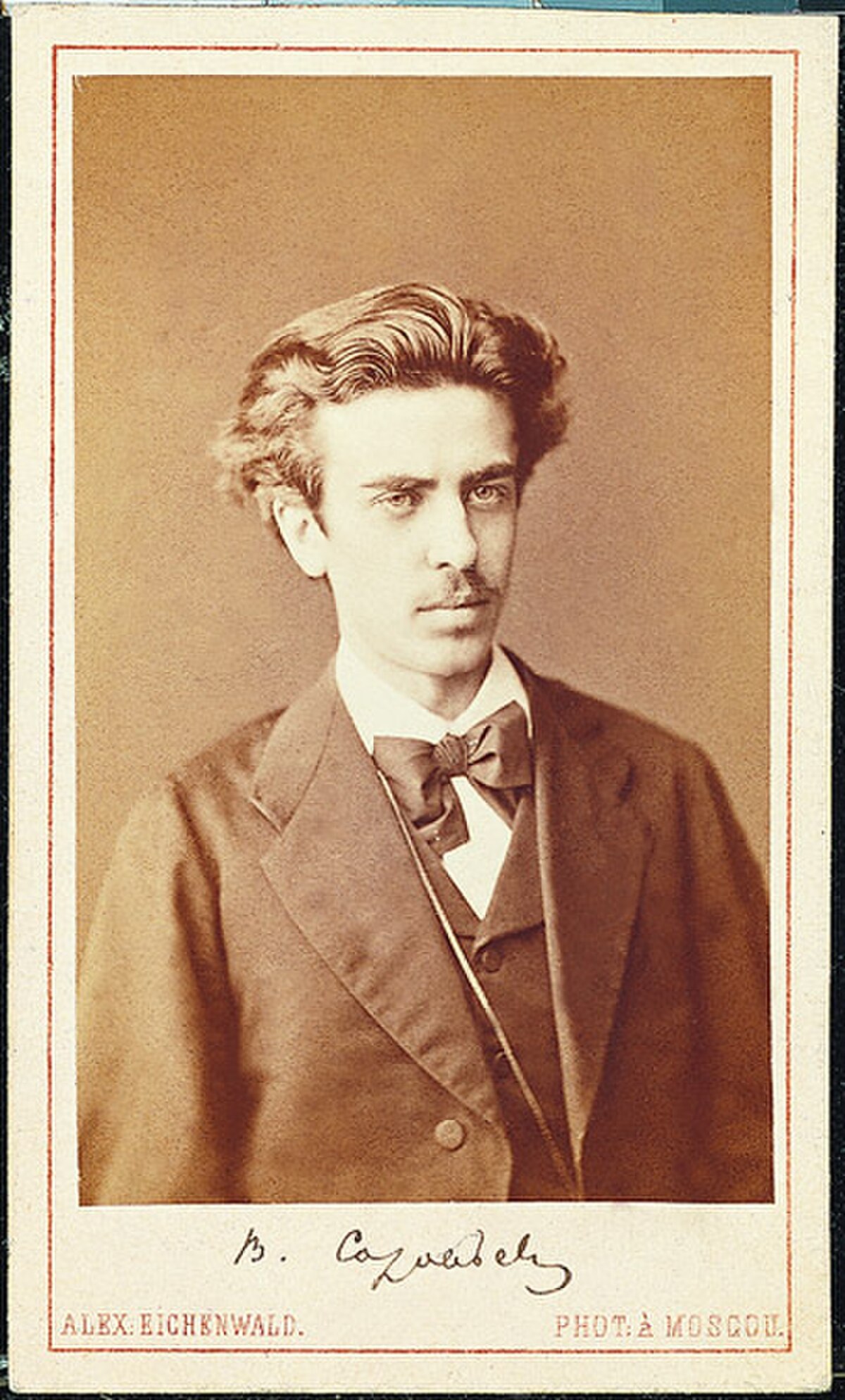
Vladimir Sergeyevich Solovyov
Dates: 1853–1900 Domain: Philosophy, Theology, Poetry, Sophiology
Biography
Vladimir Sergeyevich Solovyov was born in Moscow in 1853, the son of the distinguished historian Sergei Solovyov. His intellectual biography was shaped by two parallel tendencies that he never entirely reconciled but whose creative tension produced Russian religious philosophy: a rigorous systematic philosophical training (he was the first in Russia to seriously engage German idealism on its own terms) and a series of direct mystical experiences that he documented in his autobiographical poem Three Meetings (1898). In the poem, he describes three visions of Sophia, divine feminine wisdom, the first in a Moscow church at age nine, the second in the British Museum reading room at age twenty, and the third in the Egyptian desert at age twenty-four. Whether these were literal visions, philosophical imaginings, or something in between is a question Solovyov himself left open with characteristic wit.
He was Russia's most significant philosopher of the nineteenth century: he lectured brilliantly at Moscow and St. Petersburg, wrote prolifically, engaged in public debates about Russia's cultural and political future, and died at forty-seven from exhaustion, possibly kidney failure, in the summer of 1900. His death at the threshold of the new century, combined with his eschatological concerns in his final work (Three Conversations and the Short Story of the Antichrist, both 1900), gave his life and death an uncanny historical weight.
His central philosophical concept is vseedinstvo (all-unity or total-unity): the claim that all of reality is a unified organic whole, and that the task of philosophy is not to analyze the parts but to understand the principle of their unity. This is neither pantheism nor monism in the simple sense; Solovyov preserves genuine multiplicity within the unity, understanding the many as differentiated expressions of the one rather than illusions to be dissolved. The Absolute, God, is not a separate substance from the world but the unifying principle that holds all things together from within; and the human being, as the being capable of knowing this unity, is the point where the world becomes conscious of its own divine ground.
Sophia, divine wisdom, is Solovyov's name for the divine feminine principle that mediates between the Absolute and the multiplicity of creation, and between the world and God. She appears in his philosophical writings as the world-soul, as the eternal feminine, and as the principle of cosmic eros that draws all things toward their unity in God. She appears in his poetry as the transfiguring presence that transforms the lover's perception of the beloved from a particular person into a window onto the infinite. The Sophiological tradition that flows from Solovyov — through Sergei Bulgakov's The Wisdom of God, Pavel Florensky's The Pillar and Ground of the Truth, and into the general Silver Age ethos — represents the most developed modern attempt to preserve the feminine divine within the framework of Orthodox Christian theology.
Solovyov's eschatology is as significant as his Sophiology. His Short Story of the Antichrist: a novella appended to Three Conversations — depicts a future world in which a globally successful leader who has united humanity under a single beneficent governance is revealed to be the Antichrist: not a monster but a highly intelligent, apparently compassionate person who has separated universal human welfare from genuine relationship to the divine. The story is a diagnosis of the particular form of spiritual danger available to modernity — the replacement of genuine transformation with efficient management — that is one of the central concerns.
Key Works (in library)
| Work | Year | Relevance |
|---|---|---|
| Lectures on Divine Humanity | 1877–1881 | The philosophical foundation of Sophiology; divine-human unity as cosmic principle |
| The Meaning of Love | 1892–1894 | Eros as the vehicle of Sophianic transformation; the beloved as window onto the Absolute |
| Three Conversations (with Short Story of the Antichrist) | 1900 | Eschatological; the final vision of spiritual danger and its recognition |
| The Crisis of Western Philosophy | 1874 | The critique of abstract rationalism; the need for integral knowledge |
Role in the Project
Solovyov gives the project access to the Russian Orthodox dimension of the esoteric tradition — a dimension that has its own deep roots and its own specific forms. Sophiology is the Eastern Christian equivalent of the Western Hermetic tradition's Sophia/Isis figure: the feminine divine wisdom who mediates between the Absolute and the world, and whose presence in created things is the ground of genuine knowledge and genuine love. The project reads Solovyov alongside the Western tradition to demonstrate that what appeared to be Western esoteric peculiarities — the feminine divine, the mystical marriage, the transformation of eros into a vehicle of spiritual ascent — are in fact structural features of any serious engagement with the divine that preserves its relational character. His eschatological warning about the Antichrist as the figure of spiritual management without genuine transformation is directly relevant to the project's diagnosis of the contemporary digital economy.
Key Ideas
- Vseedinstvo (All-Unity/Total-Unity): Reality as an organic whole whose unity is the divine life immanent within it; the philosophical task is to perceive and articulate this unity rather than to analyze parts in isolation.
- Sophia: Divine feminine wisdom as the mediating principle between the Absolute and creation — the world-soul, the eternal feminine, the eros that draws all things toward their divine source.
- The Meaningful Universe: Solovyov's insistence that the natural world is not a mechanical system but a living whole charged with meaning — against the positivism of his contemporaries.
- The Three Meetings: The autobiographical visions of Sophia as evidence that the divine feminine is an experiential reality accessible to modern people.
- The Antichrist as Manager: The figure of sophisticated, competent, apparently benevolent governance divorced from genuine divine relationship as the specific eschatological danger of modernity.
Connections
- Influenced by: German idealism (Schelling more than Hegel), Plato (especially Timaeus and Symposium), Eastern Orthodox mystical tradition, Kabbalah (influence is debated), FIG-0028 Blavatsky (contemporary; parallel Sophianic interests)
- Influenced: FIG-0049's Sophiological legacy — Sergei Bulgakov, Pavel Florensky, Nikolai Berdyaev; the entire Russian religious philosophy of the Silver Age; FIG-0050 Fedorov (knew each other personally)
- In tension with: Russian positivism and the revolutionary intelligentsia of his period, crude nationalism, purely rationalist theology
Agent Research Notes
[AGENT: perplexity | DATE: 2026-03-22] Solovyov's dates are confirmed 1853–1900. His Three Meetings (Tri svidaniya) is autobiographical poem from 1898. The standard Russian edition of his collected works (Sobranie sochinenii) is in 12 volumes (St. Petersburg, 1911–1914). English translations are scattered; Judith Deutsch Kornblatt's Divine Sophia: The Wisdom Writings of Vladimir Solovyov (2009) is the best available English source. His influence on Alexander Blok, Andrei Bely, and the Symbolist movement is central to understanding the Silver Age. Boris Jakim has translated many of Solovyov's theological works into English (Eerdmans and other presses).