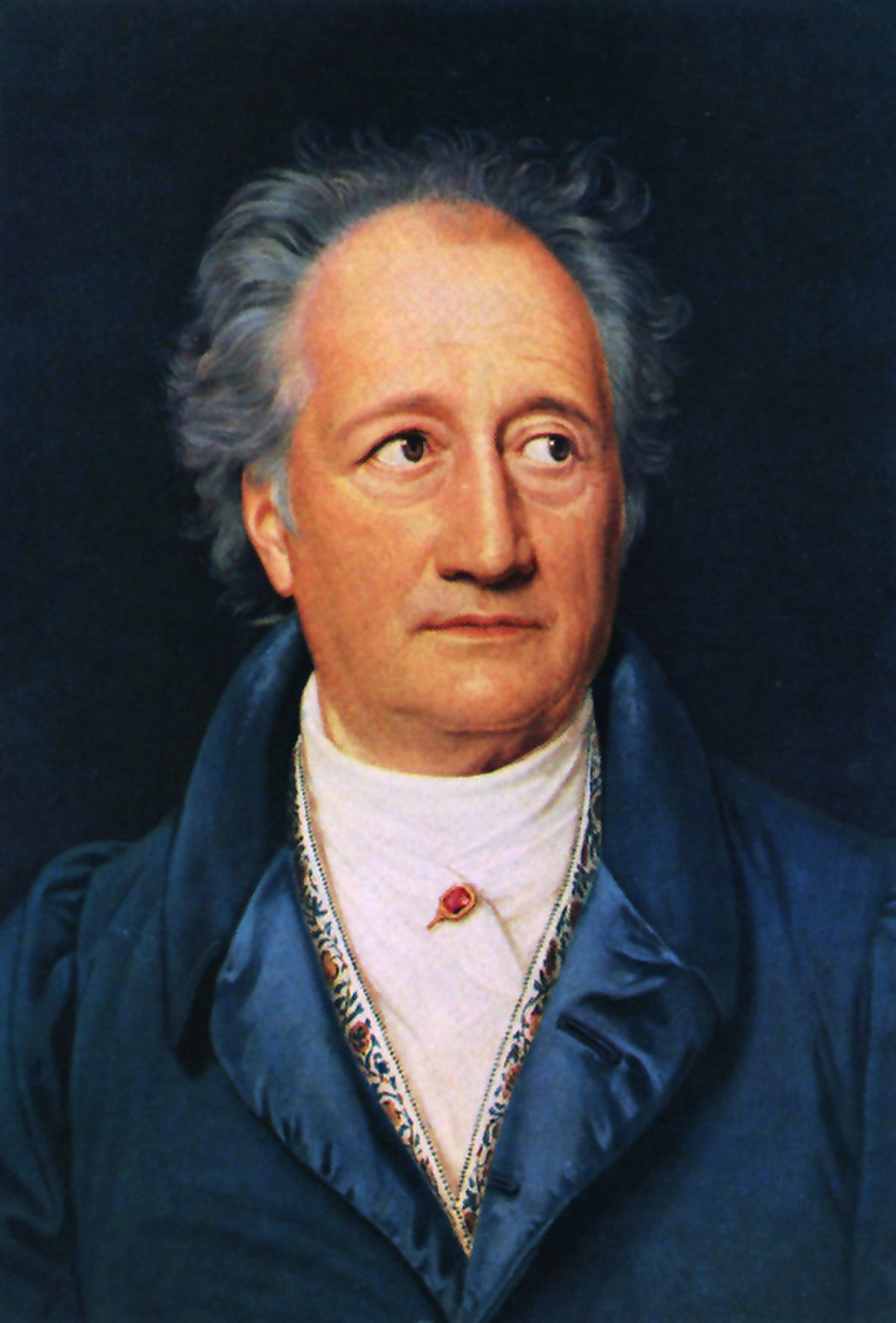
Johann Wolfgang von Goethe
Dates: 1749–1832 Domain: Literature, Natural Science, Philosophy, Esoteric Tradition
Biography
Johann Wolfgang von Goethe was born in Frankfurt am Main in 1749 into a prosperous family, received an exceptional private education, and went on to become, by virtually any measure, the central figure of German literary culture. Poet, playwright, novelist, civil servant, visual artist, and natural scientist — the range of his activities is itself the argument. His life spans the Enlightenment, Sturm und Drang, Weimar Classicism, and early Romanticism, and he outlived them all, dying in 1832 at eighty-two, having witnessed the French Revolution, the Napoleonic era, and the beginning of industrialization. What the Mystery Schools project finds in Goethe is not a biographical data point but a methodological example: he was perhaps the last major European intellectual for whom art and science were not yet in opposition, and for whom the act of knowing was itself a participatory encounter between observer and phenomenon.
Owen Barfield, one of the primary theorists, identified Goethe as his principal historical example of what Barfield called "final participation" — the conscious recovery of an earlier mode of knowing that had been partially available to ancient and medieval people but was now only accessible through disciplined effort. In the Theory of Colors (Zur Farbenlehre, 1810), Goethe explicitly contested Newton's prism experiments, arguing that Newton's methodology — isolating phenomena under controlled artificial conditions — necessarily precluded the kind of knowledge he sought. Goethe wanted to know color as a living phenomenon, which meant preserving the full phenomenal context, including the role of the human eye and psyche in color experience. Newton was not simply wrong; he was conducting a different inquiry, one that produces reliable quantitative data by severing the knower from the known. Goethe's color science is a science of the relationship rather than of the isolated object.
His botanical work The Metamorphosis of Plants (1790) proposed the concept of the Urpflanze, the archetypal plant, not as a Platonic Form existing independently of particular plants but as the morphological principle that can be perceived immanently in the developmental transformations of actual plants. This is not mysticism; it is a genuine epistemological claim about what kind of attention yields what kind of knowledge. Rudolf Steiner, who edited Goethe's scientific writings and wrote extensively about Goethean science, made this methodology the foundation of his own epistemology in The Theory of Knowledge Implicit in Goethe's World Conception (1886). Goethean science matters because it shows that rigorous attention to natural phenomena need not produce the alienated, disenchanted nature of Newtonian mechanism — there is another path, one that preserves participation.
Goethe's Faust — Part One completed 1808, Part Two completed and published in 1832, the year of his death — is the great modern initiatory drama. Faust is the figure of Western consciousness at the moment of its fullest ambition and greatest danger: the man who has exhausted every form of knowledge offered by the tradition, who finds them all empty, and who bargains with Mephistopheles for direct experience. The Faustian wager — I will win if I am satisfied; I will lose if I stop striving — encodes the initiatory logic in secular form. Faust's descent to the Mothers (Act I of Part Two) is a katabasis; his encounter with Helen of Troy is a hieros gamos; his redemption through Gretchen's intercession in the final scene replays the feminine-as-Sophia motif. Whether Goethe consciously encoded initiatory material or arrived at it through the internal logic of his dramatic subject is itself an interesting question. The project treats Faust as evidence that the initiatory pattern is so embedded in Western imaginative life that it resurfaces even in secular form.
Key Works (in library)
| Work | Year | Relevance |
|---|---|---|
| Faust: Part One | 1808 | The initiatory drama of Western consciousness at full extension |
| Faust: Part Two | 1832 | The katabasis, the hieros gamos, the Sophianic redemption |
| Theory of Colors (Zur Farbenlehre) | 1810 | Participatory epistemology in natural science; Barfield's primary example |
| The Metamorphosis of Plants | 1790 | The Urpflanze as morphological archetype — immanent rather than transcendent |
Role in the Project
Goethe appears in the project at two distinct but related levels. First, as the cultural exemplar of an alternative epistemology: his science of participation demonstrates that the Newtonian-Cartesian model is a choice, not a necessity, and that other modes of knowing yield genuine, if different, knowledge. This directly supports the project's argument that the Mysteries were not primitive pseudo-science but sophisticated epistemological practices for engaging reality at a different depth. Second, as the author of the great modern initiatory epic: Faust is the project's evidence that the initiatory template cannot be suppressed but re-emerges even in ostensibly secular contexts, transformed but structurally continuous with its ancient predecessors. Barfield's use of Goethe is central to the project's epistemological argument; Steiner's elaboration of Goethean science is the bridge to the engagement with Anthroposophy.
Key Ideas
- Participatory Epistemology: Knowing is not the observation of a passive object by a detached subject but an active encounter between two participants; the knower is transformed by the known.
- Urpflanze / Urphänomen: The archetypal phenomenon — a morphological principle perceivable within phenomena by trained attention, not a separate transcendent entity.
- Goethean Science: A methodology that preserves the full phenomenal context (including subjective response) rather than isolating variables; yields qualitative rather than quantitative knowledge.
- Faust as Modern Initiate: The Faustian figure as the archetype of the Western intellectual who must descend through the full consequences of his own ambition before transformation becomes possible.
- Color as Relational: Color is not a property of objects or of light alone but of the relationship between light, darkness, and the perceiving organism — a model for relational ontology generally.
Connections
- Influenced by: Baruch Spinoza, Plotinus (indirectly via Neoplatonism), Paracelsus, alchemy (self-reported)
- Influenced: FIG-0002 Barfield (central example of final participation), FIG-0011 Steiner (edited Goethe's scientific writings; built entire epistemology on Goethean base), FIG-0047 Novalis (contemporary; parallel Romantic scientific vision), FIG-0048 Schelling (mutual influence)
- In tension with: Isaac Newton (explicit scientific disagreement on color), the Kantian separation of theoretical and practical reason
Agent Research Notes
[AGENT: perplexity | DATE: 2026-03-22] Goethe's dates are confirmed 1749–1832. The Farbenlehre was published in 1810 and explicitly positioned as a refutation of Newton. The Metamorphosis of Plants (Versuch die Metamorphose der Pflanzen zu erklären) was published in 1790. Barfield's engagement with Goethe is most fully developed in Saving the Appearances (1957) and in his essay collection Romanticism Comes of Age. Steiner's Goetheannum in Dornach, Switzerland, is named after Goethe — an architectural embodiment of the Goethean-Anthroposophical synthesis. Goethe was also a Freemason (entered 1780) and engaged with alchemical literature; his early work Faust draws directly on Paracelsian and Rosicrucian imagery.