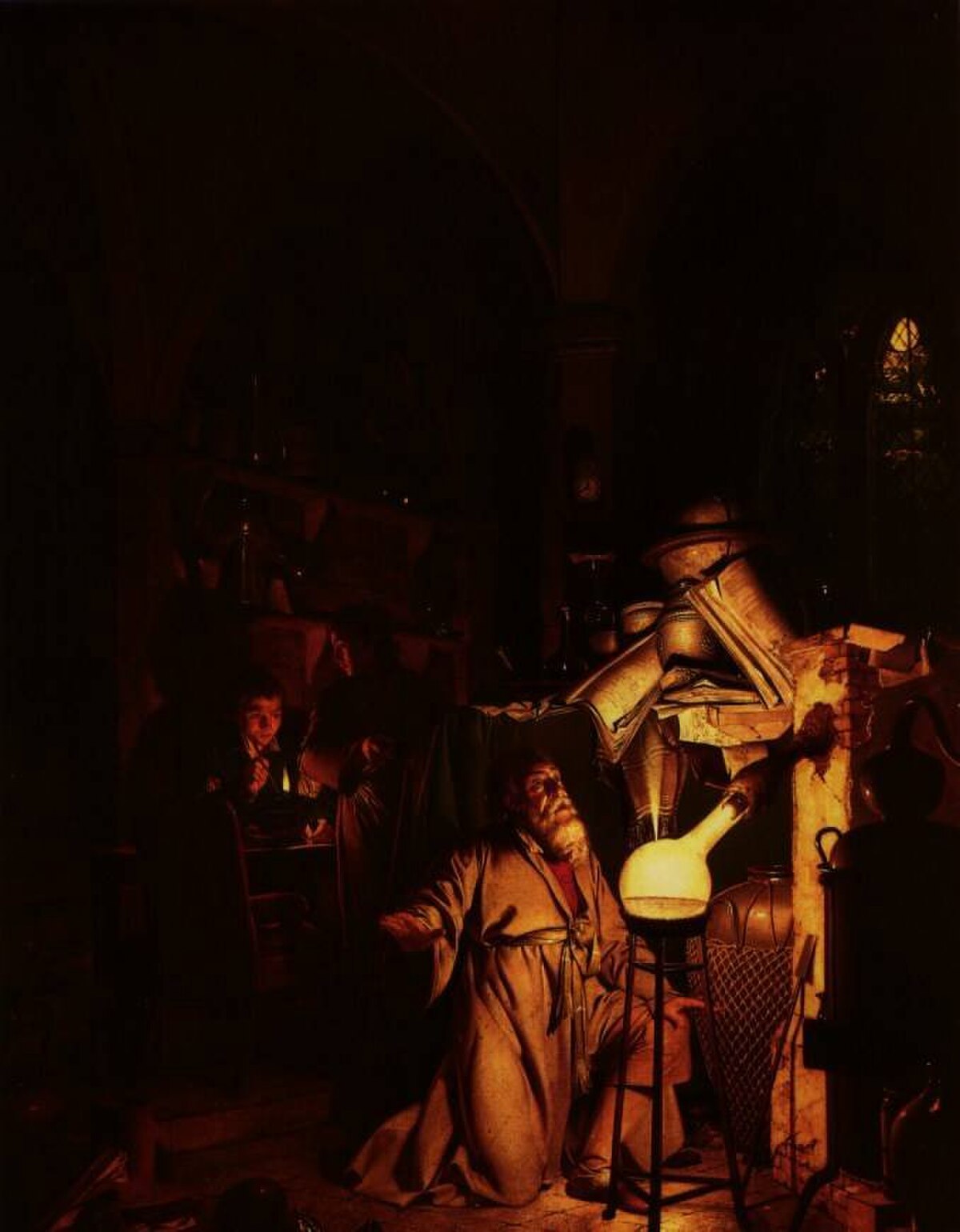
Nigredo
Definition
Nigredo (Latin: "blackening") is the first stage of the alchemical opus magna (the great work), the initial phase in which the prima materia — the base substance with which the alchemist begins — undergoes dissolution, putrefaction, and death. In the laboratory, this corresponded to the physical processes of calcination (heating until the substance burned to black ash), dissolution (immersion in solvent until the solid dissolved), putrefaction (allowing organic matter to rot and decompose into its constituent elements), and separation (the precipitation of distinct components from a complex mixture). In all these operations, what had previously been fixed, solid, and structured becomes fluid, formless, and dark. The nigredo is the death of the initial form — a necessary precondition for any new form to emerge.
In the philosophical and spiritual dimension of alchemy — which for the serious practitioners was always the primary dimension — the nigredo corresponded to the psychic equivalent of this dissolution. Psychologically, the nigredo is the confrontation with what the philosopher-alchemist was before the work began: the unexamined life, the rigid structures of habitual identity, the calcified assumptions and attachments that define the ordinary self. The nigredo confronts these with their own darkness, their own shadow, their own mortality. The encounter with the prima materia of the psyche, the raw, unprocessed, shadow material, produces the despair, confusion, and disorientation that the alchemical texts describe as blackening: a stage in which the ordinary self sees itself clearly for what it is and finds it insufficient.
This is why the alchemical tradition consistently warns against skipping or abbreviating the nigredo: the prima materia cannot be transformed without first being dissolved, and the dissolution is the nigredo. An artificially shortened nigredo produces not gold but a superficially altered lead — the same material with a bright coat of paint, not a genuine transformation. The tradition's language for this failure is sophistic gold: the imitation that resembles the genuine product without having undergone the necessary process.
The nigredo's structural relationship to the katabasis (CON-0002) — the initiatic descent into the underworld — is exact: both describe the necessary downward movement, the encounter with death and shadow, the dissolution of ordinary identity, that must precede the ascent and the final vision. The alchemical opus and the Eleusinian initiatory sequence are the same fundamental pattern expressed in different symbolic registers: laboratory and ritual, but the same initiatory arc.
Tradition by Tradition
Alchemical (Latin tradition)
The Latin alchemical tradition — from the Rosarium Philosophorum (1550) through Paracelsus and the 17th-century Rosicrucian texts — consistently describes the nigredo as the most difficult and discouraging phase of the work. The alchemist who expects rapid results is devastated when the prima materia blackens and seems to die rather than being transformed. The texts compare the nigredo to Noah's flood (destruction before renewal), to the death of Christ before the resurrection, and to the dark of the moon before the new lunar light. The alchemist is advised to endure: the blackening is not failure but the necessary first movement of the solve et coagula.
The prima materia (the base material with which the opus begins) is itself an important concept: in different texts, it is described as lead, black earth, dung, poison, the serpent that kills. All these descriptions share a common theme: the prima materia is what is lowest, darkest, most despised — and yet it contains the potentiality for gold. The alchemist's task in the nigredo is to recognize this potentiality in what appears worthless and to endure the dissolution of its initial form with the faith that what emerges will be more valuable than what was dissolved.
Depth Psychology (Jung)
Jung's Psychology and Alchemy (1944) gives the most extended modern analysis of the nigredo as a psychological process. For Jung, the nigredo corresponds to the initial phase of the individuation process: the encounter with the Shadow — the repressed, rejected, or simply undeveloped aspects of the personality — which produces a confrontation with one's own darkness that can feel like psychic death. The Shadow is the prima materia of Jungian analysis: what is most despised, most denied, most projected onto others. The individuation process requires that the ego encounter and integrate this material, and the initial encounter is typically experienced as a darkening, a crisis, a confrontation with one's own inadequacy and darkness.
Jung cites the historical parallel repeatedly: the medieval alchemist who experienced the nigredo was undergoing the same psychological process that his analytic patients underwent in the early stages of depth work. The alchemist projected the individuation process onto chemical substances; the modern person lives it directly in the psyche. The symbolic vocabulary differs; the structure is the same.
Christian Mysticism (Dark Night of the Soul)
John of the Cross's Dark Night of the Soul (c. 1578–1579) describes a process identical to the alchemical nigredo in the context of Christian mystical development. The "dark night" is not a crisis of faith in the ordinary sense but a specific phase in the soul's progressive purification: the spiritual consolations and feelings of divine presence that sustained the beginner in prayer are withdrawn, leaving the soul in a state of aridity, confusion, and apparent abandonment. This withdrawal is not punishment but purification: God draws the soul away from attachment to spiritual feelings in order to free it for a more naked, more direct encounter with the divine reality that transcends all feelings. The dark night is the nigredo of the Christian mystical opus.
Hermeticism and Neoplatonism
The Neoplatonic account of the soul's descent into matter — its progressive forgetting of its divine origin as it passes through the planetary spheres and becomes entangled in material existence — is the metaphysical equivalent of the nigredo: the soul's condition in its most materialized, most forgetful, most distant from its divine source is the prima materia that the philosophical and initiatory work must transform. Plotinus's account of the soul that has descended so far into matter that it has "become earthly" and must be recalled to its true home through philosophy and contemplation maps exactly onto the nigredo as the condition from which the opus begins.
Project Role
Nigredo provides the project's sharpest response to spiritual bypassing — the contemporary tendency to claim spiritual transformation without having undergone the necessary dissolution. The tradition across registers is consistent: there is no genuine ascent without a genuine descent; there is no gold without first a blackening; there is no final participation without first having passed through the dark night of spectator consciousness. The nigredo is the tradition's structural guarantee against false ascents.
The concept is also directly relevant to the project's argument about what makes genuine initiation different from its contemporary substitutes. Weekend retreat workshops, online courses in awakening, and therapeutic "soul work" typically minimize or aestheticize the nigredo — they offer transformation without the genuinely dangerous dissolution that the tradition requires. The project uses nigredo to name what is missing.
Distinctions
Nigredo vs. Clinical depression: The alchemical and Jungian nigredo may overlap with what clinical medicine calls depression, but the two are not identical. Clinical depression is a pathological condition requiring treatment; the nigredo is a phase in a developmental process that requires endurance and guidance, not treatment aimed at eliminating the experience. The project must handle this distinction carefully to avoid both pathologizing genuine initiatory crisis and romanticizing genuine psychopathology.
Nigredo vs. Katabasis: The two concepts describe the same structural movement (descent into darkness and dissolution) in different registers: katabasis is the ritual-mythological descent (Persephone into Hades, Orpheus's journey), nigredo is the alchemical-psychological equivalent. They illuminate each other but should not be collapsed.
Nigredo vs. Shadow work (popular): The popularized concept of "shadow work" in contemporary spiritual culture covers some of the same territory as the Jungian nigredo but typically without the depth of the Jungian framework or the clarity of the alchemical tradition about what the process requires and what it is for.
Primary Sources
- C.G. Jung, Psychology and Alchemy (1944): The definitive modern analysis of the nigredo as a psychological process, with extensive illustration from alchemical texts and imagery.
- John of the Cross, Dark Night of the Soul (c. 1578–1579): The Christian mystical parallel — perhaps the most psychologically precise account of the nigredo's phenomenology in any tradition.
- The Rosarium Philosophorum (1550): The illustrated Latin alchemical text that provides some of the most vivid symbolic depictions of the nigredo and the subsequent stages of the opus.
- Titus Burckhardt, Alchemy: Science of the Cosmos, Science of the Soul (1960): A Traditionalist reading that places the nigredo in the context of the full alchemical opus and its spiritual significance.
- Jeffrey Raff, Jung and the Alchemical Imagination (2000): A more recent Jungian analysis that develops the alchemical-psychological parallel with particular attention to the nigredo's phenomenology.
Agent Research Notes
[AGENT: perplexity | DATE: 2026-03-22] The project should be careful about the clinical dimension of this entry. Many people who seek out mystery tradition content do so in the context of genuine psychological distress, and the nigredo concept can be either enormously helpful (giving transformative meaning to difficult experience) or genuinely harmful (rationalizing untreated depression as spiritual progress). The project's handling of the nigredo should acknowledge this ambiguity directly — the distinction between productive dark nights and genuine clinical depression is real and important, and the tradition itself consistently emphasizes the need for an experienced guide.