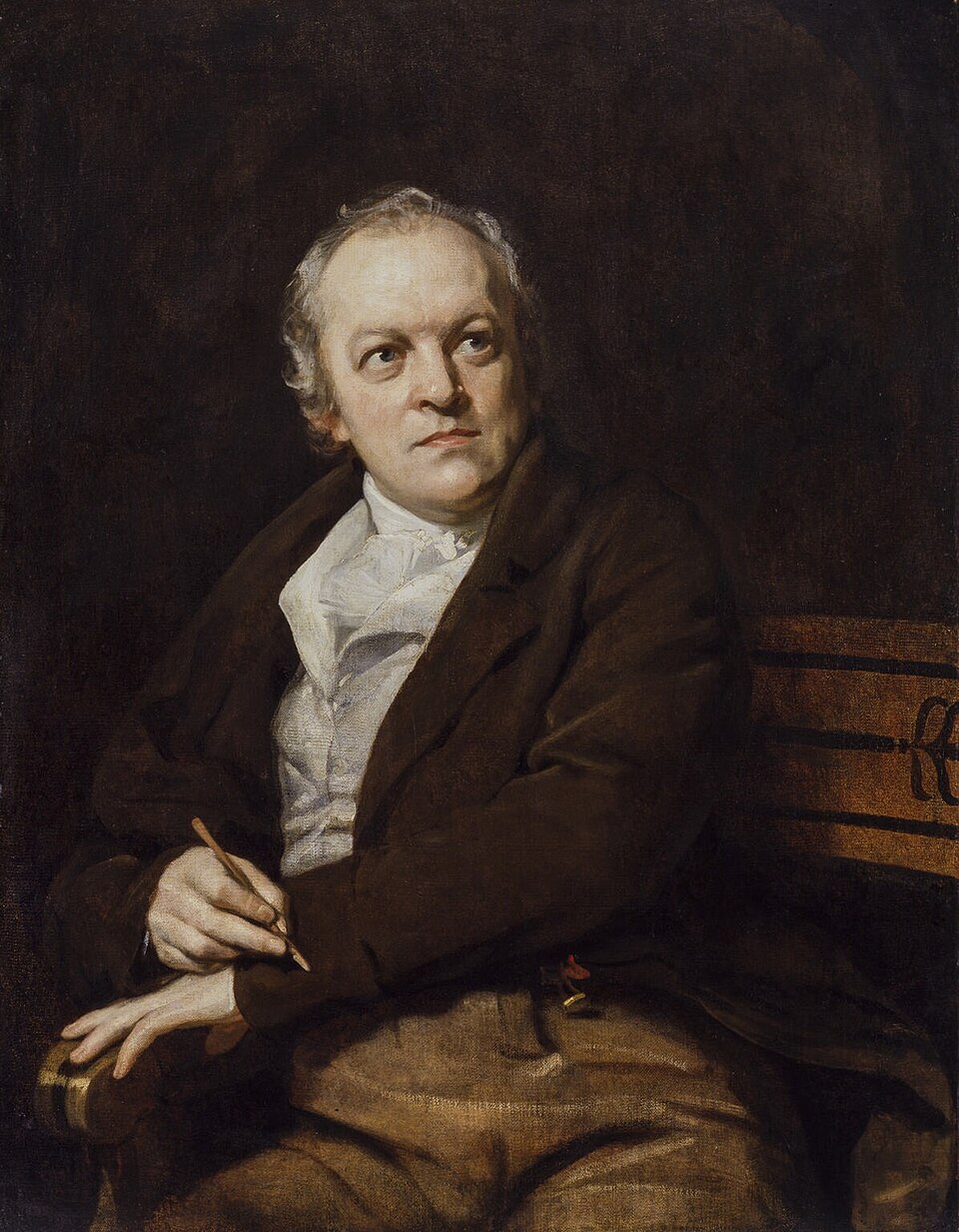
William Blake
Dates: 1757–1827 Domain: Poetry, Visual Art, Visionary Philosophy
Biography
William Blake was born in Soho, London, in 1757 and spent most of his life within a few miles of where he was born. He trained as an engraver, a trade, not a fine art, and produced his books by a process he called "illuminated printing," etching text and image together onto copper plates, then hand-coloring the results. Almost none of his work found a public audience during his lifetime. He was considered eccentric at best, mad at worst. He died in 1827 working on a series of illustrations for Dante's Commedia, which he had begun to regard as insufficiently visionary. The critical reassessment began in the twentieth century and has not stopped. He is now recognized as one of the most systematically complex and philosophically sophisticated poets in the English language — and one of the most demanding.
The core of Blake's thought is the primacy and ontological reality of imagination. For Blake, imagination is not a human faculty that generates images of things that are not there; imagination is the mode by which the eternal becomes perceptible. "One Power alone makes a Poet — Imagination, the Divine Vision" (Annotations to Wordsworth). This is not a metaphor. Blake read Swedenborg (and eventually turned against him), drew on Neoplatonism, engaged with the Hermetic tradition, absorbed the Kabbalah through intermediaries, and produced from all of this a complete cosmological system populated by his own invented mythological figures: the Four Zoas (Urizen, Urthona, Luvah, Tharmas), Los, Orc, Jerusalem, Albion. These are not allegories with fixed meanings; they are, in Blake's understanding, genuine spiritual beings expressing aspects of the divided and potentially reunited human constitution.
His philosophical argument is most directly stated in The Marriage of Heaven and Hell (c. 1790–1793): "Without Contraries is no progression. Attraction and Repulsion, Reason and Energy, Love and Hate, are necessary to Human existence." This is Blake's version of the coincidentia oppositorum, the coincidence of opposites, which is among the Mysteries' deepest structural teachings. Blake is not arguing for relativism (both sides are equally valid) or for synthesis (blend them into a grey middle). He is arguing that the dynamic tension between contraries is itself the generative principle of life. Suppressing one side — which is what the figure of Urizen (reason abstracted from life) does — produces not order but stasis and death.
The epic prophetic books — The Four Zoas (begun c. 1797), Milton (c. 1804–1811), Jerusalem (c. 1804–1820) — expand this argument into full cosmological narrative. The Fall in Blake's mythology is not a historical event but a structural condition: the fragmentation of Albion (the universal human) into the four discordant Zoas, paralleling the separation of subject from object, reason from imagination, and individual from divine that Blake identified as the characteristic wound of his age. The recovery of Albion — the apocalypse in Blake's sense, which means revelation rather than destruction — is the return of integrated vision. This is initiation at the scale of cosmic history.
What makes Blake irreplaceable is that his is a system generated entirely from visionary experience and shaped without institutional validation. He had no Mystery school, no lodge, no teacher (after his early rejection of Swedenborg). The system was built from the inside out, through dreams, visions, and the daily discipline of the illuminated printing process. When he writes "I see every thing I paint In This World, but Every body does not see alike," he is making an epistemological claim: the visionary eye is not hallucinating a private world, it is perceiving more of the actual world than the "single vision" of materialism allows.
Key Works (in library)
| Work | Year | Relevance |
|---|---|---|
| The Marriage of Heaven and Hell | c. 1790–1793 | The coincidentia oppositorum as the generative principle of life |
| Songs of Innocence and of Experience | 1789/1794 | The two contrary states of the human soul — not stages but permanent poles |
| Milton: A Poem | c. 1804–1811 | The descent and self-sacrifice of Milton as initiatory template |
| Jerusalem: The Emanation of the Giant Albion | c. 1804–1820 | The cosmic restoration of integrated human vision |
| The Four Zoas | begun c. 1797 | The full mythological elaboration of the divided cosmos |
Role in the Project
Blake occupies a unique position in the project's argument: he is the practitioner, the maker, the artist who built a Mystery school out of copper plates and hand-ground pigment. The theoretical arguments about imagination as ontological faculty (Barfield), the coincidentia oppositorum (Cusanus), and the recovery of participatory knowing (Goethe) are all enacted in Blake's work rather than argued about. He is the test case for the project's claim that the initiatory tradition is not merely a relic of ancient institutions but a living possibility that generates itself wherever genuine visionary attention is sustained. The project also uses Blake to argue against the reduction of esoteric thought to textual transmission: his was not a received tradition but a constructed one, and its structural parallels to the ancient Mysteries emerge from the nature of the work itself rather than from any chain of initiation.
Key Ideas
- Fourfold Vision: Blake's hierarchy of perception — from single vision (mere materialism) through double and treble to fourfold vision (the full imaginative engagement with the divine in all things).
- Contraries: "Without Contraries is no progression" — the dynamic tension between opposed principles as the source of life and development.
- Urizen: The faculty of abstract reason when it separates itself from the other faculties and attempts to rule alone; the spiritual pathology of the Enlightenment.
- Imagination as Organ of Knowledge: The imagination does not produce fictions; it perceives realities invisible to the abstracting intellect.
- Albion: The universal human being whose fragmentation constitutes the Fall and whose restoration constitutes the Apocalypse.
Connections
- Influenced by: Emanuel Swedenborg (ambivalently), Jacob Böhme, Paracelsus, the Neoplatonic tradition (via Thomas Taylor), the Bible (as visionary document)
- Influenced: FIG-0002 Barfield (central example of the recovered imagination), Northrop Frye (Fearful Symmetry and Anatomy of Criticism), W. B. Yeats (direct literary influence)
- In tension with: FIG-0022 Goethe (parallel but Blake is more apocalyptic, less scientific), John Locke and Isaac Newton (named adversaries in the prophetic books), Emmanuel Swedenborg (started as disciple, became critic)
Agent Research Notes
[AGENT: perplexity | DATE: 2026-03-22] Blake's dates are confirmed 1757–1827. The Marriage of Heaven and Hell is typically dated c. 1790–1793 based on internal references and plate evidence. Jerusalem is Blake's longest and most complex prophetic book; it was not printed until 1820 though begun around 1804. Blake's printing process is documented in detail by scholars including G. E. Bentley Jr. Northrop Frye's Fearful Symmetry (1947) is the foundational modern critical work on Blake's mythology. Kathleen Raine's two-volume Blake and Tradition (1968) establishes the Neoplatonic and Hermetic background in detail — essential secondary source for the project.